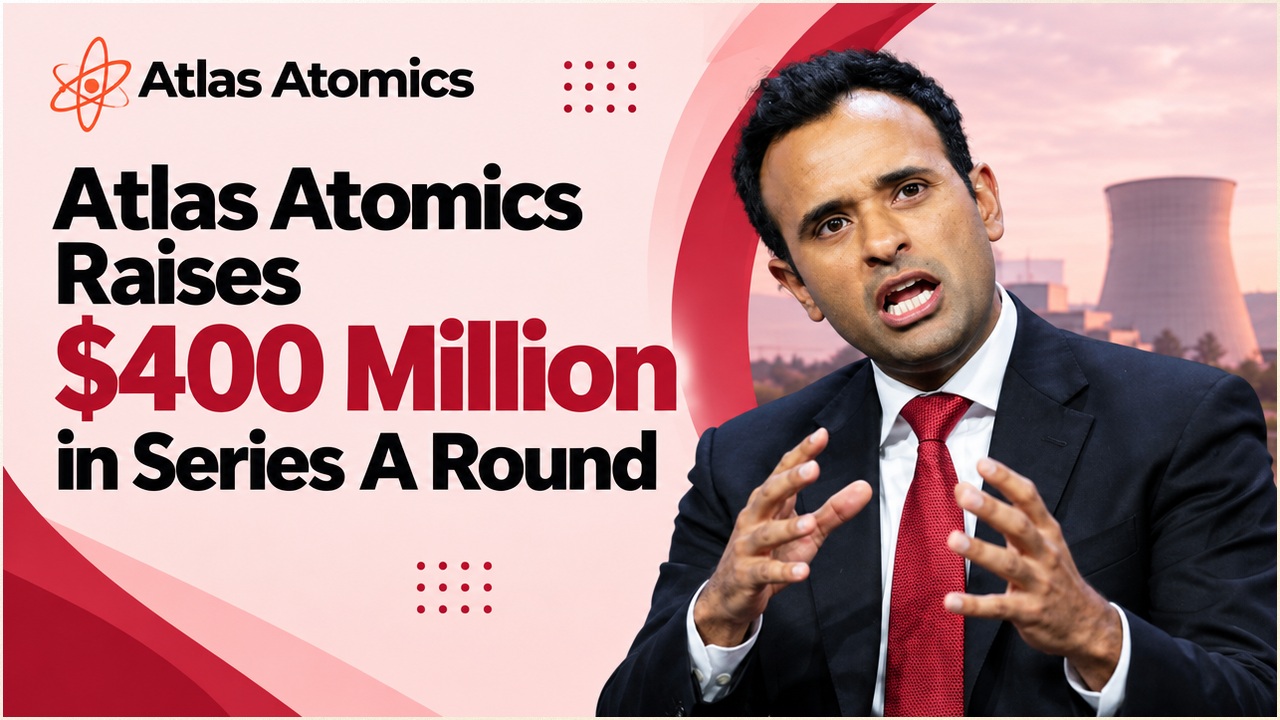

Atlas Atomics, the nuclear energy startup co-founded and backed by entrepreneur Vivek Ramaswamy, has raised about $400 million in a Series A round that values it at roughly $1.9 billion, people familiar with the matter told Bloomberg, which reported the deal on October 8, 2026. The company is building an improved heavy-water nuclear reactor that does not rely on enriched uranium.
General Catalyst led the round, with Andreessen Horowitz participating, the report said. Atlas Atomics and both investors declined to comment. The company remains in stealth mode, with no public product, no named customers and no reactor timeline.
The Funding Round and Its Investors
The Series A is one of the largest early-stage rounds for a nuclear technology company this year. General Catalyst, a venture firm that backs energy and technology businesses, led it, with Andreessen Horowitz participating. The people who confirmed the deal spoke on condition of anonymity.
A round of this size at such an early stage is unusual: Atlas Atomics has not named a customer, published a reactor design or set a timeline, yet two of Silicon Valley’s best-known funds signed up. Investors have been hunting for new reactor technologies as electricity demand from data centres and artificial intelligence keeps climbing, lifting nuclear startups across the board this year.
What the Money Will Be Used For
The company has not detailed how it will deploy the capital. Based on what is public, its focus is on developing an improved heavy-water reactor, on fuel recycling and on using the existing nuclear supply chain. Work of this kind needs heavy spending on engineering, testing, safety assessments and regulatory approvals long before any revenue appears.
The Technology and the Business Bet
Heavy-water reactors use deuterium oxide, a form of water rich in the hydrogen isotope deuterium, as a neutron moderator. That lets some designs run on natural uranium instead of uranium enriched to raise its uranium-235 content. Enrichment is a specialised, costly step in the nuclear fuel cycle that needs dedicated facilities and heavy investment.
The approach sits behind Canada’s CANDU units and India’s IPHWR-220 fleet, so the engineering has decades of operating history. Atlas Atomics wants to improve that design, recycle fuel and draw on the existing supply chain. It has not said where its first reactors would be built or when they would come online.
Read more: Investors are writing record early-stage cheques for capital-intensive AI and deep-tech bets. Mecka AI raised $60 million in a Series B round led by Sequoia Capital this month.
Financials and Valuation
The round values Atlas Atomics at about $1.9 billion, the people familiar with the matter said. The precise valuation basis and final terms have not been independently confirmed. With no public product and no named customers, the valuation rests largely on the promise of the reactor design and the team behind it, not on current revenue.
Background and Founders
Atlas Atomics was co-founded by Vivek Ramaswamy and Kevin Gan. Ramaswamy built his profile in biotech, founding the drugmaker Roivant Sciences, and is campaigning to become Ohio’s next governor. Gan leads the company as chief executive and has spent more than 15 years investing in energy companies, most recently at the hedge fund Millennium and earlier at D. E. Shaw.
The chief nuclear officer is Balendra Sutharshan, a former chief operating officer at Oak Ridge National Laboratory, a major US research institution active in nuclear science. He adds nuclear research and operations experience to a young business trying to turn a reactor design into a commercial product.
What Happens Next
What remains unclear is how quickly Atlas Atomics can move from a design on paper to reactors on the ground, and whether heavy-water designs can beat the small modular reactors its rivals are pitching. Removing enrichment from the fuel cycle does not by itself make nuclear electricity cheaper: construction costs, regulatory compliance, financing and operating performance all shape the final cost of power.
The financing signals strong investor appetite for the company’s approach. It is not evidence that the technology has been commercially demonstrated. For Ramaswamy, the raise adds a business milestone to a busy political year, even as the company’s plans stay mostly out of public view.