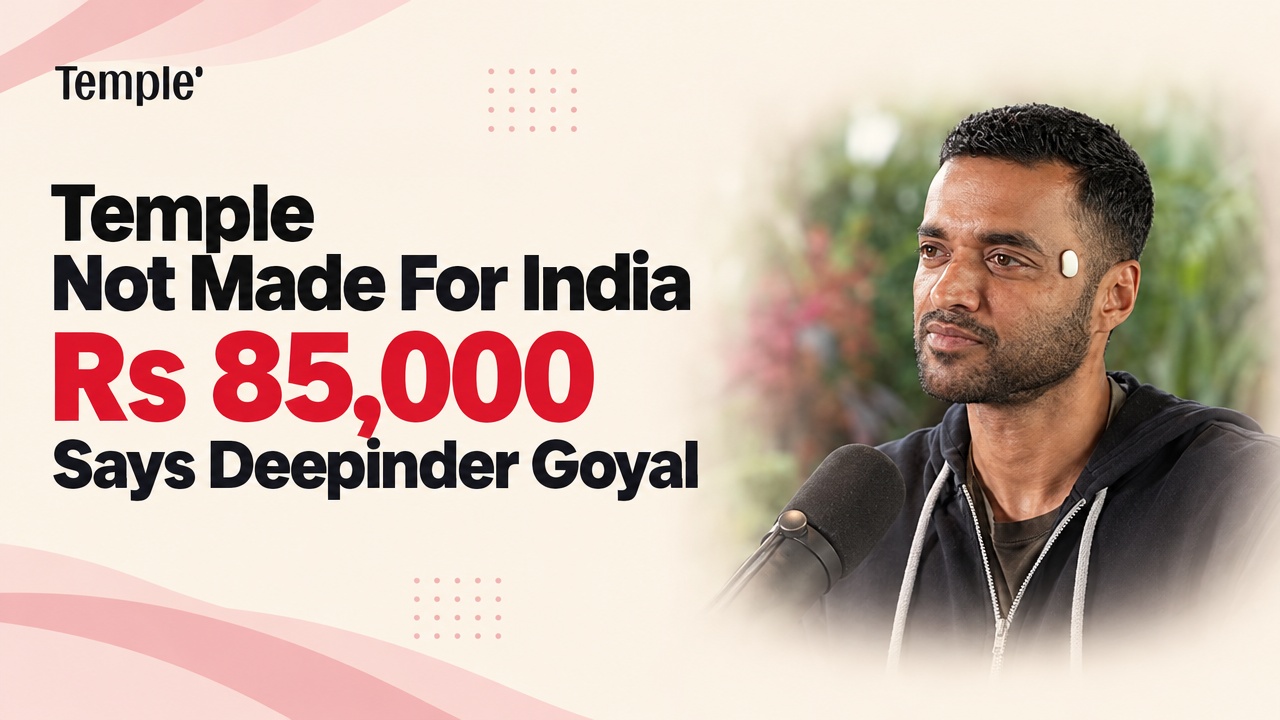

Deepinder Goyal has told critics of Temple, his new health wearable, that the device is not built for the Indian market and that he expects no more than 1 per cent of its sales to come from the country. In a Diwali post on X on Sunday, the Eternal founder said Temple is “made for the world”. Pre-orders opened on 1 November at Rs 85,000 a unit.
The ten-point post answered a fortnight of backlash over that price and over Brain Flow, the metric Temple uses to read blood movement near the temple. Goyal said no medical claim has been made, that Temple is “strictly a fitness + AI device” and is not proven to diagnose or prevent disease. He promised a note on 9 November explaining how Brain Flow is calculated and its limitations.
Read more on newzshort:
Eternal Unveils Privacy-Focused AI Platform Dark, Eyes Global Launch In 2026
What Goyal Conceded, And What He Did Not
On price he offered regret, not a discount. “If you are upset that the pricing is too high, I am sorry,” he wrote, adding that buyers can wait for user reviews. He placed the science on a ladder running from white paper to pre-print to peer-reviewed paper. To the doctors who challenged him he said social media is not the regulator for Temple and that clearances will be in place before any claim that needs one.
What he did not concede matters as much. There is no price cut, no delay and no change to the shipping plan, which Inc42 reported as hand-made units arriving about three months after purchase from early 2027. He also rejected the idea that Brain Flow is the centre of the product, saying Entropy is the main metric and Roomdeaf AI, the microphone-free voice feature, is an expansion rather than a pivot.
Read more on newzshort:
Health ATM Maker Clinics On Cloud Raises Rs 120 Crore
The Money Behind The Device
Goyal has put real money behind the argument that Temple is not a quick scheme. He said on 5 November that development has cost $30 million, $20 million of it his own, and that a few thousand units would recover only a fraction of that. Temple raised $54 million in seed funding in February 2026 from Steadview Capital, Peak XV, Vy Capital and Info Edge Ventures, and an employee buyback has since valued it at $375 million.
Why Doctors Are Not Convinced
The criticism has been specific. Hepatologist Cyriac Abby Philips, who posts as TheLiverDoc, called Temple “the biggest health scam and wellness fraud in India”, arguing that a sensor at the temple picks up blood rushing to the face but cannot measure what happens inside the skull. Zubin Sharma, a Gurugram gastroenterologist, made the anatomical point: blood reaches the brain through arteries in the neck and the back of the head, not the temple. Reviewers also noted that studies hosted on Temple’s website were not peer reviewed.
The Evidence So Far
Temple’s own first validation paper, released as a pre-print in September and still under review, tested 23 healthy adults against transcranial Doppler ultrasound, with data from 20 participants analysed under each protocol. The Brain Flow metric showed a median within-subject correlation of about 0.8 with blood flow velocity in the middle cerebral artery while participants cycled and moved from standing to lying down. That tests direction and pattern, not absolute cerebral blood flow, and the authors said more work is needed before clinical use. Temple now runs that work through Robert Mohr and Avi Roy, hired as chief medical officer and head of science when it bought London longevity practice Longevous in August.
The Regulatory Line
Analysis: the sharpest risk for Temple is not the comment section but the label on the box. India’s Medical Devices Rules, 2017, require registration before a product is sold with claims to diagnose, prevent or treat a condition, and a wearable that measures Entropy and Brain Flow sits close to that boundary while describing itself as fitness and wellness. Goyal’s formula keeps the device on the consumer side, but it turns every marketing line into a regulatory decision.
What To Watch
The 1 per cent admission has an arithmetic. At Rs 85,000 a unit, a 1 per cent country share on even 10,000 devices sold worldwide works out to 100 units and Rs 8.5 crore of revenue, which explains why an export-first launch suits a company that has spent $30 million on research. The Indian wearable market is expected to grow at 14.9 per cent a year to $4.4 billion by 2034, according to Inc42, though that growth sits in cheaper bands. Three things decide whether Temple earns its price: the peer-reviewed paper, the Brain Flow note due today, and on-time delivery in 2027.