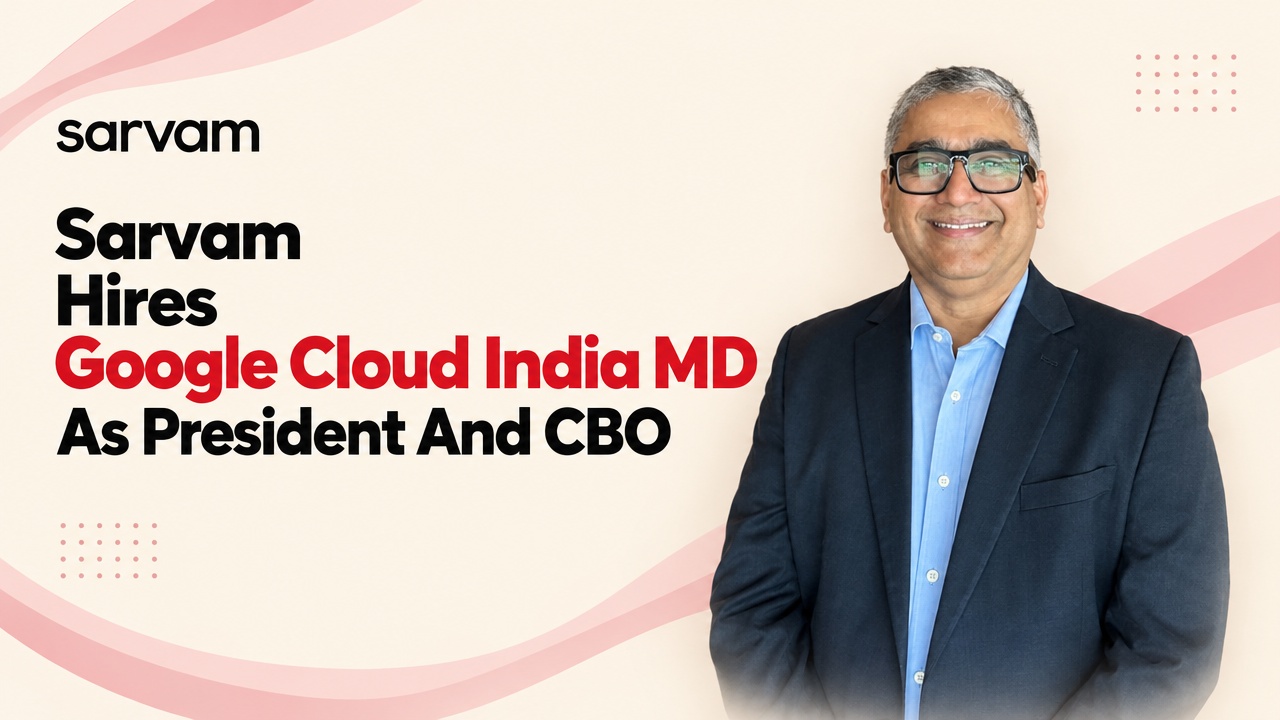

Sarvam said on Monday that Sashikumar Sreedharan, until recently the managing director of Google Cloud in India, has joined as president and chief business officer and as a member of its board. The Bengaluru company described the appointment as the start of a phase in which it expects to operate at a far greater scale.
Sreedharan has spent more than three decades in technology businesses, including over five years running Microsoft India’s enterprise business as managing director before he moved to Google Cloud. At Sarvam he takes charge of business with enterprises and government, widens work with digital native companies, developers and partners, and holds marketing, finance, forward deployed engineering, service delivery and commercial operations.
Read more on newzshort:
Cognizant In Talks To Buy Stake In Sarvam At $3.5-4 Billion Valuation
One Leader For Sales, Money And Delivery
A commercial chief with finance and service delivery under him is unusual for an Indian AI company of Sarvam’s age. Large enterprise AI deals are rarely a licence handed across at signature. They arrive with a deployment team, a billing model a customer’s chief financial officer has to defend, and a support promise that outlives the pilot.
Forward deployed engineering, the function now under Sreedharan, is the model in which engineers sit inside the customer’s operations and shape the product around the workflow. For a company that builds its own models, that is the expensive half of the business, and the half that decides whether a trial becomes a contract.
Read more on newzshort:
L&T Tech Wins Five-Year Nokia R&D Deal In India
A Hundred Accounts And A Widening Catalogue
Sarvam says more than 100 enterprises and government institutions now build on its full stack, which spans models, speech, translation, document intelligence and agents. The catalogue has filled out quickly: it open sourced its 30B and 105B models, released Sarvam Vision 2.1 for documents, Bulbul V4 Flash for speech synthesis and Saaras V4 for speech recognition, and on 4 November launched Sarvam Prism, a decision model built on Sarvam 105B.
Sarvam signed a memorandum of understanding with the Ministry of Defence in late October and, with HQ IDS, set out a framework for AI adoption across the Army, Navy and Air Force. Its website lists Axis Bank, SBI Life, LIC, NABARD, Infosys, IndiaMart, CRED and Urban Company among customers, a more useful signal than the headline count, since these buyers carry procurement committees, audit trails and data residency rules.
The War Chest Behind The Hire
The commercial build out is being financed by the largest private AI round in the country. Sarvam is raising $300 million in Series B capital, and in August added a $74 million extension to that round, with NVIDIA putting in Rs 237.9 crore, Glade Brook Rs 190.3 crore, Gaja Capital Rs 95.1 crore and Indigo Ventures Rs 30 crore, alongside family offices. That extension belongs to the same round, not to a second one.
Inc42 reported on 28 October that Cognizant is in talks to join the round at a valuation of $3.5 billion to $4 billion, which would make it the second IT services major on the cap table after HCLTech. On those reported figures, $300 million works out to between 7.5 and 8.6 per cent of the company. Capital at that price buys compute and sales headcount, and both are what a business chief is hired to turn into revenue.
What Could Go Wrong
Analysis: the risk is not that Sarvam has picked the wrong executive. It is that the market is priced by companies with far deeper balance sheets. Google, Microsoft and Amazon can fold a language model into a cloud contract an Indian buyer has already signed, and open weight models have pushed the price of a token close to zero. Sarvam’s answer is sovereignty, the promise that data, models and agents stay inside the enterprise and inside India.
That is a real advantage with banks, insurers and the armed forces, and also a premium that depends on friendly policy and procurement cycles that run for quarters. Sarvam does not publish revenue, so the 100 customer figure cannot be checked against income, and government contracts bring long payment tails and tender risk.
What To Watch
The test over four quarters is narrow. Watch whether the customer count keeps climbing two quarters into Sreedharan’s tenure, whether the Cognizant investment closes on the reported terms, and whether Sarvam starts disclosing revenue as it moves toward a listing.
Sarvam was founded in 2023 by Vivek Raghavan and Pratyush Kumar, and argues that Indian institutions should own the intelligence they run on. Its announcement sits on the Sarvam blog. It now has the capital, the catalogue and, as of Monday, a business chief who has sold to Indian enterprises for the better part of a decade.