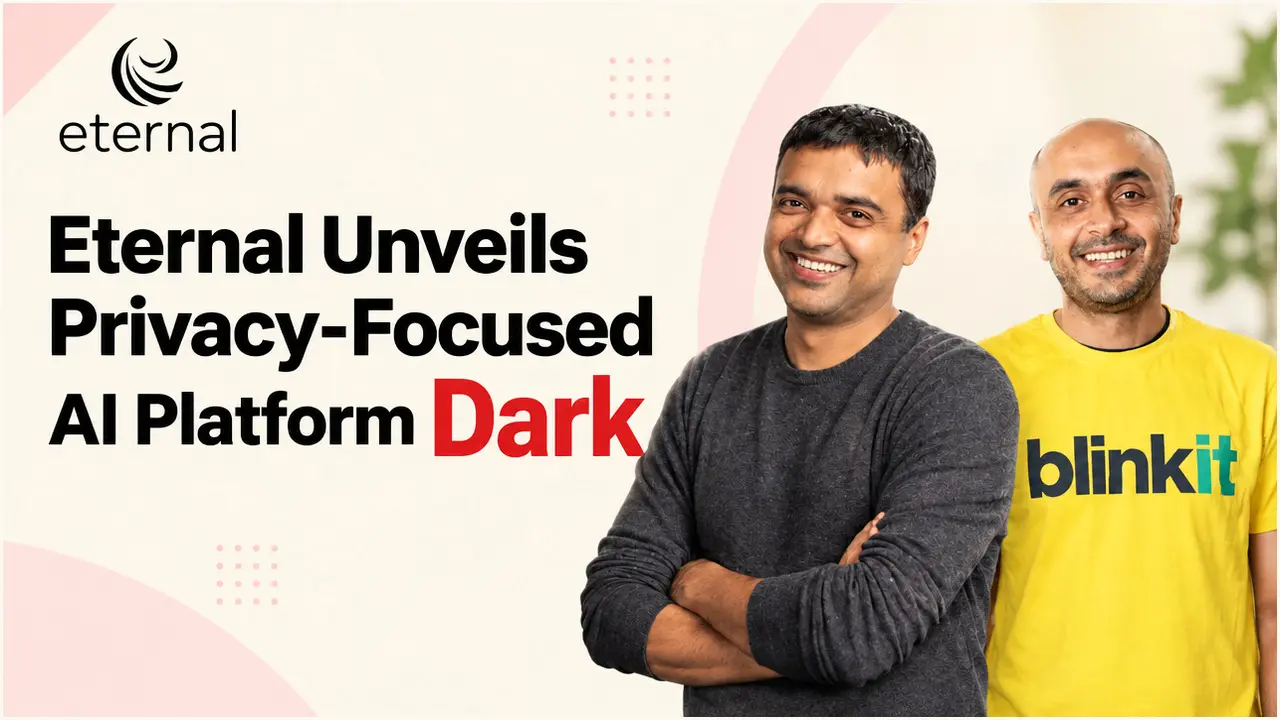

Eternal has unveiled Dark, a privacy-focused AI platform built for users who do not want their conversations read. Founder Deepinder Goyal wants to take it global within 2026. Eternal is the parent company of Zomato and Blinkit.
Goyal outlined the plan in Eternal’s Q2 FY27 shareholder letter, aiming Dark at power users such as founders, researchers, scientists, enterprises and governments. According to the report, the platform has already been in internal use for a few months. Because the plan appeared in a shareholder letter rather than a product launch, few details were shared.
Who Dark Is Built For
The pitch is aimed at people who handle information they cannot afford to expose. That includes company founders discussing strategy, researchers sitting on unpublished work, and government teams dealing with sensitive material. These are users who already pay for AI tools but hold back the most valuable questions because they do not trust where the conversation ends up.
That is a narrower audience than a consumer chatbot chases, and it is also the segment most willing to pay for a product that promises confidentiality.
How The Platform Is Designed
Dark runs on fine-tuned frontier open-weight models hosted on Eternal’s own infrastructure. The company did not build a model from scratch. It adapted existing open-weight models that developers are allowed to modify, a route that is cheaper than pretraining. The platform uses end-to-end encryption and an encrypted memory layer, so context carries across sessions without the company holding the keys. That memory layer is the feature that separates Dark from most chat assistants.
Goyal said the privacy features made him share more and ask questions he would avoid on other assistants. He argued that users hold back sensitive information when they fear a conversation could be stored or reviewed, and that switching off model training is not enough. In the letter he wrote: “we cannot read your conversations, even if we are forced to.”
Read more: Enterprise AI startup AuxoAI raised $20.7 million in a Series A round led by NTTVC to build AI systems for large companies.
Why The Privacy Claim Will Be Tested
Encryption removes one kind of risk, not every kind. Questions remain about data retention, legal holds, human reviews for abuse and third-party logging that sits inside any hosted stack. A company can hold the keys and still be asked to hand over metadata, and an encrypted memory layer only helps if users understand exactly what is and is not covered.
Eternal has not published an audit, a threat model or a compliance certification for Dark, so the claim rests on the company’s own description for now. Enterprise buyers usually ask for those documents before they move sensitive workloads.
A Shift Beyond Food And Quick Commerce
Eternal is best known for food delivery and quick commerce. Dark takes it into AI infrastructure, where buyers are enterprises and governments rather than consumers, bringing a different sales cycle and cost base. Running models on its own hardware also means Eternal carries the compute bill. The company has the balance sheet to fund some of that, but not at the scale of a pure AI lab.
The move also puts Eternal in a crowded market. Global model providers, cloud platforms and a long list of Indian AI startups are all selling to the same enterprise buyers, and most of them already have security reviews, procurement relationships and regional data commitments in place.
What Is Still Unknown
Eternal has not disclosed pricing, its model partners or the countries it will enter first, and it did not say how many users sit on the internal version. A global launch within 2026 is the stated goal, though no date has been given.
Whether enterprises will trust a delivery company with sensitive AI workloads remains the open question. The encryption story is the strongest part of the pitch, and the next step is showing that it holds up when someone outside the company checks it.