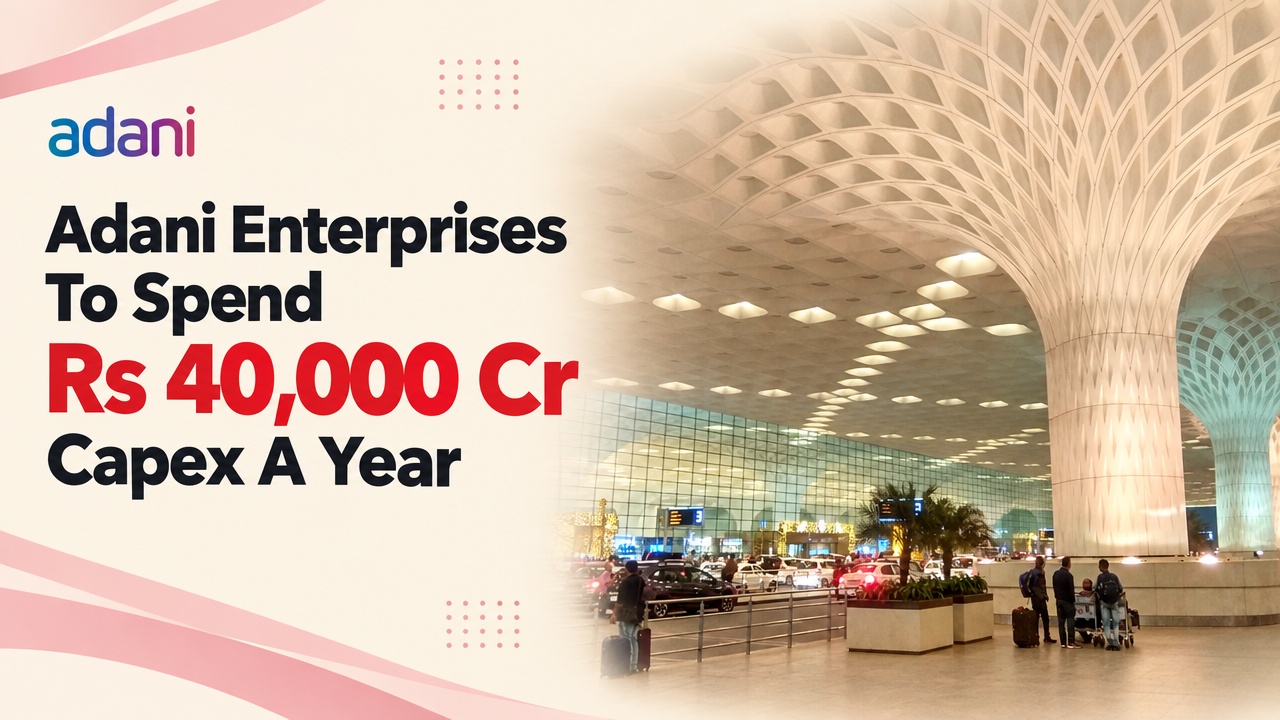

Adani Enterprises plans to spend Rs 35,000 crore to Rs 40,000 crore every year for at least the next two years, with airports, data centres and a PVC complex at Mundra absorbing most of the money. The guidance came on the company’s September quarter earnings call and was reported by Business Standard on November 8, with The Economic Times and ET Infra carrying the same range that morning.
The figure matters because this is a company that has spent a decade building assets rather than harvesting them. “We expect to do capex at a run rate of around Rs 40,000 crore… which is the rate we expect to continue over the next couple of years,” Manan Vakharia, head of finance, told analysts. “The heavy lifting will be done by airports, data centres and PVC.”
Read more on newzshort:
Tata Communications To Build $450 Million AI Fibre Network
Airports Deliver The Volume And The Margin
Adani Airport Holdings runs eight airports, including Navi Mumbai International, and handles about 23 per cent of India’s passenger traffic and 29 per cent of its air cargo. In the September quarter the business served 21.3 million passengers, grew revenue 20 per cent to Rs 3,786 crore and lifted EBITDA 55 per cent to Rs 1,641 crore. Non-aeronautical revenue rose 57 per cent against 9 per cent for aeronautical revenue, and that gap is the margin story, since retail and advertising earn better spreads than landing fees.
AdaniConneX, the data centre joint venture, has tied up more than 1.2 gigawatts of contracted capacity against 1.4 GW under development, and signed a fresh 240 megawatt hyperscale contract in the quarter. Only 94.6 MW is operational, after 29.2 MW was handed to customers. Management expects 120 to 150 MW by the end of this financial year and close to 500 MW in the following 12 to 18 months, when the facilities begin billing.
Read more on newzshort:
Hindalco Q2 Profit At Record Rs 7,532 Crore
The Arithmetic Behind The Guidance
The half-year numbers show how the company can carry it. EBITDA for the six months to September 2026 hit a record Rs 11,958 crore, up 56 per cent, consolidated income rose 62 per cent to Rs 71,569 crore, and profit before tax from continuing operations climbed 45 per cent to Rs 3,297 crore. Chief executive Arun Bansal called it a move from a build-out phase to a value realisation phase.
Set the spending against that. Rs 35,000 crore to Rs 40,000 crore a year is about 1.5 to 1.7 times the roughly Rs 23,900 crore the first half annualises to, and two years of it adds up to Rs 70,000 crore to Rs 80,000 crore. The heaviest single line is the Mundra PVC complex at about Rs 26,000 crore, close to two thirds of one year of spending at the top of the range. That concentration is why one commissioning date matters more to near-term cash flow than anything else here.
Why PVC And Solar Decide The Near Term
The 1 million tonne per annum PVC project has about 60 per cent of its spending and construction done, with the first section due in the next financial year, alongside chlor-alkali and related chemical units. On solar, module capacity is now 10 GW, 6 GW of cell capacity is due by the end of this financial year, and 1,478 MW of modules were sold in the quarter, up 35 per cent.
Risks And Open Questions
Three large projects at once is the obvious execution risk, and the data centre numbers show why timing matters. With 94.6 MW operational against 1.2 GW contracted, more than nine tenths of that portfolio is still to be built. A PVC plant commissioned into a soft market would carry the same fixed costs on weaker realisations. The company also did not split the plan between debt, internal accruals and asset sales, and gave no EBITDA forecast for FY27.
The desk’s read is that this is less a surprise than a confirmation. Adani Enterprises is valued on its pipeline rather than its current profit and loss, and a Rs 40,000 crore run rate is the price of keeping that pipeline full. The test is whether the first three assets produce returns before the next financing decision, not whether the money gets spent.
What To Watch
Four dates matter over the next eighteen months. The first PVC section is due in FY28, data centre capacity should touch 120 to 150 MW by March 2027 and approach 500 MW in the following 12 to 18 months, Navi Mumbai is targeted at 20 million passengers by the end of FY28, and the 6 GW of cell capacity is scheduled for this financial year. Slippage on PVC will show in capex guidance before it shows in profit.