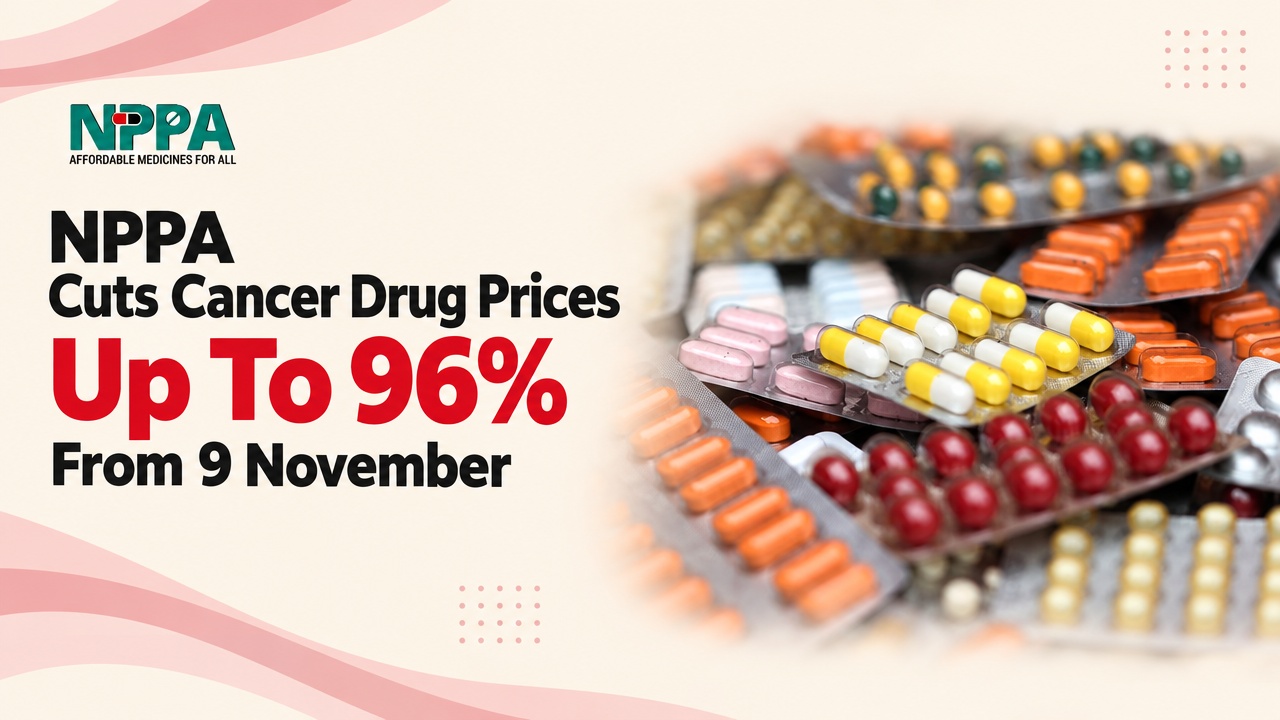

Prices of 1,364 anti-cancer formulations were revised on Monday, 9 November, after the Centre capped trade margins on oncology medicines at 30 per cent of the maximum retail price. The government puts the annual saving at Rs 3,540.38 crore.
The Ministry of Chemicals and Fertilizers said 85 companies had filed revised prices for 1,364 formulations covering 121 drugs. Cuts above 50 per cent apply to 679 brands and the deepest is 96.45 per cent. An earlier release counted 76 companies, 1,225 formulations and Rs 3,502 crore of savings, before the last filings landed.
Read more on newzshort:
Morepen Breaks Into US Prescription Drug Market
How The 30 Per Cent Trade Margin Cap Works
The National Pharmaceutical Pricing Authority notified the cap on 17 October, on an expert committee’s advice under the Directorate General of Health Services. The ceiling is 30 per cent of the MRP excluding GST, which equals a mark-up of about 42.86 per cent over the stockist price, and that definition decides how much of the headline cut reaches the counter.
Prices are built from what manufacturers charged stockists in March 2026, or from April 2025 to March 2026 sales for products that did not move that month, with government supplies excluded. Formulations launched after 31 March 2026 are covered, and NPPA expects 10 to 15 identified medicines not yet sold in India to enter the net at launch.
Read more on newzshort:
Maharashtra FDA Suspends 43 More Food Licences
What The Cuts Look Like On A Chemist’s Bill
Some corrections are stark. RPG Life Sciences’ Palbopro, a 125 mg palbociclib capsule for breast cancer, falls from Rs 40,421 to Rs 2,720. Arvincare’s Abirone, an abiraterone tablet for prostate cancer, drops from Rs 41,250 to Rs 3,218. Zydus Lifesciences’ Bryxta moves from Rs 25,995 to Rs 3,318, and Lupin’s Lupiher 2 from Rs 83,520 to Rs 37,358.
The list leans on the medicines that dominate oncology spending: immunotherapy drugs used in more than 20 cancers, along with bevacizumab, denosumab, pegfilgrastim, pembrolizumab, durvalumab and osimertinib. Several are patented products sold by a single company, which is why the cap bites unevenly across the portfolio.
Seven Years After The First Cap, Margins Came Back
This is the second attempt at the same problem. In February 2019 the regulator capped trade margins at 30 per cent on 42 non-scheduled cancer drugs, and MRPs across 526 brands fell by as much as 90 per cent. The relief did not hold.
Thirty-four of the 137 drugs now covered were on the 2019 list. An analysis reported by The Times of India found mark-ups on most of those overlapping brands had climbed back to between 100 per cent and over 700 per cent by 2026, against the 43 per cent the cap implies. The All India Drug Action Network argues that fixing an MRP without a standing mechanism to police margins lets the gap reopen.
One In Four Packs Has Not Become Cheaper
The relief is uneven too. An analysis of 643 packs by advocate K.C. Jain, a petitioner in the Supreme Court proceedings on medicine pricing, found an average cut of 38.22 per cent but 159 entries unchanged. Untouched packs included Keytruda at Rs 2.16 lakh, Tagrisso at Rs 4.16 lakh, Alecensa at Rs 4.3 lakh and Koselugo above Rs 10 lakh.
That gap is the part worth watching. Retailer margins on scheduled drugs are capped at 16 per cent of the price to retailer, while the new ceiling allows an aggregate 43 per cent mark-up over the stockist price; Jain’s contention, which NPPA has not accepted, is that the trade is being allowed more than the law contemplates. Our reading is that this design protects the patient against the distributor more than against the manufacturer, and that the savings figure assumes every covered pack sells at the new price rather than out of old stock.
What To Watch
Compliance now rests with the states. Retailers, dealers and hospitals must display revised lists on premises and websites, State Drug Controllers are to monitor, and patients can check rates on the NPPA portal or the Pharma Sahi Daam app and complain on designated helplines.
Two risks hang over the exercise. The Supreme Court is hearing petitions by lawyer Kishan Chand Jain and paediatric surgeon Sanjay Kulshrestha, and a bench of Justices Vikram Nath and Sandeep Mehta has criticised the distance between what retailers pay and what patients are charged. In a separate case, the Delhi High Court restrained NPPA until 11 January from coercive recovery against AstraZeneca over Rs 151 crore. India detects about 1.5 million new cancer cases a year, and the test is whether this round still looks like a cut in 2032.