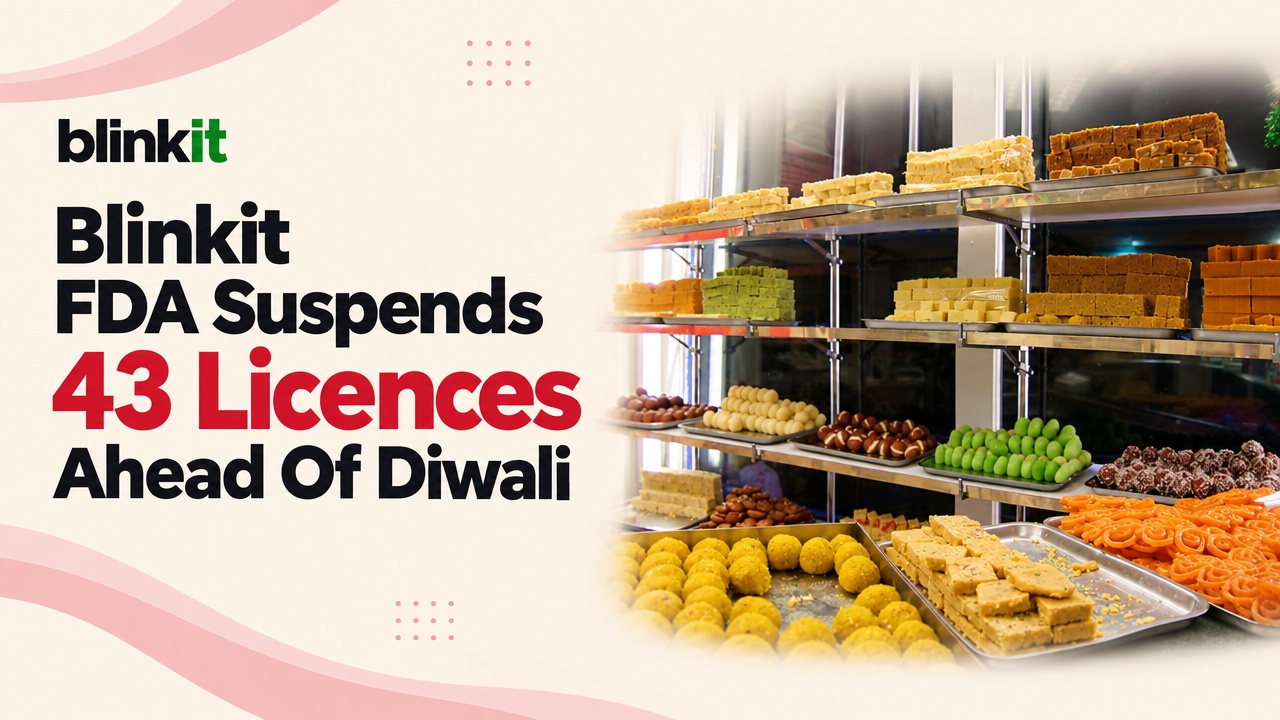

Maharashtra’s food safety regulator has suspended 43 food business licences after inspecting 73 establishments on 6 and 7 November, its second enforcement sweep in four days, and once again named Blinkit among the outlets stopped. The state Food and Drug Administration said in a statement on Saturday that the drive covered sweet shops, dairy units, dry fruit sellers, hotels, clubs, canteens, grocery stores, e-commerce entities and caterers across all seven divisions. Inspectors seized 17,824 kg of food articles valued at Rs 63.09 lakh from 29 establishments and destroyed perishable stock judged hazardous to public health.
The action follows a separate drive on 4 and 5 November, reported on Friday, in which the Maharashtra Food and Drug Administration suspended 105 licences, ordered seven establishments to shut and seized 39,485.42 kg of food worth Rs 1.35 crore from more than 70 premises. The two statements cover different inspection dates, so the figures add rather than overlap: 148 licences suspended, 57,309 kg of food seized and close to Rs 1.98 crore of stock taken off shelves in four days, by our arithmetic on the department’s own numbers.
Read more on newzshort:
Gig Workers Get National Social Security Board
Where The Action Fell
The division-wise split shows the sweep moving away from Mumbai. Nagpur accounted for 18 of the 43 suspensions, Nashik nine, Greater Mumbai five, with Pune, Chhatrapati Sambhajinagar and Amravati three each and Konkan two. In the first drive the weight sat in the metros and the Nashik belt: 39 suspensions in Nashik, 28 in Mumbai, 20 in Pune, 15 in Amravati, two in Chhatrapati Sambhajinagar and one in Thane. The second list names Blink Commerce Pvt Ltd, which runs Blinkit, in Wardha, after the first named Blink Commerce and Zepto Ltd in Mumbai.
What Inspectors Found
The violations were procedural as much as physical. The FDA cited unhygienic production and storage, missing wire mesh on windows, inadequate pest control, and failure to maintain Food Safety Management System records or FoSTaC training records. Establishments could not produce water analysis reports, medical fitness certificates for food handlers, or purchase bills. The seized stock reads like a Diwali shopping list: khoya, mawa, paneer, pedha, kunda, kalakand, kaju katli, barfi, chakli, chivda, namkeen, almonds, figs, ghee and edible oils. Inspectors also stopped two vehicles carrying 3,935 kg of khoya and sweets on highways.
Read more on newzshort:
YatriKart Bags Rs 120 Crore From MMG Group To Open 1,000 Quick Stop Stores
A Pattern, Not A One-Off
Commissioner Tukaram Mundhe has run an unusually visible enforcement calendar this year. On 15 October the department prohibited the sale of loose, unpackaged spice powders and mixed spices statewide, banned colouring agents such as Metanil Yellow, Rhodamine B and Sudan dyes, and barred ethylene oxide treatment. Its October drug enforcement note, issued on 5 November, counted 1,986 inspections, 674 notices, 122 cancelled licences and 422 suspensions, with drugs and cosmetics worth Rs 34.51 lakh seized. Blinkit-linked premises were flagged in a separate October action, and the platforms faced similar orders in August.
Why Quick Commerce Is Exposed
The reason e-commerce entities keep appearing is structural. Blinkit, founded in 2013 as Grofers and bought by Zomato, now Eternal, for $568 million in 2022, sells fresh produce, dairy, sweets and bakery items out of dark stores. Zepto, founded in 2021 by Aadit Palicha and Kaivalya Vohra, runs the same model from Bengaluru and other metros. Every one of those stores needs a food licence, and a suspension stops that outlet from conducting food business for as long as it runs. Diwali, when mithai and dry fruit sales peak, is the worst fortnight of the year to lose one.
The Commissioner’s Warning
Mundhe framed the drive as brand-neutral. “Whether a brand is big or small, the rules are the same for all and the action will be equally strict. Honest businesses have our full cooperation; however, no leniency will be shown to those who endanger public health,” he said, according to the Free Press Journal. The department also registered five cases under Section 69 at Borivali and Bhandup, recovered Rs 70,000 in penalties and drew 10 samples for analysis.
What To Watch
Three things matter from here. First, whether inspections continue after the festival season, because a drive that ends with Diwali looks like a seasonal exercise rather than a compliance regime. Second, whether the platforms respond at the level the regulator is probing, with store-level licence audits and third-party hygiene checks rather than a press statement. Third, whether other states copy the model. Maharashtra is effectively testing whether a licence can be enforced outlet by outlet against companies that market themselves as a single app, and the department has not published the full list of 43 premises, so only the names it chose to disclose are public.