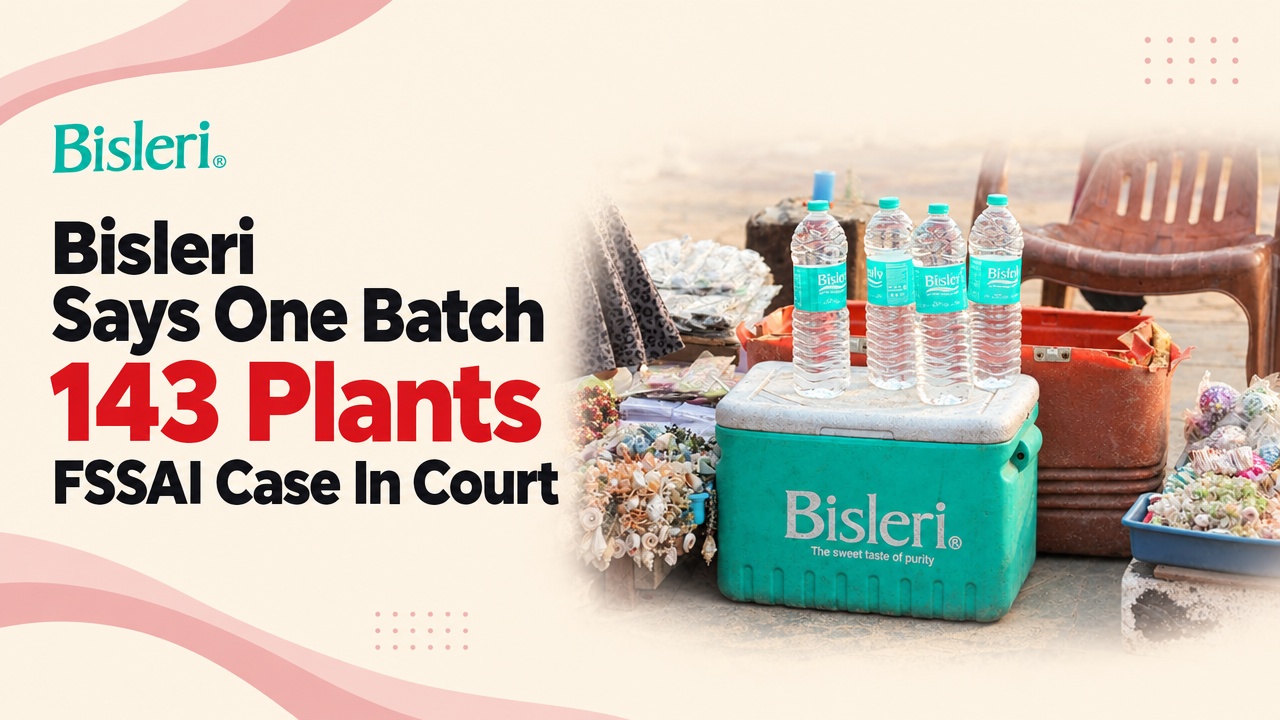

Bisleri International said on Tuesday that the Food Safety and Standards Authority of India has prohibited the sale of only one batch, GO 270, made at its Goa plant on 27 September 2025, and that all 143 factories keep running with no suspension order against the site. The company said no stock from that batch remains in the market and that the regulator’s own re-test found bromate inside the permitted limit.
The clarification came as the scrutiny widened well beyond one company. Goa’s Food and Drugs Administration has told its food safety officers to draw samples of packaged drinking water from several brands sold in the state, and FSSAI is preparing checks across the category. A government official said testing is under way and action will follow wherever samples fail.
Read more on newzshort:
Maharashtra FDA Suspends 43 More Food Licences
A Batch From September 2025
The file opened on 30 September 2025, when FSSAI collected six samples from the Goa factory. By Bisleri’s account, five cleared every parameter and the sixth carried bromate at 12 micrograms per litre against a limit of 10 micrograms per litre, an exceedance of 20 per cent. The regulator declared that sample unsafe under the Food Safety and Standards Act, 2006.
Bisleri appealed on 22 November 2025 and the sample went to a referral laboratory, which found bromate within the limit but flagged polycyclic aromatic hydrocarbons instead. A separate laboratory approved by FSSAI also cleared the bromate reading. The company sent those results to FSSAI’s Western Regional Office on 2 February 2026 and says it heard nothing further until the prosecution sanction arrived last Sunday.
Read more on newzshort:
Cancer Drug Prices Cut Up To 96% From Today
Why One Batch Still Matters
Bromate forms when ozone, used to disinfect water, reacts with bromide already present in the source. The World Health Organization sets a provisional guideline of 10 micrograms per litre and treats the chemical as possibly carcinogenic to humans. PAHs are a family of more than 100 compounds released by incomplete combustion, and some can damage DNA. Bisleri accepted a PAH reading of 0.144 micrograms per litre in one of six samples tested later, while FSSAI has not published its own concentration figure.
A prosecution sanction is not a finding of guilt. It means the regulator has cleared the file for trial, and on Tuesday a food safety officer filed the case in a Goa court, the state FDA’s director, Shweta S Dessai, confirmed. FSSAI has also asked the company for a root cause analysis, which turns attention to how one line at one plant drifted outside specification.
The Market At Stake
The commercial weight explains the attention. India’s packaged drinking water market was valued at about $3.6 billion in 2025 by industry estimates, and Bisleri holds more than 30 per cent of it. A one litre bottle sells for about Rs 20, and stock moves through more than 6,000 distributors and 7,500 trucks in India and the UAE. Its closest rivals are Coca-Cola’s Kinley, PepsiCo’s Aquafina and Parle Agro’s Bailley.
Brand specialists expect damage even while the science stays contested. “Bisleri is, to an extent, the lowest common denominator brand of water in the Indian market,” said Harish Bijoor, a brand strategy expert. “When one popular, big brand is hauled up for bromate and PAH levels, it is a serious issue for the brand.” Rivals are expected to tighten their own checks, and beverage executives have told bottling partners to re-verify testing.
Rules That Moved Twice
The rulebook shifted while the case sat between laboratories. In October 2024 the government dropped compulsory BIS certification for packaged and mineral water, and a month later FSSAI placed both categories among high-risk foods. From 1 January 2026 a mandatory FSSAI Scheme of Testing replaced the old mechanism, obliging manufacturers to keep test records and route samples through accredited laboratories.
Analysis: the timeline is the uncomfortable part. Batch GO 270 was produced under one inspection regime, tested under a second and is being prosecuted as a third takes hold. That is not evidence of a systemic failure, but the regulator’s case rests on a single sample whose readings two accredited laboratories could not agree on. The nationwide sampling will show whether that gap is an outlier or a pattern.
What To Watch
Three markers matter from here: the results of the national sampling, the outcome of the more than 80 samples Goa has drawn since April 2025, and the court case itself. Ownership adds a second thread. Tata Consumer walked away from a reported Rs 7,000 crore deal in 2024, and the Chauhan family, with Ramesh Chauhan as chairman, kept the business. A long prosecution will test how much of that asking price rested on trust in the bottle.