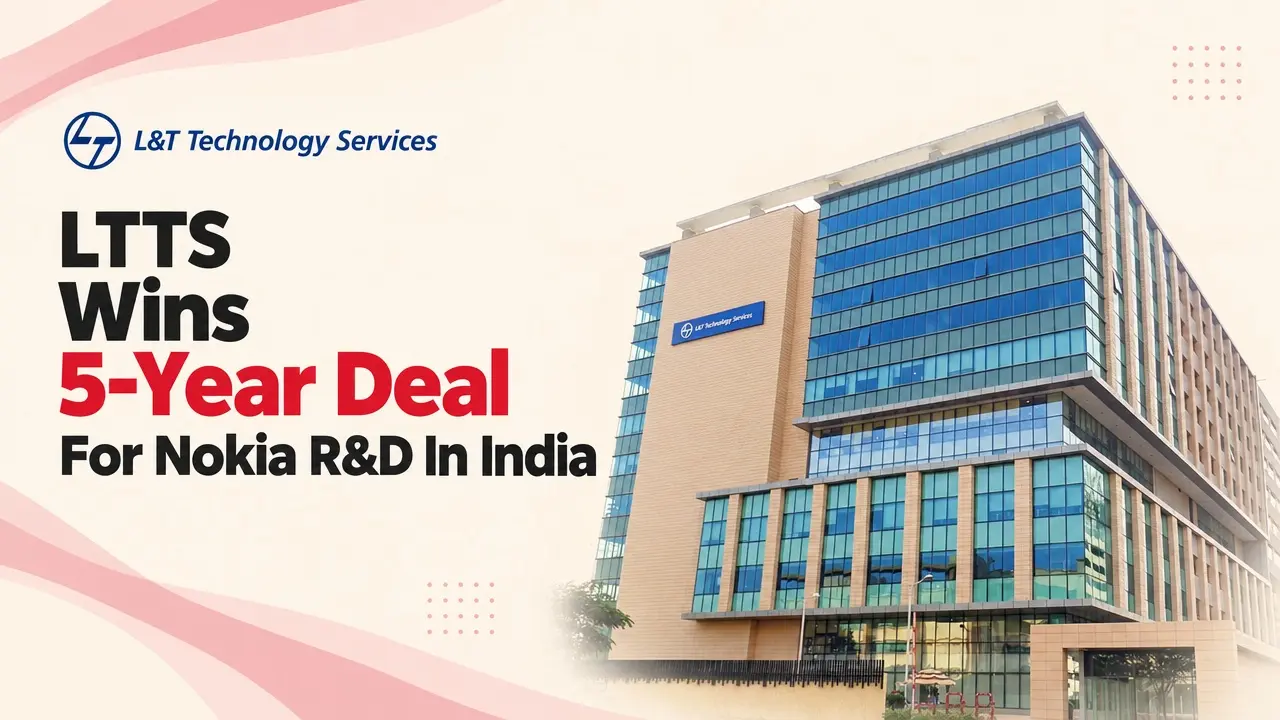

L&T Technology Services has won a five-year contract from Nokia to run engineering and research work for the Finnish telecom equipment maker in India, the company said in an exchange filing on Monday, 26 October. The mandate covers Nokia’s research and development programmes in product engineering, software development, system integration and product support.
Under the agreement, LTTS will build a dedicated Offshore Development Center in India and a separate engineering team that works with Nokia’s Technology Center globally. The scope runs across 5G networks, intelligent automation, AI-driven operations and AI infrastructure, with the Indian team plugged into Nokia’s global R&D organisation through what the two companies call an integrated operating model.
Read more on newzshort:
Jio IPO Subscribed 22.19 Times Ahead Of Listing
Vivek Jaiswal, senior vice president of engineering at Nokia, said India is an important innovation hub for the company and called LTTS a critical partner that will help it expand its research footprint in what he described as a strategically important geography.
Alind Saxena, executive director and president for strategic initiatives and growth markets at LTTS, said the contract reflected the confidence global technology companies place in the firm’s engineering expertise. LTTS has placed the win under Lakshya 31, the strategy that treats next-generation computing and AI infrastructure as its next leg of growth.
Read more on newzshort:
Semiconductor Startup Tessolve Raises USD 75 Million Led By Vector Line Capital
The Numbers LTTS Brings To The Table
The contract lands nine days after LTTS reported September quarter revenue of Rs 30,404 million, or about Rs 3,040 crore, up 3.4 per cent sequentially and 12.1 per cent from a year earlier. Dollar revenue was USD 317 million, a gain of 2.7 per cent quarter on quarter. EBIT margin came in at 16.3 per cent, 60 basis points better than the June quarter, and net income of Rs 5,482 million included a one-time gain of Rs 1,650 million from the sale of its SWC business.
Large deal wins in the quarter crossed USD 200 million in total contract value, with AI-linked work accounting for more than half of it. The company booked one USD 75 million deal, one above USD 30 million, one of USD 25 million and six worth over USD 10 million each. AI patent filings have passed 250, and the wider portfolio stands at 1,808 patents, of which 1,085 are co-authored with clients.
Why Nokia Is Buying Research Capacity
The results published by Nokia explain the urgency. Comparable operating profit for the September quarter rose to 605 million euros from 448 million euros a year earlier, beating the 453 million euro consensus in a company poll, on net sales of 5.15 billion euros, up 10 per cent. Order intake from AI and cloud customers jumped 118 per cent year on year to 1.5 billion euros.
India already carries a large slice of that engineering load. Nokia runs a research team of nearly 10,000 people across Bengaluru and Chennai, and its India country manager Vibha Mehra said this month that there is no technology the company has which is not developed and researched in India, naming radio access networks, core networks, autonomous networks and optical systems.
Risks And Open Questions
Neither company disclosed the value of the five-year contract, which makes the revenue impact impossible to size. Offshore development centre contracts of this shape usually ramp over several quarters, carry headcount commitments before they carry margin, and often start at lower realisations than fixed-price engineering work.
Analysis: what Nokia is outsourcing matters more than the size of the cheque. A decade ago an Indian vendor won telecom work largely on cost arbitrage. This mandate bundles 5G, automation and AI infrastructure engineering, the capabilities LTTS has been assembling through its EI platform, its NVIDIA-backed lab and its AI partnerships. If a European equipment maker will hand a partner work at the meeting point of telecom and AI compute, the line between IT services and product engineering has moved again.
Three questions stay open. How many engineers will the centre employ, and by when? Does the contract add to the work Nokia’s own India team does, or absorb part of it? And does the AI infrastructure component earn better margins than traditional managed services, or more volume at similar rates?
What To Watch
The next checkpoints are LTTS’s December quarter commentary, where management has guided to stronger second-half revenue momentum with EBIT margins in the 16 to 17 per cent band, and Nokia’s order intake from AI and cloud customers, now the cleanest gauge of how much research capacity the equipment maker needs to buy rather than build.