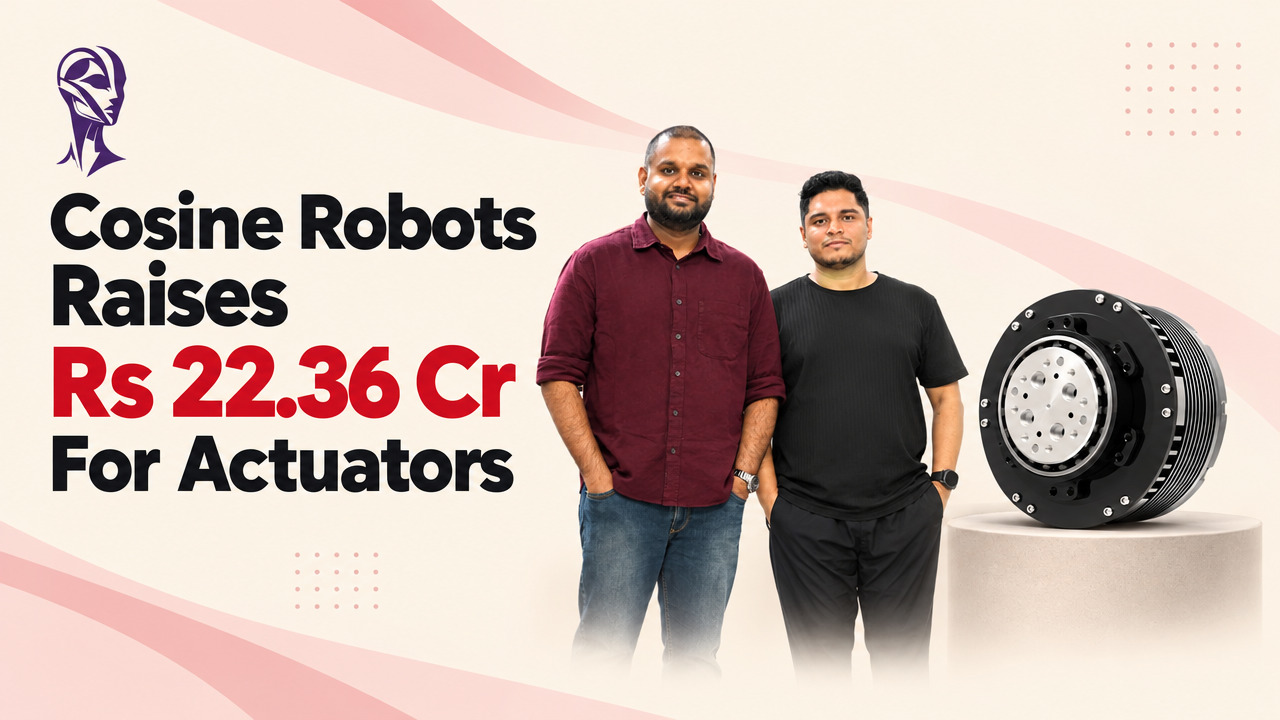

Cosine Robots, a Bengaluru startup that builds the actuators which move robotic joints, has raised Rs 22.36 crore, or about $2.4 million, in a round led by Avaana Capital, with WEH Ventures and a group of angel investors participating. The company said on 24 November that the money will fund a dedicated research and development and production facility, a larger engineering team and the next generation of its integrated servo actuator range.
Cosine did not disclose its valuation or how the equity was split between new and returning shareholders. Avaana partner Vikas Verma said the startup was solving a fundamental engineering problem by combining precision mechanics, proprietary controls and manufacturing inside one company. WEH Ventures managing partner Deepak Gupta said a domestic actuator supplier could serve robot builders both in India and overseas.
Read more on newzshort:
Origin Raises $20 Million To Scale Autonomous Construction Robots Across US
Where The Money Goes
The new facility will put precision machining, assembly, calibration and endurance testing under one roof, a sequence that is usually spread across four separate vendors in India. Cosine says that consolidation is what lets it hold tolerance and repeatability at volume. The company is also hiring across mechanical design, control systems and manufacturing engineering as it shifts from building prototypes to running a line that can supply robot makers on schedule.
Its core product is an integrated servo actuator, a single unit that packs a motor, gearbox, sensors, electronics and control software together. Cosine builds two gearbox families, cycloidal and planetary, so one motion architecture covers different torque bands. The same parts are aimed at industrial arms, collaborative robots, quadrupeds and humanoid machines, which is where most of the new demand is forming.
Read more on newzshort:
Bengaluru Space Robotics Startup Cosmochute Raises $1.5 Million in Pre-Seed
Why The Control Loop Matters
The company says its control architecture pairs dual position sensing with a 25 kHz loop, which means the software recalculates movement and torque 25,000 times a second. The figure matters because a joint that corrects slowly shows up as vibration, overshoot and wasted energy at the end of a robotic arm. Cosine argues that tuning the electronics and the firmware together, instead of assembling third-party parts, is where it can beat imported units on precision and price at once.
A Market Growing Faster Than Its Supply Chain
Demand is not the constraint. The International Federation of Robotics counted 603,307 industrial robot installations worldwide in 2025, up 11 per cent from a year earlier, and expects about 655,000 units in 2026. India’s own robotics layer is filling in, with Addverb Technologies, Ati Robotics and Unbox Robotics building systems for factories and warehouses. What those firms still import is the precision hardware underneath, a dependence a Mint report flagged in July 2026.
The Company Behind The Parts
Cosine Robots Private Limited was incorporated in 2024 and lists its registered office in the Devasandra Industrial Estate in Mahadevapura, Bengaluru. Kiran Mathew Koshy, co-founder and chief executive, has positioned the business as a supplier to the industry rather than a rival to robot brands. The company’s own website, Cosine Robots, already lists C-20, C-60, P-50, C-120 and C-280 actuators for developers, students and researchers, sold with browser based setup and a TypeScript software kit.
Risks And What To Watch
Component manufacturing is unforgiving. Imported bearings, magnets and encoder chips still set much of the cost, and a startup must prove thousands of hours of joint life before a robot maker will design its part in. Cosine also has to show that a team small enough to move fast can run a factory, hold tolerances and ship on time, which is a different skill from getting one prototype to work.
The near term markers are simple. Watch for the Bengaluru facility to open and for the first named industrial customers, because a design win with a robot manufacturer converts into repeat orders rather than a one time sale. Watch whether the low cost developer kits turn into an engineering talent pipeline, and how quickly the company moves from five actuators to volume production. For Indian robotics, a local supplier of this layer has been the gap.