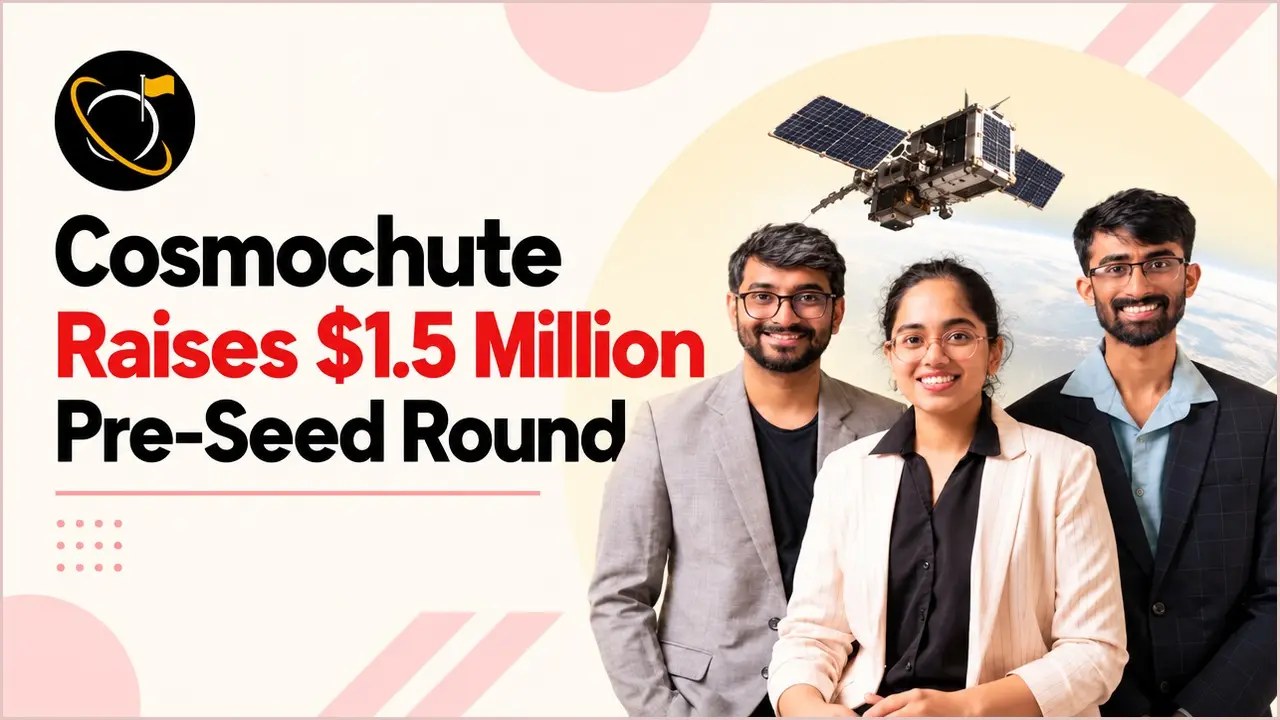

Cosmochute, a Bengaluru-based space robotics startup, has raised USD 1.5 million in a pre-seed funding round led by Accel and Prosus Ventures. The investment was made through Atoms X, the early-stage programme that Accel and Prosus run together.
The round also drew participation from IIMA Ventures’ Deep-tech and Aerospace Acceleration Fund, Operators Studio and angel investor Chinmayi Muthyala. Cosmochute is one of seven startups in the inaugural Atoms X cohort, which was launched earlier this year.
The Pre-Seed Round and Its Backers
The pre-seed cheque gives Cosmochute its first significant pool of outside capital. Accel and Prosus Ventures co-led the round, and the company entered the Atoms X programme alongside six other startups picked for the first cohort.
Prosus Ventures said it backs frontier technologies that combine scientific breakthroughs with engineering ambition. “At Prosus Ventures, we actively explore frontier technologies spanning specialised engineering, deep technology and future-economy infrastructure, supporting founders as they build ambitious companies on their terms,” said Dhruv Gupta, an investor at Prosus.
How the Funds Will Be Used
Cosmochute has said the capital will go into three main areas: developing its lunar mobility platform, expanding its engineering team and advancing its commercial roadmap. Janhavi Gore, co-founder of Cosmochute, said the money will also support space research and innovation.
The company is separately setting up lunar laboratories at IIMA Ventures’ incubation facility. Those labs will support work on the technology needed for lunar mobility and space robotics.
Read more: Nandan Nilekani-Backed Fundamentum Frontier Advisors Raises Rs 3,000 Crore for AI and Deeptech. The round shows how frontier and deep technology are drawing large pools of Indian capital.
LEAP and the Lunar Transportation Plan
Cosmochute’s first product is LEAP, a modular lunar mobility platform designed to carry and deploy payloads on the Moon. The system combines a modular rover and trailer with standard payload bays, so different payloads can be slotted into a common mission architecture.
The problem it targets is cost and complexity. Delivering and deploying equipment on the lunar surface still needs highly specialised engineering, and every mission tends to rebuild the same capability from scratch. Cosmochute wants to create a reusable infrastructure layer that several lunar missions can build on, rather than designing one-off systems for each flight.
Over time, the company says the technology could have applications in broader in-space operations and in terrestrial robotics.
Financials and Valuation
Cosmochute has not disclosed a valuation for the round, and this pre-seed investment is its first publicly reported funding. The USD 1.5 million is a modest early cheque by global standards, but it is in line with the size of most Indian pre-seed rounds in frontier hardware. As the company is at a product-development stage, it has not shared revenue figures.
Background and Founders
Cosmochute was founded by Janhavi Gore, Amit Chowdhary and Dhruv Alok Sangal, three rocket engineers who returned from the United Kingdom to build in India. The startup is guided by Mylswamy Annadurai, the former programme director of Chandrayaan-1, India’s first lunar mission.
Gore framed the round as part of a wider shift in the sector. “Space 1.0 was ISRO proving India could reach orbit. Space 2.0 made orbit commercial: cheaper, more frequent, and open to private capital. With sustainable access now secured, we believe it is the moment for Space 3.0, what happens after you make the in-space economy operable and extend it to the surface of the Moon,” she said.
What Happens Next
With the fresh capital, Cosmochute will move from concept to hardware, build out its engineering team and prepare LEAP for commercial missions. Its progress will be watched as a test of whether India’s private space ecosystem can move beyond launch and satellites into the infrastructure that supports operations in space and on the lunar surface.