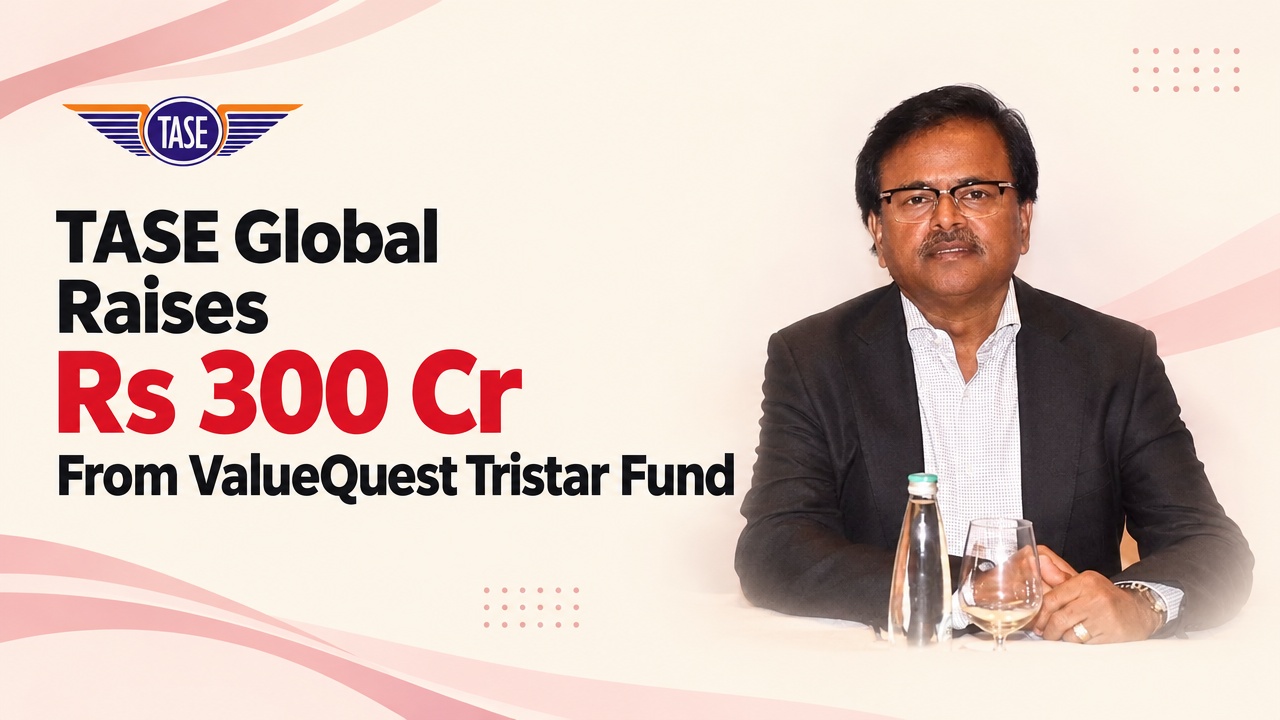

TASE Global, the Chennai-based precision engineering and manufacturing platform, said on Friday that ValueQuest’s Tristar Fund will invest Rs 300 crore, making it the fourth business in the private equity vehicle’s portfolio. VCCircle put the cheque at $31.9 million. Spark Capital was the exclusive financial adviser.
The money funds three things the company has so far paid for from cash and bank debt: capacity at its Indian plants, folding its US operations into one platform, and larger contracts with global equipment makers. “ValueQuest’s partnership will support our next phase of growth as we expand capacity, integrate our US operations and pursue larger OEM programmes,” founder, chairman and chief executive Shankar Raman Vaidyanathan said in the company’s statement.
Read more on newzshort:
Health ATM Maker Clinics On Cloud Raises Rs 120 Crore
What The Company Actually Makes
TASE Global runs high-precision machining, complex component manufacturing, sheet metal fabrication, specialised processes and precision assemblies out of plants in India and the United States. Its customers include Roche, PerkinElmer, Honeywell, Collins Aerospace, GE and Eaton, across medical instrumentation, aerospace, defence and industrial work. Such work is won on audit history, not on price.
The business is older than the startup economy around it. TASE, short for Trusted Aerospace and Engineering, has been machining for 45 years and grew without outside equity until last year. In October 2025 it bought Arizona-based Joined Alloys for about $12 million, or Rs 106 crore, and committed $18 million, about Rs 150 crore, to a brownfield expansion at Sriperumbudur near Chennai. In January it opened that plant, built with Japanese machine tool partner DMG Mori, and committed a further Rs 100 crore to a zero liquid discharge surface treatment line and a cleanroom for semiconductor equipment.
Read more on newzshort:
Giva Raises $100 Million Led By Multiples PE
The Numbers Inside The Round
The cheque is roughly the size of the entire capex programme TASE Global announced over the past 15 months, about Rs 250 crore across the US acquisition and two Indian projects. For Tristar, the deal is the fourth position in a fund that has gathered more than Rs 2,100 crore of commitments within 15 months of its first close. ValueQuest, founded in 2010, manages Rs 32,304 crore, with its private equity vehicles housed under Quest4Value Investment Managers LLP at more than Rs 6,500 crore.
TASE Global was a $32 million revenue business when it signed the Joined Alloys deal. It guided to $45 million for that financial year and has set a $100 million group target for the next three to four years. The Indian entity is far smaller: it reported Rs 49 crore of revenue, expected to close the year at Rs 70 crore to Rs 75 crore, with the new plant alone projected to generate up to Rs 300 crore in three years, largely from European customers. This is a business converting revenue into plant, and plant into qualification, faster than internal cash can fund.
Why Growth Capital Is Moving Into Manufacturing
The notable part of the deal is its direction rather than its size. Tristar is explicitly hunting capex heavy, qualification gated manufacturing in aerospace, defence, precision engineering and energy transition, after a decade of asset light consumer and software bets. Aniket Dharamshi, co-founder and managing partner at ValueQuest, argues that as global supply chains shift, Indian precision firms can move beyond component supply and become integrated manufacturing partners. That thesis depends on customers such as Boeing, Airbus and Dassault certifying Indian shops for work they once kept in Europe.
Editorial view: if it holds, the winners will be judged less on topline growth and more on how much of a global platform’s bill of materials they can hold, and for how long. A supplier that machines one bracket is worth a fraction of one that also owns the surface treatment, the assembly and the testing.
Risks And Open Questions
The risks follow the model. A handful of global OEMs account for most revenue, aerospace qualification cycles run for quarters and slip often, and both the semiconductor cleanroom and the surface treatment line carry operational deadlines. The announcement also left several things unsaid: the stake ValueQuest is taking, whether the instrument is pure equity, and any valuation. Those gaps matter, because a Rs 300 crore infusion into a business of this size is close to a full year of revenue.
What To Watch
The April target for the surface treatment line and the December target for the semiconductor cleanroom are the first proof that the capex is landing on schedule. Airbus and Dassault approvals will decide whether new capacity becomes contracts rather than idle machine hours. And the first full year of combined India and US accounts will show whether the $100 million target is a plan or a promise.