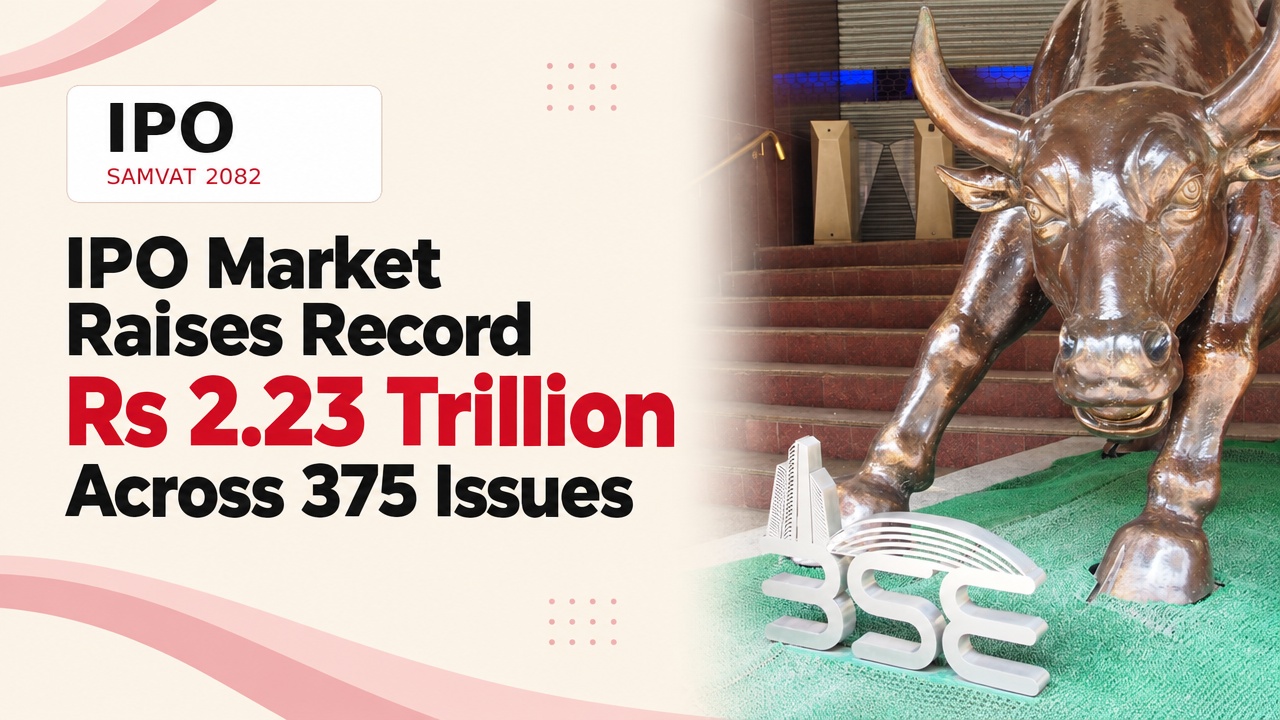

India’s primary market closed Samvat 2082 with its largest fundraising year on record. Companies raised Rs 2.23 trillion through 375 mainboard and SME IPOs between 21 October 2025 and 6 November 2026, and 230 listed above their offer price, according to Prime Database.
The mainboard carried the year. 131 issues raised Rs 2.12 trillion, 19.6 per cent more than the Rs 1.78 trillion raised by 104 issues in Samvat 2081, a 26 per cent jump in count. Add 244 SME issues and Rs 10,826 crore, and the market absorbed supply it had never handled.
Read more on newzshort:
Jio Platforms Lists At 21 Percent Premium
Fresh Capital Overtook The Exit Trade
The mix behind the record matters more than the headline. Fresh capital rose 42 per cent to Rs 1 trillion from Rs 70,641 crore, while offer for sale rose only 4.8 per cent to Rs 1.12 trillion. Exits still paid for 52.8 per cent of the year’s paper, down from 60.2 per cent, so a larger slice is headed into plants and hiring instead of a selling shareholder’s bank account.
Three issues took 29.8 per cent of the mainboard total. Jio Platforms raised Rs 30,188 crore entirely through fresh capital, the National Stock Exchange of India Rs 22,563 crore and ICICI Prudential Asset Management Company Rs 10,603 crore, the last two through offer for sale. SBI Funds Management, at Rs 9,795 crore, and Manipal Health Enterprises, at Rs 9,275 crore, completed the top five, and financial services led the sectors with 14 issues and Rs 60,781 crore.
Read more on newzshort:
Maxwell Engineering Lists At 90 Percent Premium On NSE Emerge
The Aftermarket Was Far Less Generous
Listing day flattered the cohort. Of 131 mainboard issues, 89 closed above their issue price on debut, a median gain of 6.8 per cent. By Friday, 6 November, that count had slipped to 87 above and 43 below, a median return of 16.8 per cent from the offer price.
Size decided the outcome. Of the 42 issues of Rs 1,000 crore or more, 34 are still above their offer price. Billionbrains Garage Ventures, the operator of Groww, is up 115.1 per cent, Meesho 110.3 per cent and Lenskart Solutions 80.3 per cent, while Pine Labs is down 26.5 per cent. Omnitech Engineering, up 166.2 per cent, led and Shree Ram Twistex, down 64.8 per cent, trailed.
The Small Caps Did Not Work
The SME platform grew in count and not in reward. Its 244 issues raised Rs 10,826 crore, 4 per cent more than the Rs 10,407 crore raised a year earlier, while offer for sale collapsed 40.6 per cent to Rs 628 crore. 141 of those issues closed above their issue price on debut, yet by 6 November only 114 were still above it and the median return was a loss of 3.9 per cent. Anyone who bought every SME listing of the year lost money at the median.
Domestic Money Carried The Year
What makes the record unusual is the year. The Nifty 50 fell 3.1 per cent and the Sensex 4 per cent, their worst Samvat since 2011, while foreign portfolio investors pulled a record Rs 4.55 trillion out of Indian equities. Domestic institutions bought Rs 8.55 trillion, also a record, and mutual funds alone put Rs 5.56 trillion to work. The primary market was funded by the same household savings that kept the secondary market from falling further.
The pricing conversation has changed with it. Vinay Jaising, chief investment officer at ASK Private Wealth, said the market is now separating companies on earnings visibility, cash flow, balance sheet quality, governance and valuation. Mahavir Lunawat of Pantomath Capital Advisors called the near Rs 1 trillion of fresh capital the encouraging half of the record because it funds expansion rather than an exit.
What To Watch In The Next Samvat
The pipeline is filling. Sebi cleared five IPO proposals in the final week, including IIFL Finance, Arjun Jewellers, Encube Ethicals, Sagar Defence Engineering and Mahanadi Coalfields, three with offer-for-sale components. The closing rally helps the queue: the Sensex and the Nifty gained 8.6 to 8.8 per cent, their best week in nearly six years, and Nifty valuations sit near 17 times earnings, below the ten-year average.
Our reading is that Samvat 2082 settled one argument and opened another. The settlement is that India’s primary market no longer needs foreign money to absorb a Rs 30,000 crore issue. The open question is whether it can keep paying for that supply without the median listing turning negative. Two numbers to carry forward are the 52.8 per cent offer-for-sale share, which shows how much of the boom is private equity cashing out, and the 3.9 per cent median SME loss, which shows what retail investors paid for the rest.