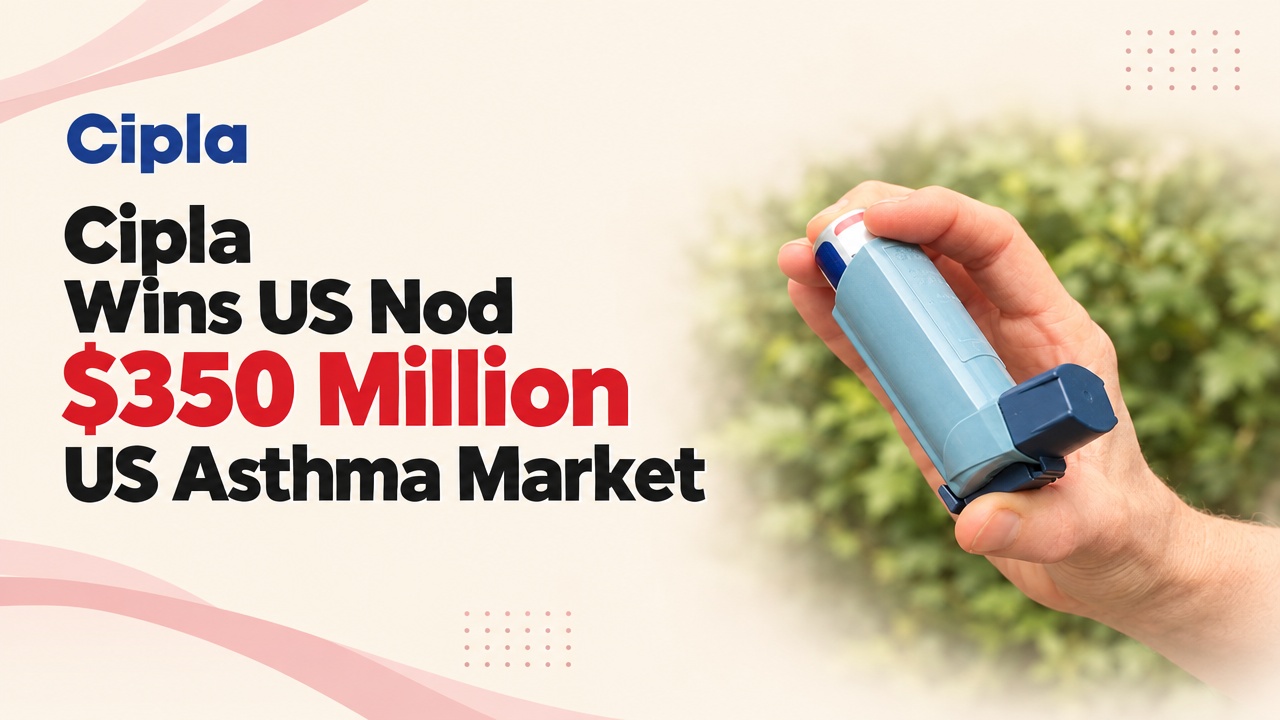

Cipla said on 25 November that the US Food and Drug Administration has approved its fluticasone HFA metered dose inhaler, the first generic equivalent of Flovent HFA, in the 110 mcg and 220 mcg strengths for asthma. The product was developed jointly with Teva Pharmaceuticals. Fluticasone HFA is an inhaled corticosteroid cleared for maintenance treatment of asthma in patients aged four and above.
The two partners have split the job. Teva holds the abbreviated new drug application and will commercialise the inhaler in the United States, while Cipla manufactures and supplies the product, the company told the stock exchanges. That division decides who books what: the US front end sale sits with Teva, and Cipla earns manufacturing and supply income.
Read more on newzshort:
Morepen Breaks Into US Prescription Drug Market
The Two Adult Strengths Were Still Brand Only
Federal records show the approval sits with Teva Pharmaceuticals USA under ANDA 209917, covering 0.11 mg and 0.22 mg per actuation, with an AB rating that lets pharmacists substitute it for the brand. The original approval is dated 3 November 2026, three weeks before Cipla’s announcement. GSK’s Flovent HFA was itself approved in May 2004 and was pulled from US shelves at the start of 2024.
Cipla’s first generic claim needs one qualifier. Glenmark Specialty won approval for its own fluticasone propionate inhaler, ANDA 219602, on 3 March 2026, but only for the 44 mcg strength, the low dose used for children. The 110 mcg and 220 mcg strengths, which carry most adult prescriptions, stayed brand only until the Teva application cleared this month.
Read more on newzshort:
Cancer Drug Prices Cut Up To 96% From Today
A $350 Million Market Split Several Ways
Cipla put the size of the prize at about $350 million, citing IQVIA data for the two strengths in the US. That is the sales value of the brand and its authorised generic, not the revenue a new entrant collects. With Glenmark already selling the 44 mcg version and Teva launching the adult doses, the pool gets shared at generic prices.
Analysis: the arithmetic is thinner than the headline suggests. A $350 million market divided between at least two generic suppliers, and priced at a discount to the brand, is a supply contract rather than a franchise. For Cipla the gain is in keeping a respiratory line busy at its US plants and winning more Teva style manufacturing mandates, not in a step change in US revenue.
Why This Matters To Cipla’s US Reset
The approval lands in a difficult year for that business. In the September quarter, Cipla’s net profit fell 35 per cent year on year to Rs 878 crore, revenue slipped 2.4 per cent, and the operating margin contracted 630 basis points to 18.7 per cent, as a high base and weak ingredient sales weighed. Management has guided to an 18.5 to 20 per cent margin for the full year.
Cipla expects US revenue above $1 billion in FY27, against $780 million last year, and plans 45 to 50 filings over three years. It won approval for its generic Advair dry powder inhaler in July, and has an exclusive deal with Qilu Pharmaceutical to sell a Keytruda biosimilar in the US and Canada. Net cash stood at Rs 9,823 crore.
Risks And What To Watch
The risks are the usual ones in US generics. Prices erode as more applicants clear the FDA, Teva controls the commercial strategy and the launch timing, and Cipla carries a manufacturing obligation without owning the customer relationship. Investors are already paying for a recovery: the stock trades at about 40 times trailing earnings, against a five year average near 27.
What to watch is concrete. Whether Teva confirms a launch date and shipping volumes, whether the 44 mcg strength follows from the same site, and whether respiratory supply shows up in Cipla’s North America numbers for the March quarter. The $350 million figure is the company’s own, and the first full quarter of sales will test it.