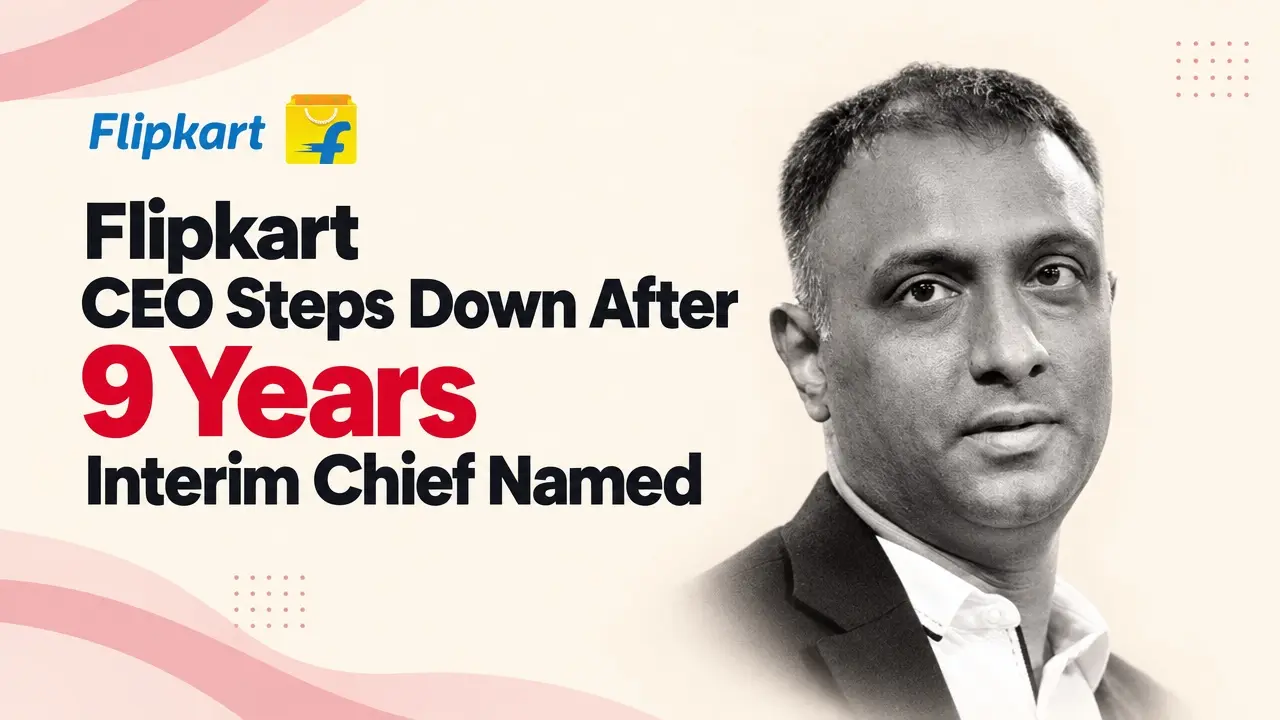

Flipkart group chief executive Kalyan Krishnamurthy will step down, the company said on 25 November, ending a decade in which he took the Walmart-owned ecommerce major from a founder-less turnaround to the edge of a public listing. Chief product and technology officer Balaji Thiagarajan will lead the company alongside the Flipkart board until a successor is named in the coming weeks.
Bloomberg reported that the exit takes effect on 4 December. Flipkart’s own statement named neither a last working day nor a reason, and the company did not answer queries from at least two publications before it announced the change. The handover leaves India’s largest online retailer without a permanent chief executive at the moment its listing decision matters most.
Read more on newzshort:
Jensen Huang Back As Nvidia CEO After 11 Days
Why Krishnamurthy Is Leaving
According to the Economic Times, Krishnamurthy met Walmart leadership in Bentonville, the parent’s Arkansas headquarters, earlier this month, and the talks broke down over Flipkart’s IPO plans and a liquidity event for executives and employees. The decision was finalised after that breakdown, a person briefed on the development told the paper.
An emergency meeting was called on Wednesday for senior vice presidents, vice presidents and senior directors, with a wider townhall planned for staff. Moneycontrol reported that Flipkart had summoned that townhall before it confirmed the change, a sequence that left employees briefing each other ahead of the official statement.
Read more on newzshort:
SEBI Tells Market Players To Stop Quoting IPO GMP
The Decade He Ran
Krishnamurthy became chief executive in January 2017 and group CEO in 2018, after rejoining Flipkart in 2016 from Tiger Global, an early backer where he worked after a stint as the company’s chief financial officer. Before that he spent seven years in eBay’s Asia finance operations, a detail that explains the operating discipline he brought to a business founded by engineers.
He arrived when the founders had gone. Sachin Bansal and Binny Bansal stepped back from executive control after Walmart agreed in 2018 to buy about 77 per cent of Flipkart for roughly $16 billion, and the task handed to Krishnamurthy was to make the company run like a listed business. Under him it added grocery, fintech, voice and regional-language interfaces, the Minutes quick commerce service and a planned entry into food delivery.
The Numbers Behind The Handover
Flipkart Group’s revenue rose 18 per cent to Rs 145,880 crore in FY26 while its consolidated loss narrowed to Rs 8,468 crore from Rs 8,646 crore, an improvement that still leaves a loss of roughly Rs 23 crore a day. That growth, in a year when Amazon and Meesho both pressed on price, is the strongest argument that the operating model works. The loss is the argument that a listing cannot wait indefinitely.
Walmart’s stake is now about 80 per cent, and the company moved its holding company domicile from Singapore to India in March, a prerequisite for a domestic listing. Flipkart had been targeting a draft filing with SEBI by late 2026 or early 2027, the Economic Times reported in May, and Walmart has not committed publicly to a date.
What The Exit Exposes
The departure is the visible end of a longer drift. At least 14 vice presidents and senior vice presidents have left Flipkart in the past year, and more than 1,000 former employees have pressed Walmart for a buyout of stock options locked up since the listing slipped. Separately, Walmart has been probing alleged kickbacks exceeding Rs 150 crore; Flipkart has said its governance is robust.
Risks And What To Watch
Three things decide what happens next: who Walmart appoints, whether the new chief executive is an internal operator such as Thiagarajan or an outside name, and how quickly the board commits to a listing date. A long interim is the risk, because Minutes is fighting Blinkit, Instamart and Zepto in a quick commerce market that rewards speed of decision rather than patience.
The Editorial Read
This is a Flipkart governance story before it is a leadership story. A chief executive leaving weeks after a boardroom disagreement over listing, at a company where the parent owns four-fifths of the equity and employees hold options they cannot sell, is what a stalled listing looks like from the inside. Walmart now has to show the company can be run by a process rather than by one person.