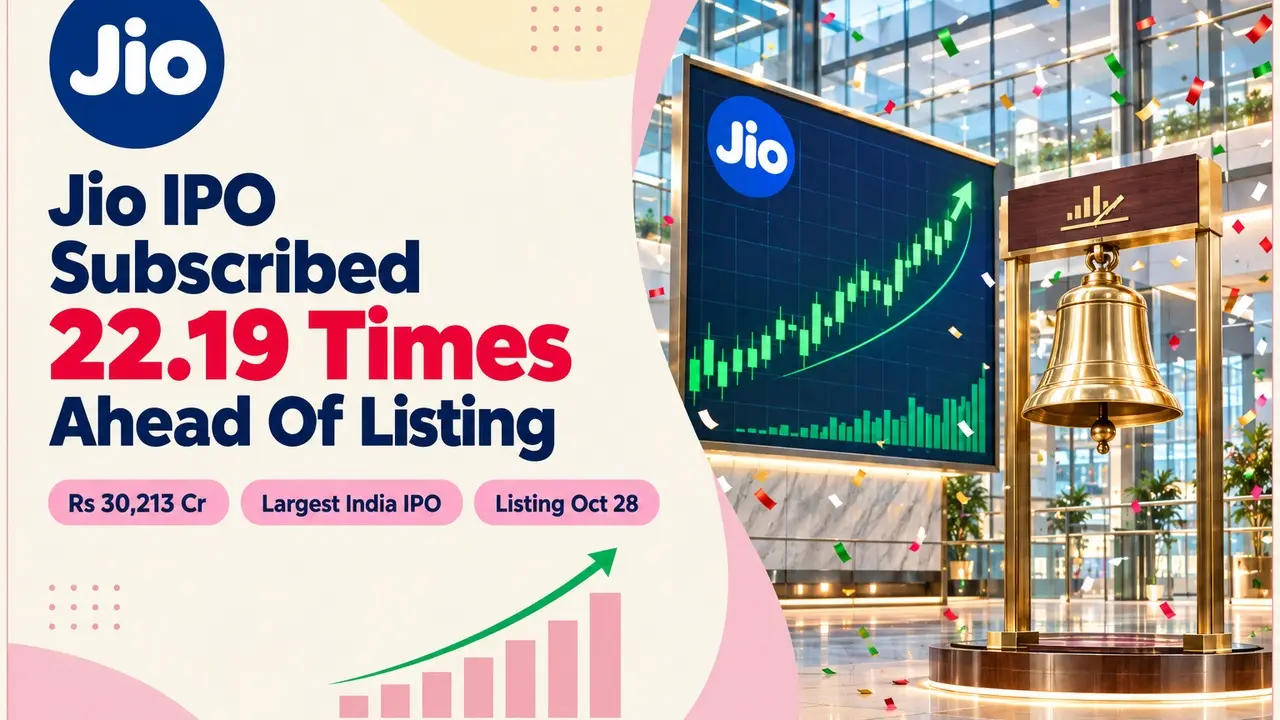

Jio Platforms closed its Rs 30,213 crore
initial public offer on Friday, October 23, with bids for 438 crore shares against 19.75 crore on offer, a
subscription of 22.19 times. Allotment is set for October 26, with trading on the BSE and the NSE at 10 am
on October 28.
The size makes it India’s largest public issue, ahead of Hyundai Motor India’s Rs 27,859 crore offering in
2024. At the top of the Rs 1,065 to Rs 1,119 band the company is valued near Rs 10.3 lakh crore, which would
make it the first Indian firm to cross that mark on listing day.
Read more on newzshort:
Zetwerk Raises Fresh Issue to Rs 2,830 Crore as Rs 5,012 Crore IPO Opens October 15
Cult.fit Gets SEBI Nod For Rs 950 Crore IPO As FY26 Loss Narrows 48 Percent
The numbers behind the 22 times
Institutions carried the book: the qualified institutional buyer portion was subscribed 70.55 times against
4.90 crore shares reserved, while non-institutional investors bid 14 times their 3.64 crore quota. Retail took
2.72 times its 8.50 crore shares, employees 2.93 times and Reliance shareholders 7.6 times. Live Hindustan put
total demand near Rs 7 lakh crore.
Read more on newzshort:
Kissht Parent OnEMI Gets BSE, NSE Nod For Rs 832 Crore Share Issue
Udaan Targets IPO By Early 2028 As Three-Year Turnaround Takes Hold
The application count is the record that will last. More than 1.2 crore people applied, against roughly
97 lakh in the Waaree Energies issue and 90 lakh in Bajaj Housing Finance, data cited by The Economic Times
shows. The institutional book was covered within 100 minutes, and first day bids of Rs 90,500 crore
were the highest for any Indian issue above Rs 15,000 crore, Moody’s noted.
A telecom business priced as a technology platform
The financials are large and improving. Revenue rose to Rs 1,46,885 crore in FY26 from Rs 1.28 lakh crore,
EBITDA to Rs 76,255 crore from Rs 64,170 crore, and profit after tax to Rs 30,049 crore from Rs 26,109 crore.
Average revenue per user moved from Rs 181.7 in FY24 to Rs 215.6 in the June quarter.
Nearly all of it still comes from connectivity. Reliance Jio Infocomm contributed 87.74 percent of
consolidated revenue, 94.88 percent of EBITDA and 93.76 percent of profit in FY26, per the red herring
prospectus, while digital services revenue was about Rs 16,167 crore, roughly 11 percent. The pitch rests on
the rest: 7,220 patent applications, a proprietary 4G and 5G stack, JioAICloud, private 5G, 533.3 million
subscribers in June and about 60 percent of India’s wireless data traffic.
Fresh capital, not a promoter exit
Unlike most large Indian issues, this one has no offer for sale. All 27 crore shares are fresh, so the money
stays inside the company. Up to Rs 27,500 crore will repay borrowings at Reliance Jio Infocomm. Existing
owners are diluted, not sold out: Reliance Industries slips from about 66.4 percent to 64.4 percent, Meta to
9.68 percent and Google to 7.49 percent, on a 2.9 percent dilution.
The anchor book, allotted October 19, raised Rs 8,110 crore from 212 investors at Rs 1,119 a share
against demand above Rs 2.5 lakh crore. LIC, BlackRock, Fidelity, GIC and the Abu Dhabi Investment Authority
were among the buyers. The listing re-rates the 2020 round, when most investors bought in at about
Rs 4.91 lakh crore.
Grey market, valuation and the risks
The grey market has been quoting a premium of Rs 238 to Rs 249 a share, about 21 to 22 percent over the top
of the band, implying an opening near Rs 1,357 to Rs 1,368. That market is unregulated and its premium does not
decide the listing price.
ANALYSIS: The valuation is demanding, not absurd. At Rs 1,119 the stock is priced below Bharti
Airtel’s trailing multiple of about 40.7 times, though growth now rests on tariff repair and on broadband,
cloud and enterprise services ceasing to be a rounding error. The category split is the better signal:
institutions bid 70 times their quota, retail 2.72 times. The large buyers are underwriting index inclusion and
scale above $100 billion, not a quick pop. Moody’s called the issue credit positive for Reliance while flagging
its roughly $15 billion annual capex.
What to watch next
Allotment on October 26 will show how much of that demand converts into shares. The listing print on October 28 is the first real price discovery since 2020. Two numbers matter
more than the opening gain: whether Reliance Industries holds up once the holding company discount is repriced,
and whether non-telecom revenue compounds fast enough to justify a technology multiple. Figures are from the
red herring prospectus as reported by The Economic Times and Live Hindustan on October 24, 2026.