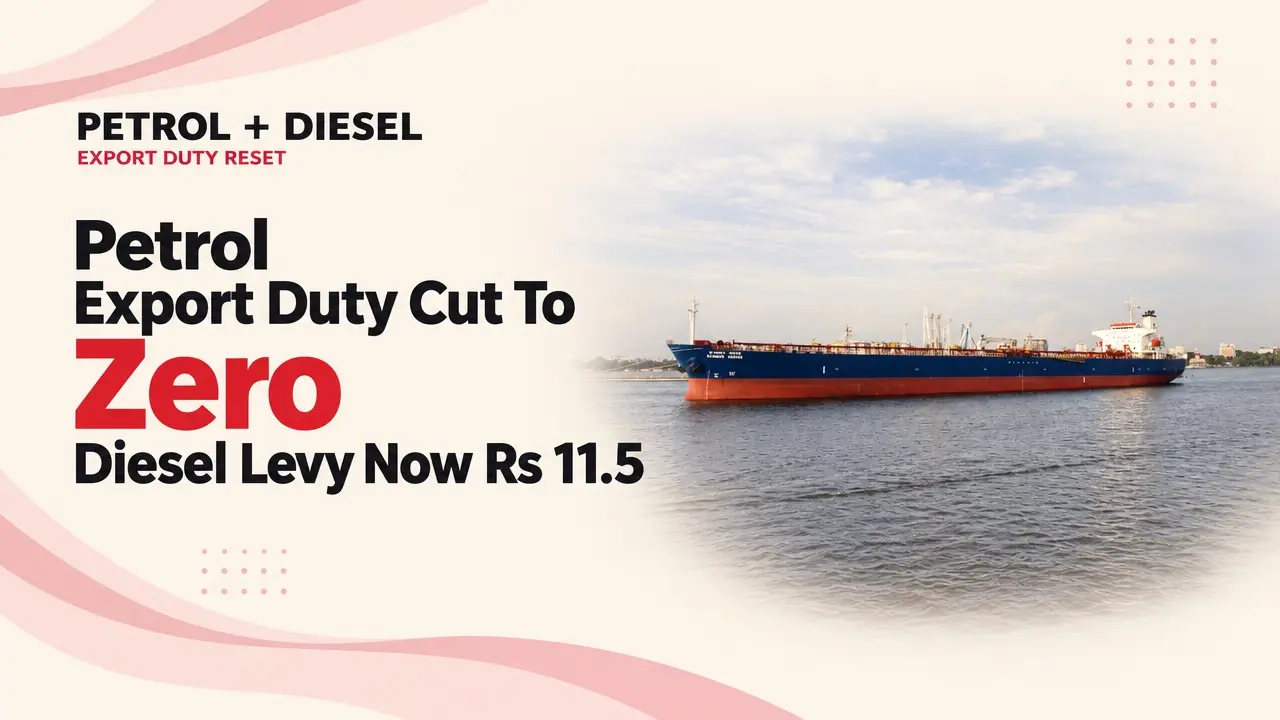

The finance ministry scrapped the special additional excise duty on petrol exports on Saturday and raised the levy on diesel shipped abroad by Rs 3 a litre, a reset that moves the cost of the West Asia supply crisis from one fuel to another. Petrol exports now carry no duty, down from Rs 2.50 a litre. Diesel exports will pay Rs 11.50 a litre, up from Rs 8.50, and aviation turbine fuel exports Rs 11, up from Rs 10.50.
The changes took effect on 31 October, the day the notifications were published in the Official Gazette. They apply only to fuel sold overseas. Retail petrol and diesel prices have been held steady through the war, so the pump price a motorist pays in Mumbai or Lucknow does not move because of this decision.
Read more on newzshort:
Reliance Q2 Profit Hits Record Rs 29,550 Crore
What Changed On Saturday
Three numbers define the revision. The petrol levy falls to nil. The high speed diesel levy rises by more than a third, from Rs 8.50 to Rs 11.50 a litre. Aviation turbine fuel, which was set at Rs 10.50 on 16 October, goes to Rs 11 under Notification No. 56/2026 Central Excise.
The levies date to 27 March, when the near closure of the Strait of Hormuz threatened domestic supply. New Delhi reviews the rates every fortnight against average international prices of crude, petrol, diesel and jet fuel, which is why one notification can cut a duty and raise another on the same afternoon.
Read more on newzshort:
Indian Oil Q2 Profit Jumps 184 Percent To Rs 21,630 Crore
Why Diesel Went Up And Petrol Came Down
Each duty tracks the crack spread, the gap between what a refinery pays for crude and what it earns from a barrel of product. Regional diesel benchmarks averaged USD 151 a barrel in the six months to September against USD 120 for petrol, according to petroleum ministry data. Diesel has been the scarcer and more profitable export, so the state taxes it harder to keep barrels at home.
That is the stated logic of the regime: discourage refiners from choosing overseas buyers when export realisations beat domestic ones. A levy does that without touching pump prices. The petrol exemption applies the same test in reverse, since a lower crack means the tax was holding back little supply while still costing exporters money.
The Arithmetic Per Barrel
A barrel holds about 159 litres. At Rs 3 a litre, the diesel increase takes roughly Rs 477 off every barrel a refiner ships out, about USD 5 at the rupee’s April to September average of 95.17 to the dollar. The petrol exemption returns about Rs 397 a barrel, or USD 4.2. For a refiner with a diesel heavy slate, the two changes do not cancel out.
Product mix decides who wins. Diesel made up 42 per cent of India’s petroleum product exports by volume in April to September and petrol 23 per cent, so the average export barrel is diesel weighted. A refinery selling mostly petrol gains on this notification. One selling mostly diesel does not.
Who Carries The Cost
Reliance Industries accounts for about 70 per cent of India’s fuel exports, with Rosneft backed Nayara Energy, state run MRPL and a handful of smaller refiners supplying the rest. The exposure is large because the earnings are. Petroleum product exports earned Rs 2.59 lakh crore in April to September, up nearly 50 per cent in rupee terms even as volumes fell 16 per cent, per data compiled by the Petroleum Planning and Analysis Cell.
Diesel alone earned about Rs 1.2 lakh crore, up 58 per cent, and petrol Rs 58,000 crore, up 21 per cent. The rupee’s slide from 86.44 to 95.17 against the dollar over the year did much of that work, which is also why the duty arithmetic looks smaller measured in dollars than in rupees.
The Consumer Side
Motorists are insulated for now. The export levies are not taxes on domestic sales, and retail prices have been frozen through the disruption. Demand has risen regardless: diesel consumption grew 5 per cent and petrol 7 per cent in the six months to September, while output of both fell less than 1 per cent, leaving refiners a thinner surplus to sell abroad.
What To Watch
Two prices set the next revision. Diesel cracks near USD 151 keep the case for a high levy, and petrol cracks near USD 120 keep the case for none. If diesel stays scarce, Rs 11.50 is a floor rather than a peak and the burden on export heavy refiners grows with every fortnight. The editorial read is that this is supply management dressed as taxation, and it will keep moving until shipping through Hormuz normalises.