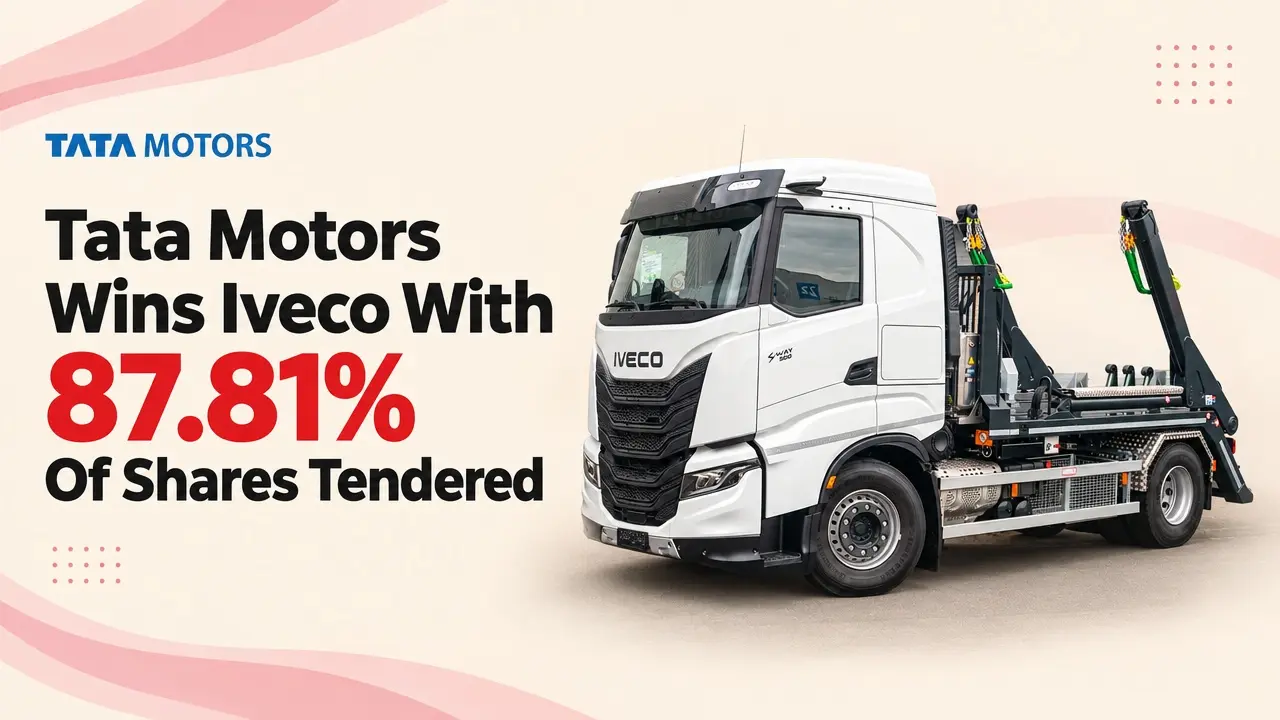

Tata Motors has cleared the acceptance threshold that stood between it and Iveco Group, the Italian truck maker it agreed to buy 15 months ago. Provisional acceptances under the 3.91 billion euro offer reached 87.81 per cent of Iveco’s share capital, comfortably above the 80 per cent floor that Iveco’s own shareholders approved earlier this month.
Iveco disclosed the count in a stock exchange filing on 26 October, the last day of the tender window. It said 97,078,765 applications arrived that day, taking total acceptances to 238,157,212 shares, or about 87.81 per cent of the instruments on offer. Tata Motors’ holding in Iveco will rise to 89.42 per cent once those shares settle.
Read more on newzshort:
L&T Tech Wins Five-Year Nokia R&D Deal In India
The Price Tag Moved Twice
The offer opened at 14.10 euro a share in September and moved to 14.40 euro on 9 October, when Tata Motors described it as best and final. At that price the whole equity is valued at roughly 3.91 billion euro, or about Rs 41,600 crore at current exchange rates. It pays only for shares actually collected, so the tender cheque itself is nearer 3.43 billion euro.
Iveco’s shareholders had to clear the way, not just its board. At an extraordinary general meeting in Amsterdam on 16 October they passed every resolution put to them, including one that cut the minimum acceptance condition from 95 per cent to 80 per cent. Business Standard reported that about 53 per cent of the capital voted in favour, 12 per cent against, and 35 per cent did not vote at all.
Read more on newzshort:
Tata Communications To Build $450 Million AI Fibre Network
Why The 80 Percent Line Mattered
Dutch law permits a statutory squeeze-out only at 95 per cent, a bar that open offers rarely clear. The lower threshold instead switches on a back-end route: a post-offer demerger, a sale of the operating business to the bidder, and then liquidation of the listed shell with the proceeds returned to whoever held out. Iveco is expected to delist from Euronext Milan and convert from a Dutch N.V. into a private B.V.
What The Deal Adds To Tata Motors
Scale is the first answer. The two businesses together sell more than 540,000 vehicles a year and collect over $25 billion in revenue. Iveco brings roughly 10 billion euro of annual sales, plants across Europe, China and Latin America, and a network in 160 countries. India still supplies about 90 per cent of Tata Motors’ commercial vehicle revenue.
The arithmetic deserves a caveat. Business Standard reports that analysts expect commercial vehicle revenue to nearly triple from about Rs 77,000 crore to more than Rs 2 trillion. On Iveco’s own stated revenue of about 10 billion euro, which converts to roughly Rs 1.06 lakh crore, the combined top line works out nearer Rs 1.8 lakh crore. Both figures point the same way, but the size of the jump depends on which revenue lines are counted.
Technology is the second answer. Iveco owns FPT Industrial, a powertrain arm with 16 plants and 22 research centres building Euro VII diesel, biomethane, hydrogen and heavy-duty electric drivetrains. Tata Motors has leaned on licensed technology and its Cummins joint ventures, so owning FPT hands it control of engines and axles across both product lines.
Fifteen Months Of Approvals
The deal was announced on 30 July 2025 and was expected to close by June this year. Italian golden power clearance came in November 2025, French and Spanish approvals pushed the timetable into the current quarter, and the European Commission cleared Leonardo’s purchase of Iveco’s defence arm only on 14 October. The tender itself opened on 7 September.
Tata Motors is a young listed company in its current shape. Its commercial vehicle business was demerged from the old Tata Motors and began trading separately on 1 October 2025, with about 20,600 employees against Iveco’s 34,000. The last comparable move was the 2004 purchase of Daewoo’s commercial vehicle unit, which still trades as Tata Daewoo.
What To Watch Before 29 October
Final acceptances are due before the market opens on 29 October, and the offer reopens from 2 to 6 November for holdouts. The number to watch is whether that second window drags the stake past 95 per cent, which would allow the simpler statutory squeeze-out instead of the demerger and shell liquidation route.
Analysis: the open question here is margin, not scale. Iveco has long run thinner operating margins in Europe than Traton or Volvo, and Tata Motors is paying a full price for a business it must now repair. The case rests on pushing Indian forgings, castings and electronics into Italian assembly lines, which is a three to five year job rather than a first-year saving.