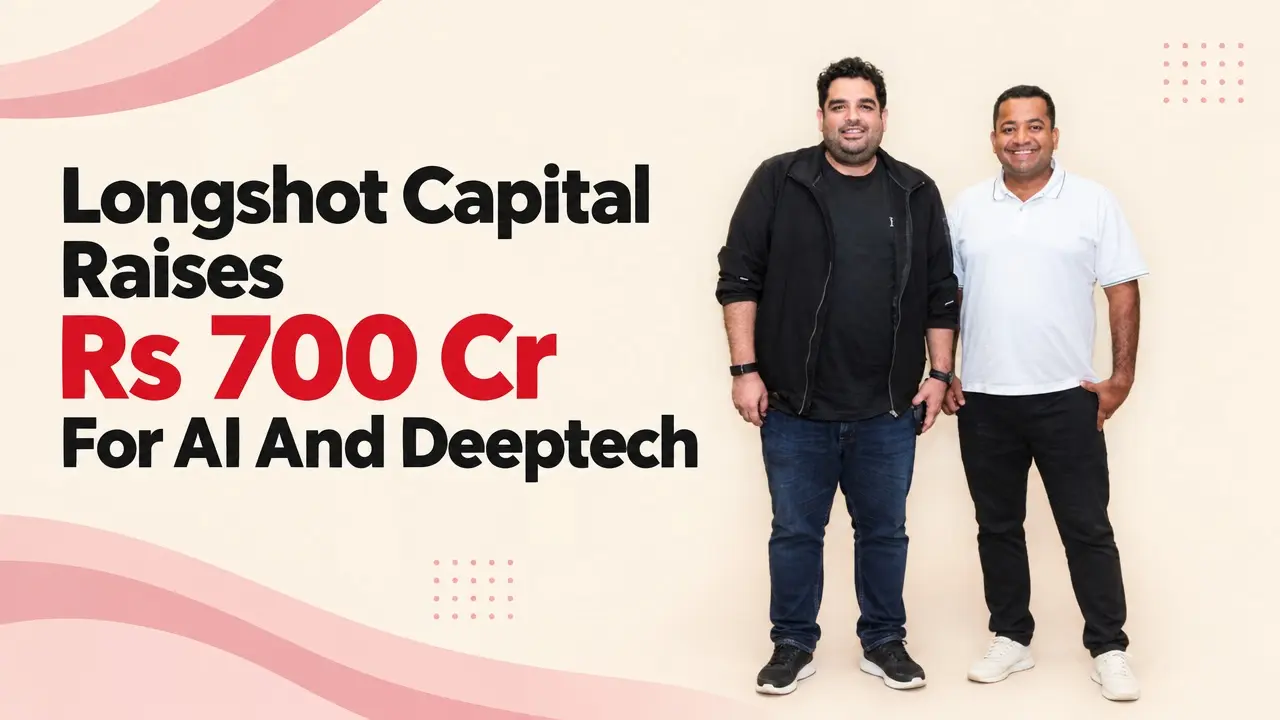

Gaurav Munjal and Roman Saini, the founders of Unacademy, are raising a Rs 700 crore venture capital fund for artificial intelligence and deep technology startups, The Economic Times reported on 26 October. The vehicle, Longshot Capital, has gathered commitments of Rs 250 crore to Rs 300 crore and targets a first close in January 2027, after which it will begin writing cheques.
Longshot will run from Bengaluru as a Category II alternative investment fund, the private equity bracket of India’s AIF framework. It plans 25 to 28 seed and pre-Series A positions, writing $500,000 to $1.5 million cheques for 8% to 12% stakes. The fund life is 10 to 11 years, long enough for slow deeptech and AI product cycles.
Read more on newzshort:
Nandan Nilekani-Backed Fundamentum Frontier Advisors Raises Rs 3,000 Crore for AI and Deeptech
What The Fund Will Back
The mandate is narrow by design. Longshot will write into AI-led businesses and deeptech segments such as manufacturing, space, defence and robotics, and stay away from consumer brands and retail. It will back India-based startups and companies founded by people of Indian origin, deploying the corpus over three years.
Saini runs the firm full time and Munjal stays part time alongside his Unacademy role, both as general partners. Capital is expected from founders, family offices and overseas institutions.
Read more on newzshort:
Firstwork Raises $15 Mn Series A For AI Agents
The upGrad Reset That Made This Possible
Timing explains much of this. upGrad completed its Unacademy acquisition on 1 September 2026 at a valuation of just over $200 million, roughly 94% below the $3.5 billion the company touched in 2021. Munjal has said the company raised at a peak and sold at a fraction. A founder through a full valuation reset has both the reason and the standing to move from operating to allocating.
The company’s arc is the backdrop. Founded in 2015 by Munjal, Saini and Hemesh Singh, Unacademy began as a YouTube channel for exam preparation and raised about $880 million from SoftBank, Peak XV, Elevation and General Atlantic. Shrinking demand for online learning forced layoffs and a pivot into offline coaching.
From 200 Angel Cheques To A Rs 700 Crore Vehicle
Longshot formalises more than a decade of personal investing. The founders have put in over Rs 25 crore across 200-plus angel cheques, holding Pine Labs, Dhan, Ultrahuman, Snabbit, STAGE and Third Wave Coffee, and added Superleap, an AI-native customer relationship platform, in August. That record matters to a limited partner, though small cheques and a Rs 700 crore fund are different jobs.
The path is well worn. Kunal Bahl and Rohit Bansal raised Rs 333 crore externally for Titan Capital, which closed finally in October 2024. Girish Mathrubootham co-founded Together Fund after Freshworks, and Mukesh Bansal runs Meraki Labs.
Where India’s AI And Deeptech Money Is Going
The fund is arriving in a market that has already repriced. Indian AI startups raised $438 million across 28 deals in the July to September quarter, up 265% from a year earlier, while deeptech startups raised $290 million across 28 deals, up 176%, according to Inc42’s tracking. At about Rs 88 to the dollar, Rs 700 crore is roughly $80 million, near a fifth of the AI segment’s quarterly flow.
Analysis: the number that matters is not the Rs 700 crore target but the Rs 250 crore to Rs 300 crore already committed, which is 36% to 43% of the fund, before a single investment is announced. First closes lean on people who know the managers, so this says more about networks than institutional appetite. The test arrives at the second close.
Risks, Open Questions And What To Watch
Much remains unproven. The January 2027 close is a target, and ET noted its size and timing could change. Neither founder has commented on the record, and the fund has no public website. AI and deeptech investing needs more follow-on capital than a $1.5 million first cheque implies, so Longshot will need reserves or co-investors willing to lead later rounds.
The field is crowded at exactly the stage chosen. Cheques of $500,000 to $1.5 million are where Elevation, Blume, Nexus and a dozen AI funds already operate, and where valuations for anything carrying an AI label have moved fastest. A new manager without an institutional brand must win on speed, operator advice and lived experience.
What to watch is concrete. Whether the first close lands in January at Rs 300 crore or slips. Which limited partners are named. The first three investments, and whether they are AI software, where returns come quicker, or hardware and space, where a 10-year fund life earns its keep.