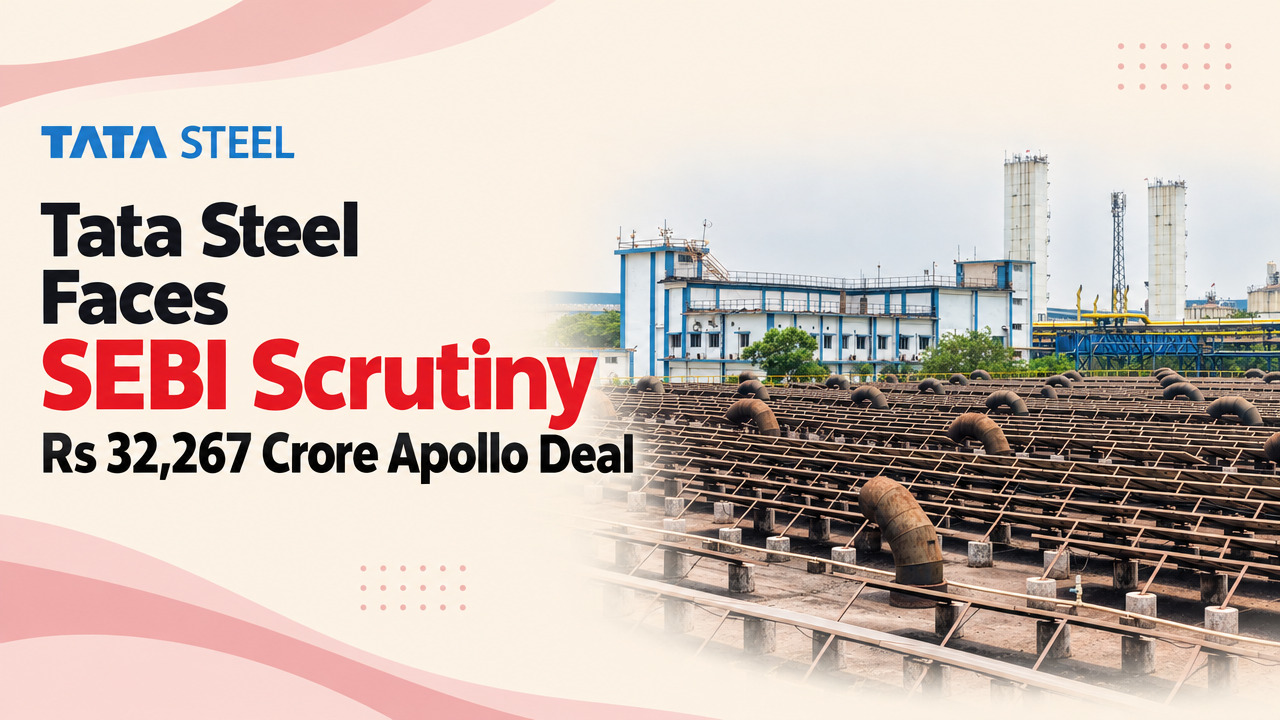

SEBI is examining the Tata Steel and APL Apollo Tubes transaction, its chairman said on 27 November, days after the deal erased more than Rs 30,000 crore of shareholder value. “SEBI takes minority shareholder rights very seriously, we are looking into the TATA-APL deal. Investor protection is very important,” Tuhin Kanta Pandey said at an ASSOCHAM event in Mumbai. APL Apollo shares rose 3.3 per cent to Rs 1,531.
Two legs run in opposite directions. APL Apollo will buy Tata Steel’s tubes business for Rs 11,700 crore and all of Tata Steel Colors for Rs 16,300 crore, Rs 28,000 crore funded by borrowings. In return, Tata Steel is buying about 26.4 per cent of APL Apollo from the promoter family at Rs 2,100 a share, or Rs 15,510 crore, and has opened a 26 per cent offer at Rs 2,301.40. Full acceptance gives Tata 52.6 per cent and a total bill near Rs 32,267 crore.
Read more on newzshort:
SEBI Tells Market Players To Stop Quoting IPO GMP
Why The Regulator Is Involved
SEBI must decide whether those legs are one transaction under related-party rules. APL Apollo’s board approved the asset purchases on 22 November, and Tata Steel signed the share purchase agreement with promoter entity S Gupta Holding the next morning, picking up a 9.9 per cent block the same day. IiAS says Tata Steel was therefore not a related party when the asset agreements were signed, which technically spares the deal an audit committee approval and a related-party vote.
Stakeholders Empowerment Services reads it differently. It says Tata Steel became a related party on 23 November and has asked whether the first tranche was kept below 10 per cent to stay outside the trigger. IiAS wants SEBI to state whether its purpose and effect test applies, arguing the deal makes commercial sense but was presented as several transactions when it is one.
Read more on newzshort:
Lakshmi Venu Sues Father Over TVS Family Assets
The Debt Arithmetic
The financing lands on the smaller company. APL Apollo will fund the Rs 28,000 crore purchase with acquisition debt before replacing it with long-term capital. IiAS estimates standalone debt to equity at 7.6 times and about 5 times consolidated, against 0.22 and 0.09 in FY26. Public holders can tender only part of their stock in the open offer, and a weaker price cuts acceptance, leaving them with a leveraged company and an equity raise not yet priced.
Tata Steel calls the leverage temporary. “This is not the end-state financing,” chief financial officer Koushik Chatterjee told investors on 23 November, saying about Rs 10,000 crore of external debt would stay and roughly Rs 18,000 crore would be equitised. It expects to recapitalise within about 12 months and cut net debt to 2.5 times EBITDA. Chief executive T V Narendran put the cap at Rs 10,000 crore to Rs 12,000 crore, against combined EBITDA of Rs 4,000 crore to Rs 4,500 crore.
The Price Tag
Price is the second grievance. The Rs 28,000 crore purchase values the assets at 24.8 times projected FY27 EBITDA of Rs 1,130 crore, IiAS calculates, while listed peers trade at 6.9 to 15.4 times and Tata Steel near 8 times. Tata Steel says independent valuers were involved.
The market has already voted. APL Apollo fell over 30 per cent from Friday’s close to Rs 1,478 and Tata Steel lost more than 10 per cent to Rs 159.10, wiping over Rs 30,700 crore, or more than $4 billion, off their combined value in two sessions. Friday brought a partial rebound after Pandey’s remarks, with the stock touching Rs 1,544 intraday.
A Test For Minority Rights
Founding families owned just under 42 per cent of non-state listed companies at the end of September, against under 35 per cent held by institutions, according to primeinfobase. “The real test of India’s corporate governance reforms is whether they can protect minority shareholders when their interests diverge from those of the country’s most powerful business groups,” said Shriram Subramanian, founder of InGovern Research Services.
Analysts say the burden of proof sits with the structure. “Strategic rationale alone is not sufficient to secure shareholder support,” said Akhilesh Kumar of Emkay Global Financial Services, adding that valuation and funding must be acceptable to minority holders. Tata Steel says it is “carefully examining the concerns”, while Narendran has said management is working on a solution but has reached no conclusion.
What To Watch
SEBI’s call on reading the legs together will set the template for similar control deals. Any re-cut needs fresh board approvals. The business transfer agreement needs a minority vote, where shareholder anger turns binding. The equity raise that replaces the acquisition debt sets the final cost for public holders. Until then the deal is approved in principle and untested in practice.