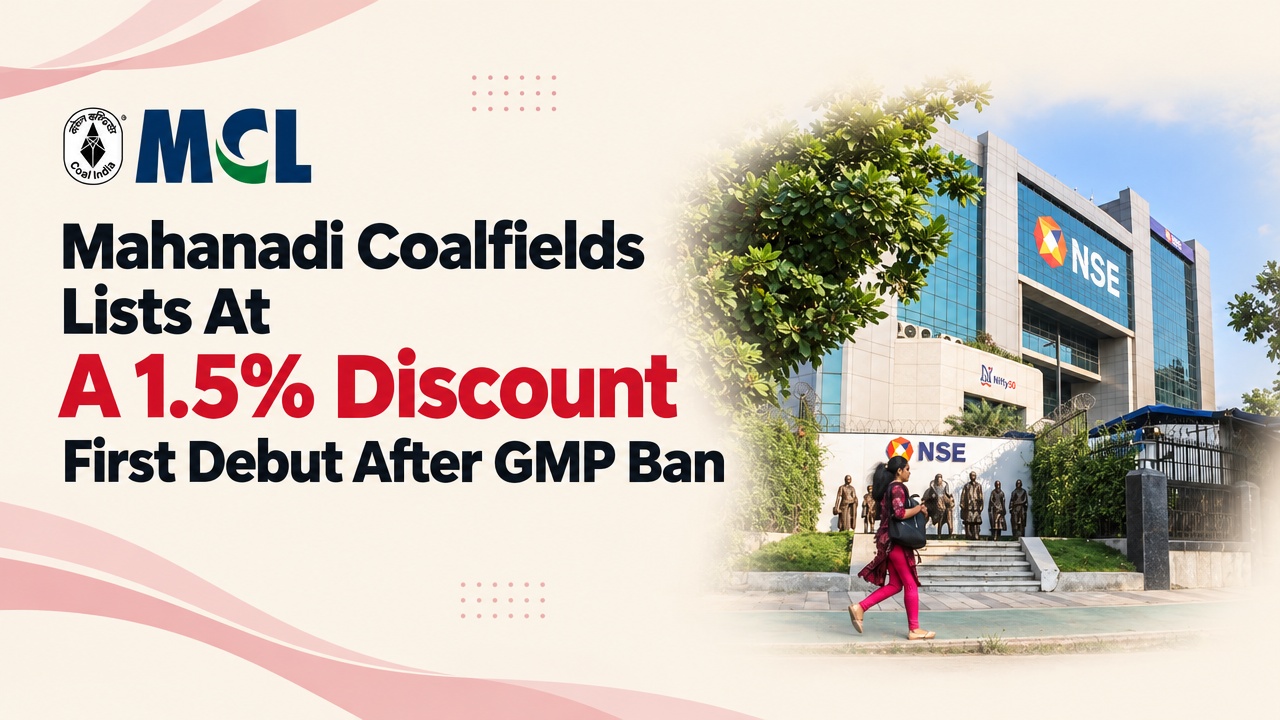

Mahanadi Coalfields Ltd listed at Rs 134 on the National Stock Exchange on Friday, 27 November, a 1.47 per cent discount to its Rs 136 issue price. On the BSE it opened at Rs 133.15, down 2.10 per cent. A lot of 110 shares cost Rs 14,960, so an allottee who sold at the NSE print booked a loss of Rs 220.
The print makes Mahanadi the third Coal India subsidiary to trade publicly this year, after Bharat Coking Coal on 19 January and CMPDI on 30 March. Reuters data cited by Moneycontrol showed CMPDI up more than 18 per cent since listing and Bharat Coking Coal down about 29 per cent from its debut price as of 16 November, a reminder that the parent’s name is not a floor under the stock.
Read more on newzshort:
Mahanadi, Sagar Defence Get SEBI Nod For IPOs
The First Debut Without A Grey Market
This is the first Indian listing since the Securities and Exchange Board of India barred publishers from carrying grey market premium quotes on initial share sales. Those indicative prices had become the informal benchmark retail buyers used to guess a first-day gain, and several recent issues had opened close to them. Friday had no such anchor. Mahanadi went from its 5 August kickoff to a listing in 114 days, one of the faster runs in the current pipeline.
The book was institutional. The offer was subscribed 1.52 times on NSE data, with bids for 74.86 crore shares against 49.30 crore on offer. Qualified institutional buyers took 4.85 times their quota, while the non-institutional portion closed at 66 per cent and retail at 46 per cent. Coal India had already collected Rs 2,295 crore from 15 anchor investors, among them LIC, Nippon Life India and Abu Dhabi Investment Authority.
Read more on newzshort:
Coal India’s SECL Files DRHP For $800 Mn IPO
Where The Rs 8,981 Crore Went
None of it reached the company. The Rs 8,981.12 crore issue was entirely an offer for sale of 66.18 crore shares, roughly 10 per cent of paid-up equity, and every rupee after expenses accrued to Coal India, which retains the other 90 per cent. Mahanadi’s balance sheet is unchanged by the exercise. What changed is the parent’s cash position, and the market now has a daily price on an asset it previously carried at book value.
The Numbers Behind The Discount
Mahanadi Coalfields mined 218.31 million tonnes in FY26, about 22.4 per cent of India’s non-coking coal output, and supplies more than 28 per cent of Coal India’s total production, according to the Crisil report in its red herring prospectus. It posted consolidated net profit of Rs 4,879 crore in the first half of FY27, up 6.7 per cent on the year. At the issue price its trailing dividend yield was 8.5 per cent against 6.6 per cent for the parent.
At Rs 136 the whole company was valued at Rs 90,001 crore, or $9.55 billion at Rs 94.24 to the dollar, as reported when the band was set. The Rs 134 print scales that to about Rs 88,700 crore, and against a simple annualisation of the first-half profit the issue sold near nine times earnings. Those are arithmetic, not forecasts, and they explain why the shares had little room on day one.
Why The Analysts Split
Prabhudas Lilladher argued that a 10 to 15 per cent valuation premium over Coal India is justified by Mahanadi’s better operating profitability, return ratios and capital allocation. Religare Broking flagged declining returns and weakening operating metrics that could weigh on performance despite large reserves and a settled customer base. Both notes, reported by Business Standard, describe the same set of accounts.
The Editorial Read
Analysis: the discount looks like a pricing outcome rather than a demand failure. A company sold at a premium to its own parent, in an issue that gave it no fresh capital and left retail at 46 per cent, had little upside stored for the first session. The institutional book did the work, which is the usual pattern in large public sector offers, and the anchor list reads more like a mandate than a vote on the coal cycle.
What To Watch Next
Two things matter from here. First, whether Mahanadi holds its premium to Coal India after the anchor lock-in lifts, because that gap rests on return ratios rather than growth. Second, South Eastern Coalfields filed its draft papers this month and will be priced against Friday’s print, so a tepid debut makes the next Coal India selldown harder to market.