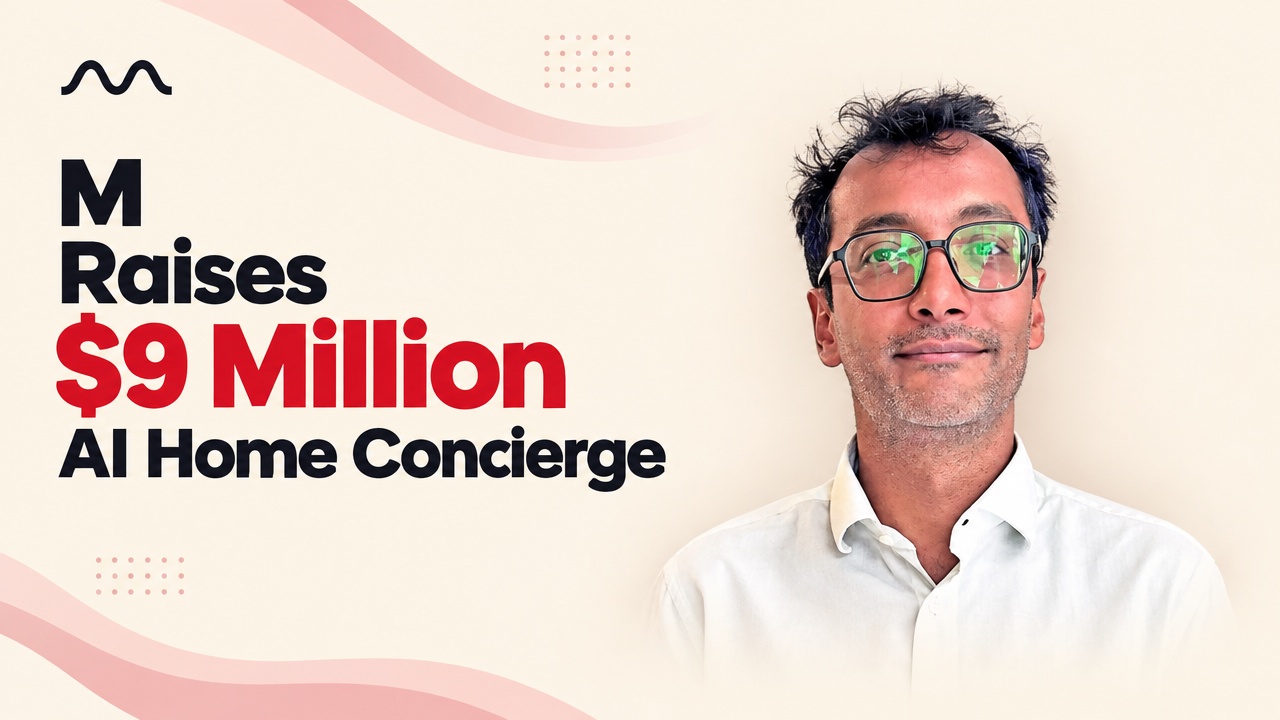

M, the artificial intelligence household concierge startup founded by Dunzo cofounder Kabeer Biswas, has raised $9 million in a follow-on round led by RTP Global, taking total funding at the Bengaluru company to about $20 million less than a year after it began operating.
RTP Global, a United States-based venture fund, put in $5 million and existing investors supplied the remaining $4 million, people familiar with the deal told ET, Moneycontrol and Inc42 on 27 November. Inc42 put the rupee value at about Rs 82 crore and Moneycontrol at about Rs 83 crore. None of the parties commented, and no valuation was disclosed.
Read more on newzshort:
Matters.AI Raises Rs 115 Crore Led By Tanglin
What the Money Buys: A Manager for the Kitchen
M does not sell groceries. It sells the decisions around them. Each new household begins with an onboarding visit in which the team maps who cooks, who cleans, what time breakfast has to be ready, which family member is diabetic, which brands the family buys and which language the cook speaks. That becomes the household’s operating manual.
The service then lives inside WhatsApp. Every evening it writes the next day’s meal plan around dietary rules and whatever is already in the refrigerator, sends instructions to the cook in Hindi, Bengali or Nepali, and reads a voice note asking for coriander, oil and bread as an order. It plugs into quick-commerce apps to place that order. Biswas summed up the ambition in June: “If Claude can run your work, can M run your house?”
Read more on newzshort:
Nvidia Backs Simplismart In $14 Million Series B Round
The Numbers Behind the Bet
The disclosed operating numbers are five months old and self-reported. In June the company served about 150 households in Bengaluru with 45 employees, claimed monthly retention above 90 per cent and daily active usage of about 82 per cent, and said only four customers had left. It has set a target of 10,000 homes and access is still through a waitlist.
Set that against the capital. Twenty million dollars spread across 150 households is roughly $133,000 of funding per home served, a measure of how early the company is rather than of the business. At 45 employees for 150 homes it runs at about three households per staff member, the shape of a managed service rather than a software product. The arithmetic is simple: $11 million of seed in April plus $9 million now equals $20 million.
Dunzo’s Shadow and RTP’s Bet
Biswas cofounded Dunzo in 2014 with Ankur Agarwal, Dalvir Suri and Mukund Jha, built it from a WhatsApp errand service into a hyperlocal delivery company backed by Reliance Retail and Google, and watched it shut services in January 2025 after years of cash burn. He then led Flipkart’s quick-commerce arm Minutes and left in October 2025.
M was founded in December 2025 with Kartik Mishra, a former Swish executive, which makes this round a bet on the founder more than on the product. The model also closes a circle, because Dunzo began as a concierge that did the work for you while M is a concierge that does the thinking for you. RTP Global’s $5 million is a quarter of the company’s total capital.
Risks and Open Questions
Three questions decide the outcome. The first is platform risk: Blinkit, Zepto and BigBasket already own the grocery relationship and can add an assistant that plans meals, which would leave M as a thin layer on top. The second is the niche, since households that employ cooks and domestic staff are a narrow urban segment. The third is disclosure, because no revenue, margin or valuation figure has been published.
The editorial read: M is being funded as a founder’s second act and as a bet that affluent Indian households will pay for coordination rather than for delivery. That is a testable proposition, and the company has supplied its own yardstick by naming 10,000 homes. What it has not supplied is a price, a market or a date.
What to Watch
Four markers matter from here: the move off the waitlist and out of Bengaluru, the household count measured against the 10,000-home target, the subscription price and churn once access opens, and whether M stays a software layer on top of delivery apps or turns into an operations company with its own staff. RTP’s cheque buys runway, not proof.