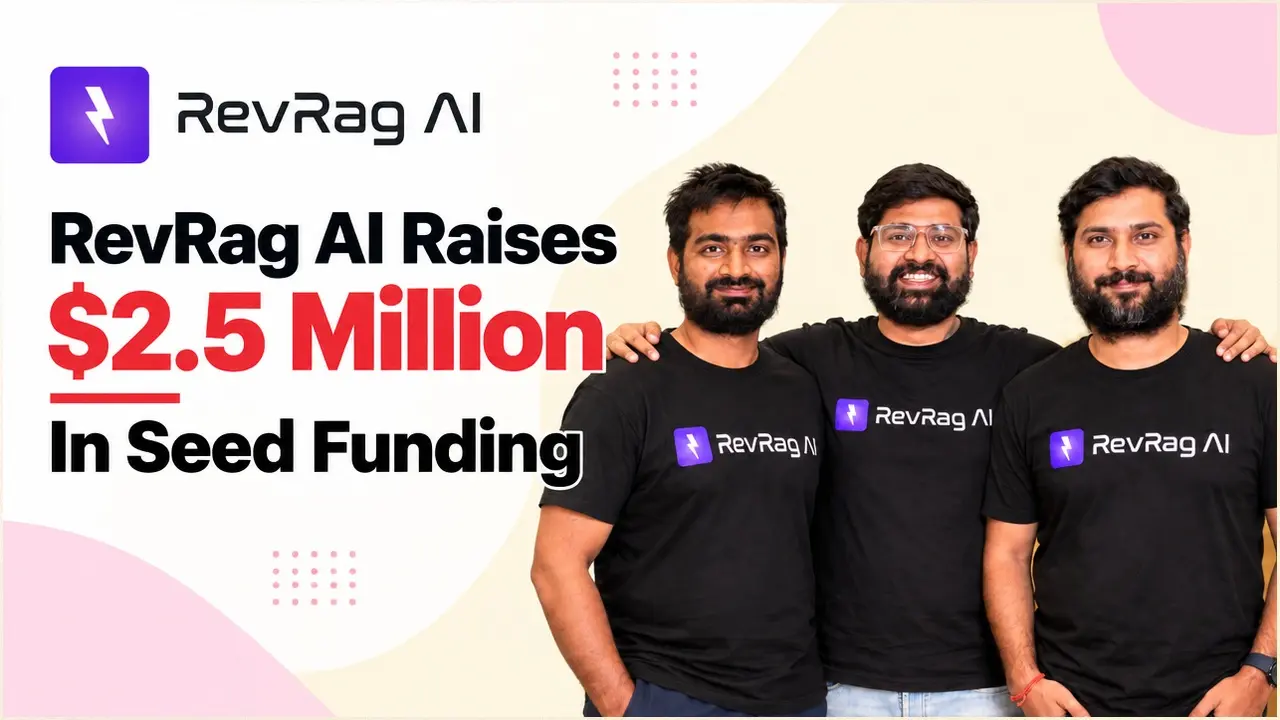

RevRag AI, a Bengaluru startup that builds AI agents for financial institutions, has raised USD 2.5 million, or about Rs 24 crore, in a seed funding round led by Accion Ventures and Cedar Hill Capital. Wyser and Venture Catalysts also participated. The company announced the round on October 14.
RevRag did not disclose a valuation. The raise comes about two years after a USD 600,000 pre-seed round led by Powerhouse Ventures, and follows its acquisition of GenStaq.ai, a workflow orchestration startup, in September 2025.
The Funding Round and Its Investors
Accion Ventures led the round alongside Cedar Hill Capital, with Wyser and Venture Catalysts joining as participants, the company said. Its earlier pre-seed was backed by Powerhouse Ventures and angel investors, including CRED founder Kunal Shah and KreditBee founder Madhusudan.
Sahil Anand, managing partner at Cedar Hill Capital, said the next phase of Indian fintech would be about making apps that already have users more useful rather than adding more users. His firm looks at how repeatable each deployment is, he said, because a product that needs a custom build for every client becomes a services business.
What RevRag Builds
RevRag develops multilingual AI agents that sit inside the apps of banks, non-banking financial companies, fintech firms and insurers and work as digital relationship managers. Instead of sending customers to a separate chatbot, the agents connect to the institution’s own workflows to handle onboarding, product selection, sales and support.
Ashutosh Singh, founder and CEO, said: “A good relationship manager knows you, tells you what to do next, and handles it for you. Very few customers ever get one. We think every financial app should work that way, and that is what we are building.”
Where the Fresh Capital Goes
RevRag said the money will fund product development, more enterprise deployments and its entry into the United States market. Singh said the US has a large financial services market spanning insurance, credit cards and loans, and that competition in RevRag’s specific category is still limited.
The company also wants to add a no-code flow builder and go in-house on technology. The platform currently runs on third-party models, and RevRag plans to fine-tune its own multimodal small language models.
Read more: AI is drawing larger cheques across financial services. See our report on Mecka AI’s USD 60 million Series B led by Sequoia Capital, another recent round in the same sector.
Background and the Founders
RevRag was founded in 2022 by Ashutosh Prakash Singh, Neeraj Gupta and Pankaj Gupta, and operates through VWelly Technologies Private Limited. Inc42 and Entrackr both list its base as Bengaluru. It began as a savings-focused fintech product, then rebuilt as a SaaS platform for financial institutions in early 2025 after the founders kept running into clunky, documentation-heavy onboarding.
Traction and Financials
RevRag says it works with more than 45 financial institutions, including PhonePe, Bajaj Finance, Motilal Oswal, IIFL, Aditya Birla Capital, DCB Bank, Razorpay, Moneyview, Jar, Kissht and Easebuzz. The company claims its agents can cut servicing costs by up to 70 percent compared with traditional channels while adding revenue, though it has not disclosed the baseline behind that figure. It has set a target of USD 50 million in annual recurring revenue by FY28.
What Happens Next
RevRag is betting that the next stage of Indian fintech is about depth of use, not just the number of accounts. The company cites data that nearly 90 percent of Indian adults have a financial account but only about 54 percent use digital payments, a gap it frames as an engagement problem rather than an access one.
The global AI in fintech market is valued at about USD 45.5 billion in 2026 and is projected to cross USD 241 billion by 2034, growing at a compound annual rate of about 23 percent, according to market estimates cited by the company. For now, the seed round gives RevRag room to build its own models and test the US market, and whether its cost claims hold up will depend on deployments it has not yet detailed.