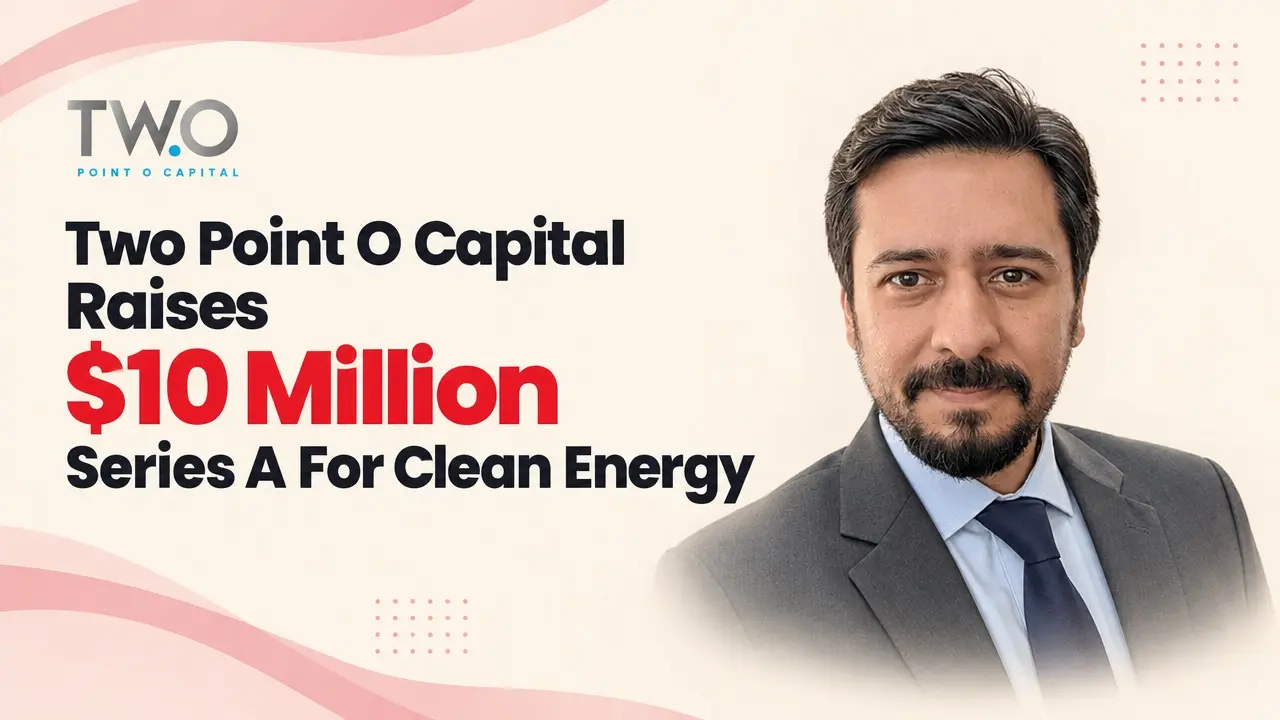

Two Point O Capital, a Mumbai-based platform that finances clean energy assets for factories and commercial buildings, has raised $10 million, or about Rs 95 crore, in a Series A led by Transition Venture Capital. Existing backer Omnivore returned, and angels Chiranjeev Singh Saluja and Sudhir M Reddy joined. The company announced the round on 2 November and did not disclose its valuation.
Most of the money will finance equipment for industrial customers, with the rest going to technology and hiring. Two Point O Capital works across rooftop solar, battery storage, energy efficiency upgrades and wastewater treatment. Lending sits inside a wholly owned non-banking finance company, while a separate entity writes leases and service contracts, so one client can be served through debt, rent or a turnkey build.
Read more on newzshort:
GreenCell Mobility Raises Rs 330 Crore From Impact Fund Denmark for Electric Bus Fleet
Why The Money Goes To Factories, Not Power Plants
India’s clean energy capital has concentrated in utility-scale parks, where a 500 MW tender is easy to finance. A 2 MW rooftop on a tyre plant, or a heat pump retrofit at a pharmaceutical unit, is a harder problem: small ticket, bespoke engineering, and a credit question that sits in the plant rather than on the balance sheet. Karan Bhutani, co-founder and chief executive, told Inc42 that capital was flowing into utility-scale projects but not enough was reaching distributed ones.
The company sizes that gap at $100 billion to $150 billion of annual demand, and Inc42 cites IMARC Group’s estimate that India’s clean technology market could reach $95 billion by 2034. Abhilash Sethi of Omnivore told Business Standard that India crossed 50 per cent non-fossil installed capacity in June 2025, five years early, yet this segment lags.
Read more on newzshort:
Kent RO Invests Rs 250 Crore In Lithium Battery Plant Near Noida
The Arithmetic Behind The Cheque
The $10 million is equity. Inc42 reported the 2024 round at more than $6 million in equity and debt, having earlier put it at $6.3 million, taking disclosed funding to about $16 million. No valuation was disclosed, so there is no public price signal on the book.
The company claims 25 to 30 large accounts, including Premier Energies, Godrej, JK Tyre, Morepen Pharma, Wipro and Phoenix Mills, and expects Rs 400 crore to Rs 500 crore of transactions from them over two to three years. At the midpoint each account is worth roughly Rs 15 crore to Rs 18 crore, which is the cross-sell thesis in one number: solar first, then storage, efficiency and water at the same site. Assets under management grew 1.5 times sequentially in each of the last three quarters, a compound 3.4 times, and the target is $75 million to $100 million in two years.
A Lender That Underwrites The Plant
A proprietary underwriting engine reads a project’s technical specifications, expected performance and the customer’s credit profile together, and the company says it returns a techno-commercial proposal within 24 to 48 hours. Deployed assets are connected and monitored, so performance data drives preventive maintenance. Installation crews are not on the payroll: equipment makers and construction partners execute under contract. That is a capital-light way to scale a book, and it is where the model earns its margin. Small tickets only work if processing costs approach zero, which is why the engine matters more than the balance sheet here.
What Could Go Wrong
Three risks stand out. A 1.5 times quarterly growth rate is impressive, but without an opening AUM nobody can tell whether the company is compounding from Rs 40 crore or Rs 400 crore, and the same silence covers collection efficiency. The book is concentrated in 25 to 30 accounts, so one stressed customer would surface fast. And execution risk has been transferred by contract, not removed: if a partner installs a system that underperforms, the customer calls the platform that sold the outcome.
What To Watch
Yashodhara Bakliwal, vice president of investment at Transition Venture Capital, said the platform complements the fund’s portfolio because its hardware companies can deploy faster through it. Whether that turns into orders is the first thing to watch. The second is the planned move into small and medium enterprises, which needs a field presence the company has avoided. The third is the cost of debt: an NBFC lending against distributed assets lives on its borrowing line, and no lender has been named.
The editorial read is that deployment is the easy half. What has been scarce is someone who will hold the credit risk on a Rs 3 crore solar system and still make a spread after funding costs and defaults. Two Point O has proved it can originate. The number that decides the next round is recovery, visible only after a full credit cycle.