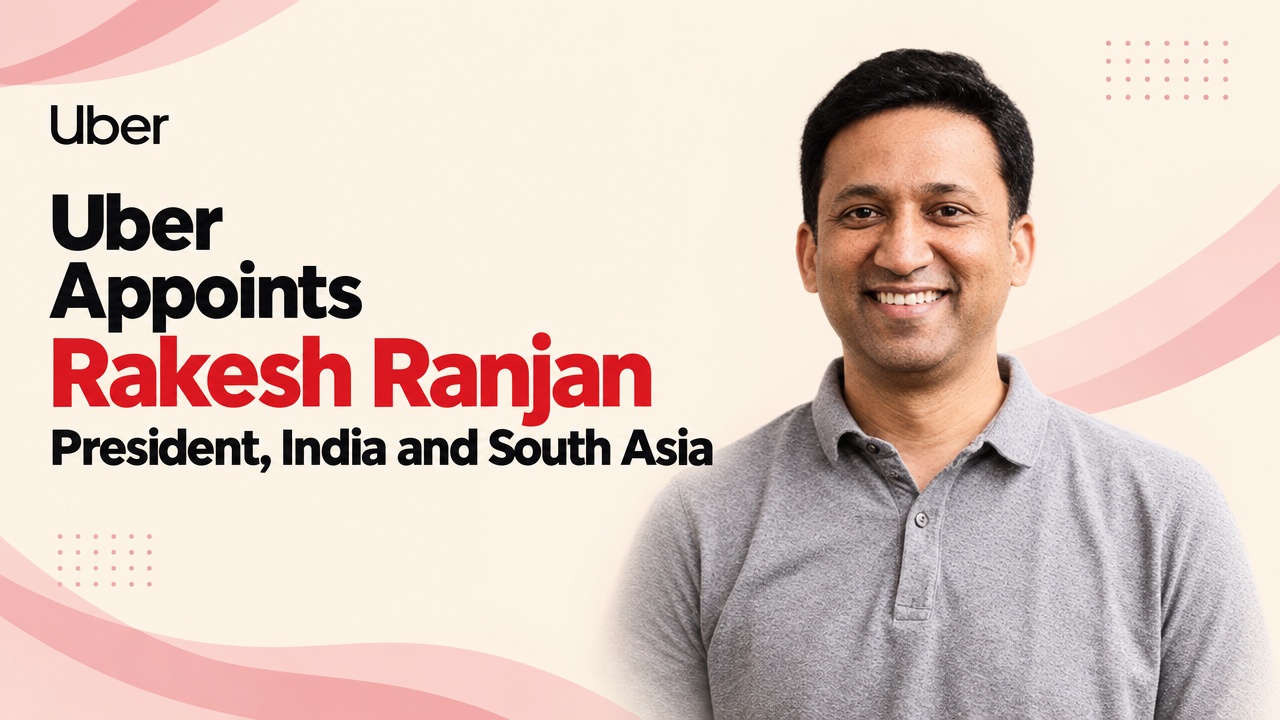

Uber said on Thursday that Rakesh Ranjan will become its president for India and South Asia on January 4, 2027, ending a search of more than five months at the company’s third-largest market by trips.
Ranjan is currently chief executive of Allen Online, the digital arm of Allen Career Institute. He will report to Dominic Taylor, Uber’s Asia-Pacific mobility head, according to The Economic Times, which said the company had spoken to several senior executives before settling on him. Reuters called the hire an outsider appointment.
Read more on newzshort:
Green SM Pours Rs 152.65 Crore More Into India EV Taxis
Ranjan spent eight years at Eternal, until recently called Zomato, joining in 2017 and rising to chief executive of its food ordering and delivery business. The career is a partial homecoming: Zomato bought Uber Eats’ India business in January 2020 in an all-stock deal that left Uber with roughly 10 per cent of Zomato, a stake it had sold by August 2022.
What Uber is buying is a marketplace operator. Food delivery and bike taxis both turn on supply density, incentive design and the cost of losing a driver to a rival app within a week. Ranjan ran that machine through Zomato’s hardest years, when it was fighting Swiggy for the same restaurants and riders.
Read more on newzshort:
Gig Workers Get National Social Security Board
A Five-Month Gap At The Top
The seat has been empty since Prabhjeet Singh announced his exit in late June after a decade at the company, six of them as India chief. Singh joined OpenAI in September as managing director for India, reporting to Asia-Pacific head Kiran Mani. Uber said at the time that it would outline a transition within weeks.
Uber did not pause. In August it added 100 cities in one expansion to reach 225, across 18 states and one union territory, led by Uber Bike because most Indian trips already run on two and three wheels. In November it began piloting Connected Journeys in Delhi, pairing metro legs with first and last-mile rides.
The Numbers Ranjan Inherits
The base looks better than the trend. Operating revenue rose 41 per cent to Rs 3,762 crore in FY24 from Rs 2,666 crore, and the loss narrowed 71 per cent to Rs 89 crore, filings sourced from Tofler showed. Ride-hailing contributed Rs 806 crore, up 19 per cent, while support services brought Rs 2,936 crore.
FY25 broke the run. Entrackr and BW Disrupt reported in February that the ride-hailing unit’s loss widened more than fourfold to Rs 1,407 crore on flat gross revenue, with driver incentives eating the topline. Uber responded by putting close to Rs 3,000 crore of fresh capital into the India arm, per Outlook Business.
Competitors explain the pressure. Ola Consumer’s operational revenue fell to Rs 2,368 crore in FY24 from Rs 3,000 crore, but Rapido grew 46 per cent to Rs 648 crore while cutting its loss to Rs 371 crore, then raised $240 million at a $3 billion valuation in May 2026. Outlook Business reported that Rapido has moved ahead of Uber in total rides.
Why India Carries So Much Weight
Uber calls India its third-largest market by trips after the United States and Brazil. The earners rank is murkier: Business Standard reported in August that India is Uber’s largest market by number of earners and in its report on this appointment put India second. Both are the company’s own figures.
Operating scale is not in doubt. Uber’s 2025 India report counted 11.6 billion kilometres of trips, 365 million of them electric, and more than 3,000 intercity routes. Metro ticketing inside Uber is live in five cities and has crossed 10 million rides booked through ONDC, where the company invested Rs 60 crore.
The Editorial View: A Delivery Operator For A Mobility War
Analysis: Indian ride-hailing has stopped being a cab business. Bikes and autos are short-hop, high-frequency, price-sensitive products that behave like delivery orders, and the playbook that wins them is supply density plus disciplined incentives, which is what Ranjan ran at Zomato. The risk is that he has never managed a regulated transport business, state fare caps or a driver base with its own social security board.
What To Watch
Three things will show whether the strategy changed. FY26 filings will reveal whether incentives cooled and the Rs 1,407 crore loss narrowed. The Connected Journeys rollout early next year will show how far Uber wants to be a public transport layer rather than a rival to it. And the JSW Group electric vehicle tie-up will test whether 365 million electric kilometres become a cost advantage or stay a marketing line.