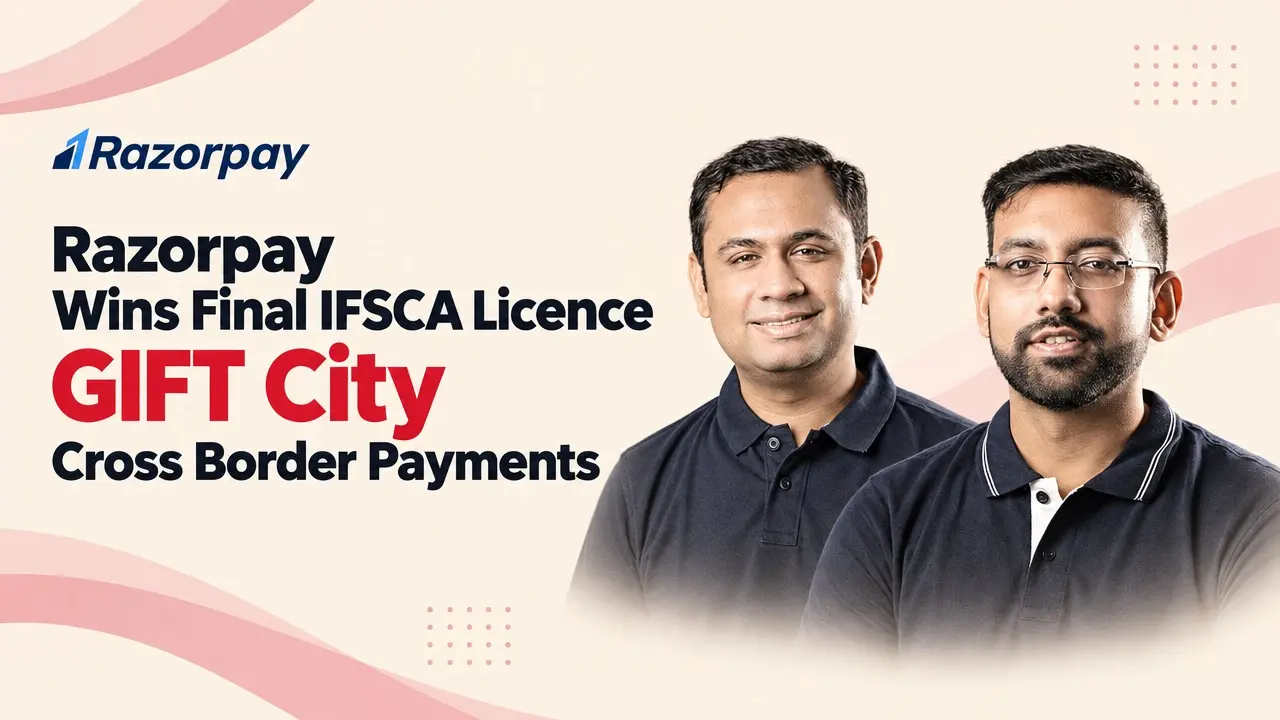

Razorpay has received the final Payment Service Provider licence from the International Financial Services Centres Authority, clearing the way for one of India’s largest payments platforms to move money in and out of the country from GIFT City in Gujarat. The authorisation, reported on 2 November, follows an in-principle approval granted in April 2026 and converts a conditional clearance into an operating permit.
The licence adds foreign currency transfers and multi-currency accounts to a cross-border business that until now ran on the RBI’s payment aggregator framework. Razorpay said the GIFT City stack is already integrated with RBL Bank and ICICI Bank, that investment platforms using it will go live shortly, and that more banks will follow.
Read more on newzshort:
UPI Processes Record 25.47 Billion Payments In October
What The Final Licence Allows
The IFSCA (Payment Services) Regulations, 2024, notified on 29 January 2024, let a licensed entity offer account issuance, e-money issuance, escrow, cross-border money transfer and merchant acquisition from the offshore centre. Approval runs in two stages: an in-principle clearance, then a Certificate of Authorisation once its conditions are met. Razorpay now holds the second.
The rules carry capital floors of their own. A regular provider needs a net worth of $100,000 at start and $200,000 by the end of its third financial year, while a significant provider needs $250,000 within 90 days of designation and $500,000 by the end of its third year. For a firm of this size the barrier is regulatory fitness rather than capital.
Read more on newzshort:
SEBI Clears IPO Papers Of Atomberg, 3 Others
Why A PSP Licence Is Different
What matters is what the money can be used for. In December 2025 Razorpay received the Payment Aggregator Cross Border licence from the Reserve Bank of India, which covers payments for exports and imports and lets businesses collect in more than 130 currencies. That permit is confined to current account trade in goods and services.
A resident buying shares or funds abroad is a capital account flow, and a PA-CB licence cannot touch it. The IFSCA permit covers both current and capital account transactions. Rahul Kothari, Razorpay’s chief operations officer, said the licence lets the company move money in foreign currency, hold it in multi-currency accounts and serve flows the domestic framework could not.
The Money Already Leaving India
The demand shows up in RBI’s own remittance data. Indian residents put $2.65 billion into overseas stocks and debt in FY26, up 56 per cent from a year earlier, even as total outflows under the Liberalised Remittance Scheme slipped about 2 per cent to $28.98 billion. Overseas education spending fell 20.9 per cent to $2.31 billion, while property purchases abroad rose 63.8 per cent to $528.7 million.
Equity and debt are now roughly 9 per cent of all LRS outflows, a share that is climbing while the overall pie contracts. Each resident can still remit up to $250,000 a year, and a 20 per cent tax collected at source applies above Rs 10 lakh, costs that both platforms and their customers weigh when picking a route.
A Decade Old Startup Nearing Its Listing
Founded in 2014 by Harshil Mathur and Shashank Kumar, Razorpay built its business on payment gateways, business banking and lending tools for merchants, with backing from GIC, Peak XV Partners, Tiger Global and Y Combinator. Its cross-border arm already counts Airbnb, Agoda, Klook, Hostinger and Shopify among users.
The licence also lands while the company prepares a public listing. Razorpay filed a confidential draft red herring prospectus with SEBI in June 2026, a route that lets a company test investor appetite before its numbers become public. A regulated cross-border rail is the kind of second engine a pre-listing story is built on.
Risks And What To Watch
The open questions are commercial rather than regulatory. GIFT City investment platforms still need a bank, a custodian and a broker in the chain, so the edge depends on how many partners the company can hold at once. Rival infrastructure is forming: Vested Finance’s GIFT City entity won PSP authorisation in July 2026, three months after a Global Access Provider licence.
Policy is the larger variable. LRS outflows are capped and closely watched, so any tightening of overseas investment limits would shrink the market this licence serves. Watch the first platform go-lives on the RBL and ICICI rails, how many more banks sign up, and whether the listing window opens before the cross-border business shows fee revenue at scale.