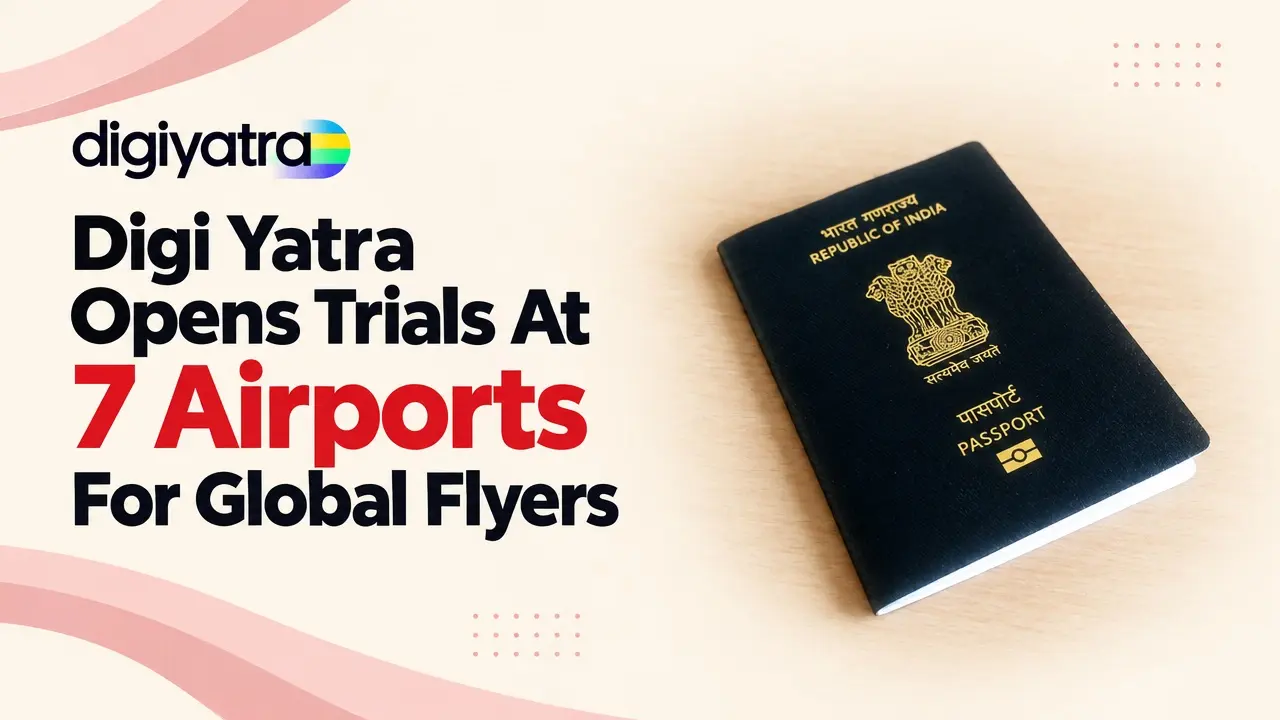

Digi Yatra has been opened to international passengers, with facial recognition trials running at seven airports from 1 November until the end of December. Only Indian nationals holding e-passports can use the service, and only while flying Air India or selected IndiGo international routes. The Digi Yatra Foundation said feedback from this quarter will shape a wider rollout planned for 2027.
The international version is narrower than the domestic one. A passenger must carry a chip enabled e-passport and travel on Air India to any international destination, or on IndiGo on routes the airline has enabled. Trials cover Delhi, Mumbai, Bengaluru, Hyderabad, Cochin, Chennai and Amritsar, where the airport operator has installed the cameras and gates the system needs.
Read more on newzshort:
X Money Lets Users Tip $1 By Long Pressing Like
How The E-Passport Credential Works
Enrolment happens entirely on the phone. The passenger scans the machine readable zone of the passport, holds the booklet against an NFC capable handset so the app can read the embedded chip, and takes a selfie. If the details match, the app issues a verifiable credential that is stored in a wallet on the device. No paper is printed and the credential is presented at the airport by face.
It works at terminal entry, inside security hold areas and at boarding gates, but only at touchpoints where the hardware exists. The ministry has been careful to say the trial does not replace immigration clearance or airline document checks. Passengers still carry their passports, complete immigration formalities and produce travel documents whenever an airline or security officer asks.
Read more on newzshort:
Apple iPhone Duo Sells Out As Retailers Charge Rs 1 Lakh Premium
The Scale Digi Yatra Already Has
The foundation says the platform has 2.65 crore users and has carried more than 11 crore journeys, across 39 domestic airports and 11 airlines. Average adoption at an enabled airport is about 30 per cent. Another 25 domestic airports are to be added by 2027, and an app that runs in 11 regional languages is to cover all 22 scheduled languages by then.
Why International Travel Is Harder
Domestic flying needs an identity check. International flying needs a travel document check, and the two are built on different trust. The e-passport credential draws on the chip inside the booklet, which is where the technical difficulty sits. Foundation chief executive Suresh Khadakbhavi said interoperability with IATA One ID and ICAO’s Public Key Directory will decide how far a phone held credential can travel. Foreign acceptance is not automatic.
The programme was launched on 1 December 2022 at Bengaluru, Varanasi and Delhi, and has since become the identity layer at the country’s busiest terminals. It is run by the Digi Yatra Foundation, a not for profit company owned by the Airports Authority of India with 26 per cent, and by five private airport operators holding 14.8 per cent each. Every expansion until now stayed inside domestic terminals.
Privacy, Consent And The Rollout Test
The app has been rebuilt alongside the trial, with a cleaner credential wallet, a boarding pass colour coded by airline, clearer markers for guardian and minor credentials, and a redesigned consent screen that spells out what is shared, with whom and for what purpose. That last change carries more weight than the interface. Consent is the legal basis for the system under India’s data protection law, and a screen a passenger cannot read is not consent.
The editorial read is that the camera has not been the constraint for four years. At roughly 30 per cent adoption, most passengers still queue at counters. An international trial that adds a step for a minority of flyers will be judged on whether it removes work or simply opens a parallel lane. The number worth watching is dwell time at the three touchpoints, not enrolment counts.
Three questions stay open. E-passport penetration sets the size of the eligible pool, and the trial leans on one full service carrier plus selected IndiGo routes. Airport hardware decides where the credential works at all. Accountability is also unusual for a public facing system, because the foundation is a private company and not answerable to Right to Information requests, which leaves the consent design carrying the privacy burden.
What To Watch Before 2027
The December feedback round is the first real test of whether a passport based credential survives an international terminal. Watch the 2027 airport list, the language target and whether any foreign aviation authority accepts the credential at its own border. The published list for the Digi Yatra programme is the simplest way to see whether a trial becomes permanent.