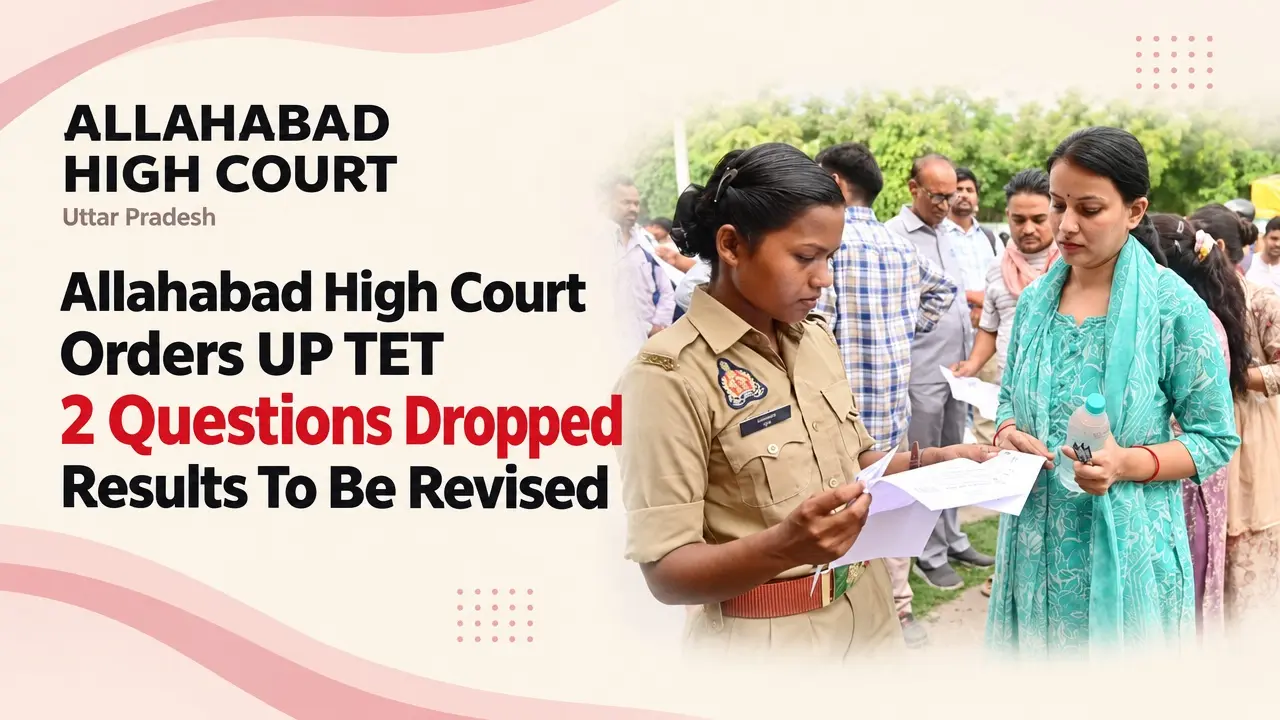

The Allahabad High Court has ordered the Uttar Pradesh Education Service Selection Commission to drop two disputed questions from the 2026 primary level Teacher Eligibility Test, recalculate marks on the remaining 148 and issue revised results and scorecards. The order, passed on 30 October, reopens an August result for candidates who missed the cutoff by a fraction of a mark.
Justice Vinod Diwakar passed the order on a petition by Vijay Sonkar and three other candidates. The court held that Master Set questions 36 and 37 had stopped working as test items, because the final answer key accepted two options as correct for each and the paper could no longer separate a qualified candidate from an unqualified one.
Read more on newzshort:
7 Lakh Applications For 12,405 UP Teacher Posts
What The High Court Ordered
The commission gave marks on those two questions only to candidates who picked one of the two options it accepted, leaving everyone who chose either remaining option with nothing. The court found no legal basis for that, noting that question 38 of the same paper had already been dropped, so there was no reason to treat 36 and 37 differently.
The exam was held on 3 July 2026 and results came on 26 August. The petitioners scored between 80 and 81.39 against a general and OBC cutoff of 82, short by 0.61 to two marks. Their case: if the commission could not decide which option was right, no candidate should be penalised for the ambiguity.
Read more on newzshort:
UP TGT Recruitment 2026: 17,735 Posts Open
Why Two Questions Cost Marks
In a four option objective test, a question with two official answers cannot discriminate. A candidate who marked a rejected option loses a mark never fairly available, while one who picked an accepted option keeps it. Removing the question for the whole cohort, instead of awarding marks to some, is the neutral remedy, and the court extended the benefit to every similarly placed candidate in line with earlier Supreme Court rulings.
The paper now counts as 148 questions. Marks are to be recalculated on that base, the qualifying threshold derived from the prescribed percentage, and the commission must correct the result and scorecard of the petitioners. The order is on the Allahabad High Court website, but the commission has not said when revised scorecards will appear.
The Numbers Behind The Order
About 20 lakh candidates registered for the two levels of UP TET 2026, according to India Today and The New Indian Express. When results came on 26 August, more than 13.3 lakh qualified: 5.71 lakh at primary level and 7.59 lakh at upper primary, The Indian Express reported. The primary pass rate was roughly 80 per cent.
The same result left about 62,000 serving teachers below the line. The state has scheduled a special TET on 3 November at 131 centres across six divisional headquarters: Agra, Gorakhpur, Lucknow, Meerut, Prayagraj and Varanasi. The Basic Education Department has ordered one day of special leave for serving teachers and special educators appearing in it.
A Second TET And A Deadline
A separate appeal by Wasim Ahmed came before a division bench of Justice Saumitra Dayal Singh and Justice Swaroopma Chaturvedi, which asked the commission to file an affidavit on its plan for a second TET in 2026 and a calendar for the next two years. It is listed for 2 November. The Supreme Court requires at least one TET a year, preferably two, with an outer deadline of 31 August 2028.
This reaches beyond four petitioners because Uttar Pradesh is hiring teachers at a scale no other state matches. The current TGT recruitment covers 17,735 posts, and the assistant teacher vacancy drew more than 7 lakh applications for 12,405 posts, so a shift of one mark changes the eligible pool in a cycle spanning lakhs of candidates. The TET is only an eligibility test, not a job offer.
What Candidates Should Watch
Analysis: the order is narrower than it looks. It does not lower the qualifying percentage or hand a pass to everyone who missed the cutoff. It deletes two questions from the denominator for the whole cohort, which helps those who lost marks on them and leaves candidates who answered an accepted option roughly where they were. The commission has not disclosed how many candidates sit between 80 and 82, so the size of the revision cannot be estimated from outside.
Candidates in that band should treat the order as a reason to check, not celebrate. The revised scorecard, once on the commission’s portal, is the only proof of a changed result, and the 2 November hearing will decide how quickly the next cycle opens. Till then, the August result stands for everyone outside the disputed questions.