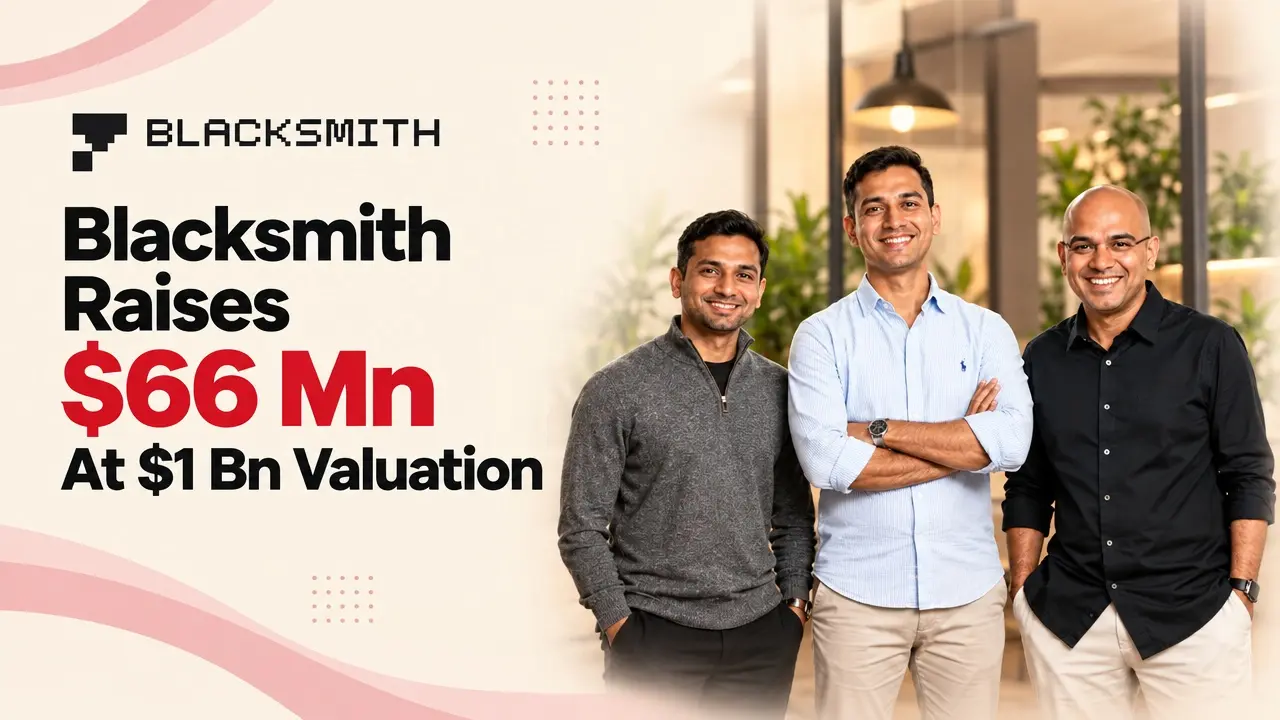

AI coding tools have made writing software cheap. Testing it has not become cheaper, and that gap is now worth a billion dollars. Blacksmith, a Bengaluru and San Francisco based startup that runs testing infrastructure for engineering teams, has raised $66 million in a Series C round led by Sequoia Capital at a valuation of $1 billion, roughly seven months after it was valued at $550 million.
The round, the new investor and the seven month jump
Premji Invest joined as a new investor in this round. Existing backers Peak XV Partners, GV and Y Combinator also participated, taking Blacksmith’s total funding to about $125 million. The previous $45 million Series B, led by Peak XV, was signed in March 2026 and announced in August at a $550 million valuation. Doubling the valuation in under three quarters is unusual for a company selling boring infrastructure, and it tells you where investors think the money in AI tooling will actually be made.
Read more on newzshort:
Karta AI Raises $3 Million Seed Round To Automate Complex BFSI Calls
What Blacksmith actually sells
Every code change in a modern engineering team runs through continuous integration, the automated step that builds the project and runs the test suite before the change is merged. Most teams rent cloud machines for this, configure them, scale them and pay by the minute. Blacksmith sells a managed version of that layer: the company says its platform completes CI jobs twice as fast at roughly 60% lower cost, because machines are kept warm and scheduled more efficiently than a team would manage on its own. More than 10,000 companies use it, including Ashby, Granola, Handshake and LangChain. The product and the customer list are published on the official Blacksmith site.
The volume numbers explain the urgency
In January 2026, Blacksmith processed about five million CI jobs a week. It now handles more than 90 million a week, an 18-fold increase in nine months. Annual recurring revenue grew 17 times over the same period, though the company has not disclosed the absolute figure. The driver is simple arithmetic. A developer who once opened three or four pull requests a day can now generate dozens with an AI coding agent, and every one of those changes still needs to build and pass tests before it reaches production.
Read more on newzshort:
Shamrock AI Raises $5 Million Seed Round Led By Endiya Partners
Founders, customers and the compute bill
Blacksmith was founded in 2024 by Aditya Jayaprakash, Aayush Shah and Aditya Maru, who met at the University of Waterloo. Shah and Maru were engineers at Cockroach Labs, a database company where distributed systems work is the day job, and that background is the pitch: this is a scheduling and hardware problem, not a dashboard problem. The customer proof is specific rather than decorative. Joaquin Borggio, an infrastructure engineer at LangChain, said Blacksmith cut the company’s runner costs by about 40%, a figure that excludes the engineering time saved.
Why the business is harder than it looks
Testing infrastructure is not an asset light software business. Blacksmith already manages close to 10 megawatts of computing capacity across data centres in the United States and Europe, and plans to expand that at least fivefold in 2027. Compute is bought up front, so margins depend on keeping utilisation high as capacity grows. If demand softens, the fixed cost does not move with it. Competition is the second risk: GitHub Actions, Buildkite and a cluster of newer CI vendors chase the same workloads, and the large cloud providers can bundle testing capacity into existing contracts in a way a standalone vendor cannot match on price alone.
What to watch before the valuation is proven
Three numbers will decide whether $1 billion holds. The first is absolute annual recurring revenue, which would turn a 17-fold multiple into a growth rate that can be judged against the price paid. The second is gross margin as compute capacity grows fivefold, because a managed infrastructure business that cannot hold margin at scale is a services company with software branding. The third is customer mix. A platform that grew on AI native startups has to prove it can win large enterprise engineering teams, where procurement cycles are long but contracts are sticky.