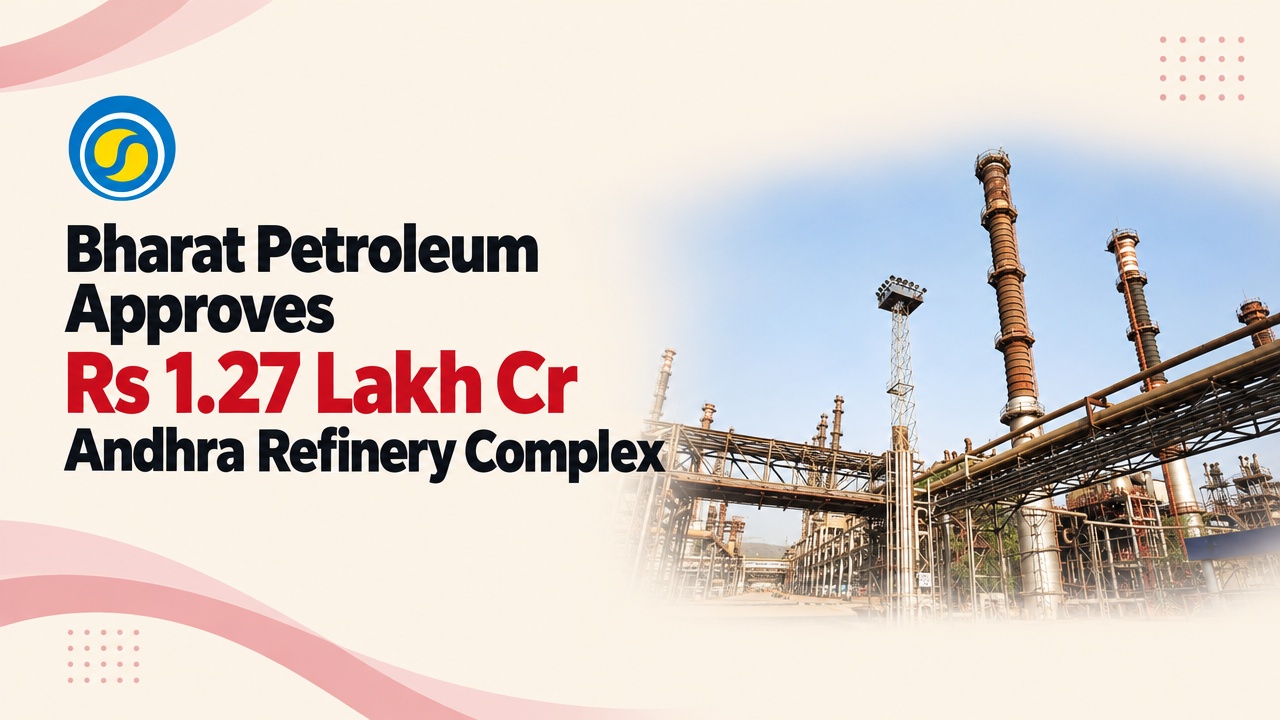

Bharat Petroleum Corporation Ltd will build its fourth refinery. Its board on Saturday approved a greenfield refinery and petrochemical complex at Ramayapatnam in Andhra Pradesh, at an estimated gross capital expenditure of Rs 1,26,656 crore. The project will run through a wholly owned subsidiary, and BPCL has set July 2032 as the target for scheduled commercial operations, according to its stock exchange filing.
The complex pairs a 9 million tonnes per annum refinery with a 1.5 MMTPA mixed-feed ethylene cracker and downstream petrochemical units, taking total processing throughput to 10.5 MMTPA. BPCL puts petrochemical intensity at about 34 per cent, which means roughly a third of the barrel is converted into chemicals rather than fuels. That ratio decides whether the project earns its cost of capital.
Read more on newzshort:
Mahanadi Coalfields Lists At A 1.5% Discount
The Arithmetic Inside The Rs 1.27 Lakh Crore Bill
The filing carries a caveat that most headlines dropped. The figure is a gross estimate with a 20 per cent tolerance in either direction, so the final bill could land anywhere between about Rs 1.01 lakh crore and Rs 1.52 lakh crore. Across 10.5 MMTPA of throughput, the midpoint works out to roughly Rs 12,062 crore of capital per million tonnes of annual capacity.
The board also cleared an equity infusion of up to Rs 44,330 crore into the subsidiary, to be released in one or more tranches. That number includes Rs 4,900 crore approved earlier and disclosed in the company’s 23 October 2026 intimation. If the full amount is drawn, equity funds about 35 per cent of the project and lenders carry the remaining Rs 82,326 crore.
Read more on newzshort:
Ultraviolette Breaks Ground On Rs 779 Crore Hosur EV Factory
A Refiner Already Running At 116 Per Cent
The justification sits in BPCL’s own operating numbers. Its three refineries at Mumbai, Kochi and Bina give it 35.3 MMTPA of capacity, and in 2025-26 that capacity ran at 116.6 per cent utilisation. Ramayapatnam adds 9 MMTPA of crude processing, a quarter more than the present base, the clearest admission that the current footprint cannot keep pace with fuel demand.
The petrochemical half serves a different gap. India meets a significant part of its polymer requirement through imports, and the filing frames the project as a route to cut that dependence while lifting value realisation through integration. Refiners earn thin, cyclical margins on transport fuels. Chemicals are the slice of the barrel that can carry a premium through a downturn.
A Two Year Paper Trail Ends In A Boardroom Vote
Saturday’s approval is the last step in a long sequence rather than a surprise. BPCL first intimated the plan on 24 December 2024 and followed up on 28 October 2025. The subsidiary was set up in October 2026 alongside the initial Rs 4,900 crore equity commitment. Environmental clearance won a recommendation in early October, and press reports in November said coastal and environmental approvals were in hand.
The cost has travelled over that period. PTI reported on Saturday that the latest figure is more than 26 per cent higher than the original estimate, which places the first number near Rs 1 lakh crore. Little of this money has been committed yet. The project still needs approval from the Cabinet Committee on Economic Affairs and other statutory clearances before execution begins.
The Risks And Open Questions
Three things can move the number again. The 20 per cent tolerance is a construction estimate, not a cap, and Indian greenfield process plants have a long record of overruns. Crude is climbing again, with Brent forecast to test $100, which squeezes refining margins exactly when BPCL is committing capital at this scale. And 2032 is a long runway for a first-of-its-kind site.
Analysis: the funding structure is the reassuring part. A 35 per cent promoter contribution, released in tranches, is more conservative than the debt-heavy model that strained several state refiners a decade ago. The unresolved bet is the chemical yield, because a 34 per cent polymer slate only pays off if Asian demand holds through 2032.
What To Watch
The CCEA reference is the next dated event and BPCL has not said when it will be filed. Financial closure and the award of the main process units follow. Watch the subsidiary’s paid-up capital, the size of the first equity tranche and any revision to the 20 per cent estimate. Bharat Petroleum has to disclose each of those markers to the exchanges as they land.
For Andhra Pradesh it is the biggest industrial commitment at Ramayapatnam, a port town in Nellore district that has waited years for an anchor investor. For BPCL, it is the difference between buying polymers from someone else and selling them. Both sides now wait on a cabinet committee, and neither has a date for it.