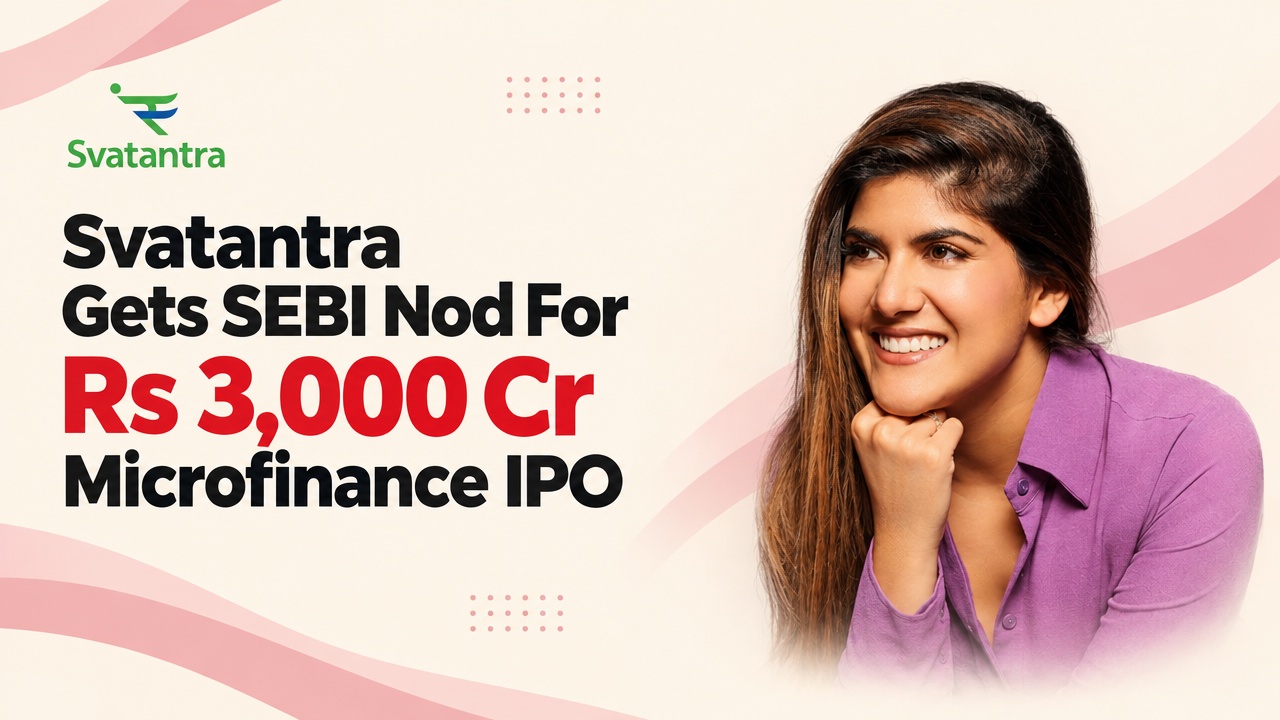

Sebi has cleared Svatantra Microfin’s Rs 3,000 crore initial public offering, with observations issued on 27 November opening the way for India’s second-largest microfinance lender to sell shares. Chaired by Ananya Birla, the company filed its draft red herring prospectus in August, and the regulator’s observation is the last clearance before a launch date is fixed.
The issue is split equally. Svatantra will sell fresh shares worth up to Rs 1,500 crore, and existing shareholders another Rs 1,500 crore through an offer for sale. The stock lists on the BSE and NSE, with Axis Capital, Avendus, IIFL Capital, Kotak Mahindra Capital and SBI Capital Markets managing the sale.
Read more on newzshort:
Mahanadi Coalfields Lists At A 1.5% Discount
Only the fresh issue brings money into the lender. Those proceeds go to Tier I capital, the equity cushion that decides how much a lender can advance before it must raise again. For a company growing its book above 20 per cent a year, that is the binding constraint.
The offer for sale is the exit existing investors have waited for. Advent International’s affiliate Violicina holds 28.02 per cent, Multiples 11.45 per cent through three funds, Ananya Birla 26.48 per cent directly and her firm Antimatter Media another 33.49 per cent. Advent and Multiples plan to sell about 70 per cent of their holdings.
Read more on newzshort:
SEBI Tells Market Players To Stop Quoting IPO GMP
The Numbers Inside India’s Second Largest Microfinance Book
The draft papers show a lender growing through a hard cycle. Microfinance assets under management rose from Rs 14,437.87 crore in March 2024 to Rs 21,093.22 crore two years later, a compound annual growth rate of 20.87 per cent. Its share of industry microfinance AUM nearly doubled to 6.37 per cent, behind only CreditAccess Grameen’s Rs 30,319 crore.
Profit followed the book. Net profit for the year ended 31 March 2026 was Rs 649 crore, up 45.8 per cent, on revenue from operations of Rs 4,121 crore. Return on average assets reached 3.57 per cent and return on equity 15.00 per cent, both higher than a year earlier.
Asset quality is the strongest part of the pitch. Gross stage 3 loans, the RBI’s label for the weakest-rated book, fell to 1.19 per cent at the end of FY26 from 2.24 per cent a year earlier, which the company says was the lowest among peers in both years.
The branch network is the distribution moat: 2,123 branches across 20 states and 394 districts, 24,594 employees including 15,575 field officers, and 4.27 million borrowers at 31 March 2026. No district holds above 2.74 per cent of microfinance AUM and no state above 23.02 per cent.
From A 2012 Startup To A Rs 22,000 Crore Lender
Ananya Birla incorporated Svatantra Microfin in February 2012 and the lender received its NBFC-MFI licence the next year, describing itself as the first company granted that category. Lending began in March 2013 through joint liability groups, where women borrowers guarantee one another and loans are disbursed cashless.
Growth came through acquisitions. Svatantra bought Micro Housing Finance Corporation for about Rs 300 crore in 2018. It acquired Chaitanya India Fin Credit from Sachin Bansal’s Navi Group for about Rs 1,480 crore in 2023, and completed the amalgamation on 21 March 2026, taking consolidated assets under management to roughly Rs 22,000 crore.
Private equity arrived in March 2024, when Advent International and Multiples invested Rs 1,930 crore for a minority stake. That deal set the valuation benchmark the IPO now has to defend in public markets, after the sector’s credit cycle had already turned.
Why This Issue Is A Test For Microfinance
Microfinance listings remain rare: only five NBFC-MFIs trade publicly. The editorial read: this is a growth story sold into a nervous sector, where Svatantra’s bad loans fell while the industry absorbed higher credit costs, and half the issue is an exit for Advent and Multiples, so buyers partly fund a private equity harvest.
Valuation decides the argument. CreditAccess Grameen is the sector’s benchmark, with a book about 1.4 times Svatantra’s. A discount to its multiple would let the issue absorb the sector’s caution. Parity, for a company with no listed record, would be harder to justify.
What To Watch Before The Issue Opens
Three things to track: the price band against CreditAccess Grameen’s multiple, the institutions in the anchor book, and whether Advent and Multiples actually sell the 70 per cent they indicated. No launch dates have been announced.
A Sebi observation is a clearance, not a listing. Svatantra still has to pick its moment, price the book and hold the issue through three days of bidding. After fourteen years building India’s second-largest microfinance franchise, the public market is the last test of whether that scale deserves a premium.