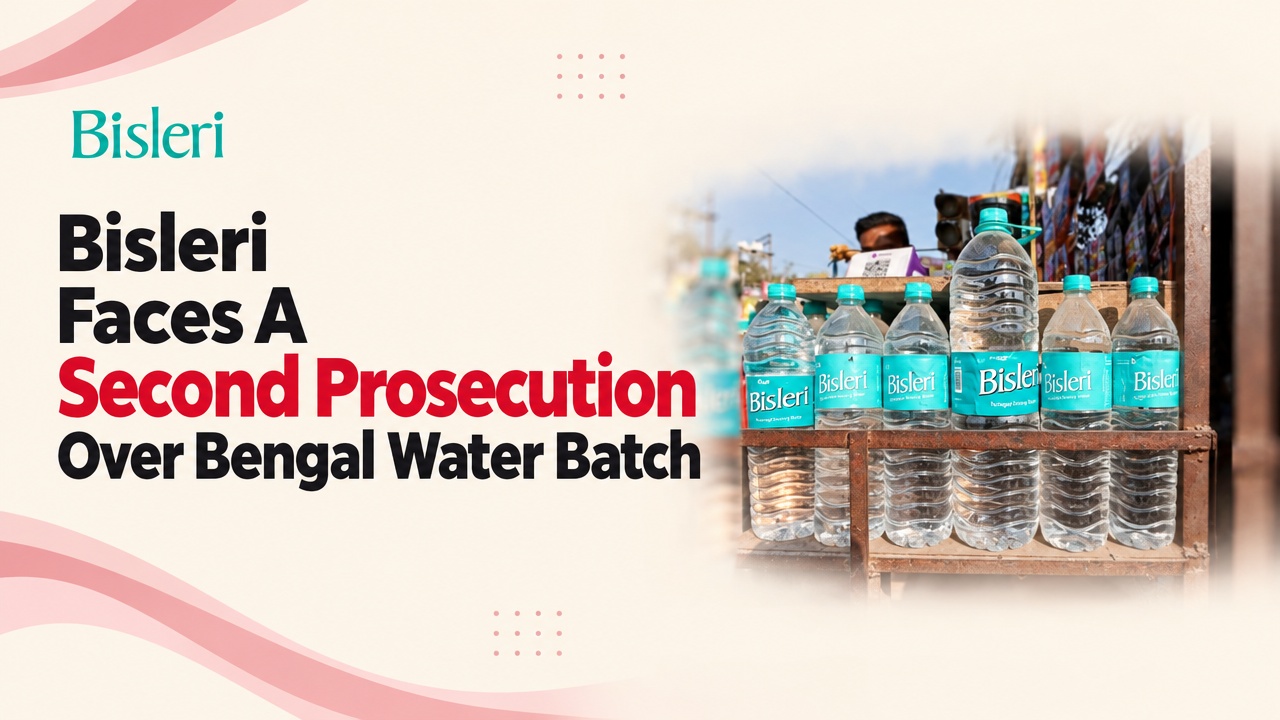

India’s food safety regulator has sanctioned a second prosecution against Bisleri International, this time over a packaged water sample from its plant in Telipara village in Jalpaiguri district, West Bengal. The sample, batch PB 201, was found to contain coliform bacteria at both the primary laboratory and the referral laboratory, according to the notice that authorised the action. FSSAI prohibited its sale on 12 August 2026.
The file became public on Saturday, when Reuters reported the August notice and the subsequent prosecution sanction. The regulator’s notice described the sample as non-conforming and unsafe, and said the confirmatory retest returned the same result. The action sits under the Food Safety and Standards Act, 2006, the law that governs packaged water, labelling and manufacturing standards in India.
Read more on newzshort:
Bisleri Says One Batch As FSSAI Widens Testing
Bisleri’s answer came the same afternoon, and it was direct. The company said it had recalled batch PB 201 in August on the regulator’s direction, and that samples from the same batch tested at two FSSAI-recognised independent laboratories met the standards for coliform and every other parameter. It asked the regulator to examine its sampling process, its testing methodology and its laboratory findings.
That request is the crux. A regulatory sample is drawn by an officer, split, sealed and sent to a notified laboratory, and the result binds the manufacturer. Two later readings from the same batch cannot cancel it. What they can do is question how the sample was handled before it reached the lab, which is what Bisleri wants FSSAI to examine.
Read more on newzshort:
Maharashtra FDA Suspends 43 More Food Licences
Two Cases, Two Contaminants
The West Bengal file is the second front in a week. On 22 November, FSSAI cleared prosecution over a sample from Bisleri’s Goa factory, where one of six samples carried bromate at 12 micrograms per litre against a limit of 10. A referral laboratory later found bromate within the limit but flagged polycyclic aromatic hydrocarbons instead.
The two matters differ in more than geography. Bromate is a disinfection by-product, formed when ozone reacts with bromide already present in the source water, and its reading sat at the edge of the limit. Coliform is a hygiene indicator, and its presence in a sealed bottle points to a failure somewhere between treatment and filling.
The Numbers Behind India’s Water Leader
Bisleri is the country’s largest packaged water brand in a market Reuters values at about $3.5 billion, competing with PepsiCo, Coca-Cola, Tata Consumer Products and Reliance Consumer Products. Its network runs to 130 operational plants, 5,980 distributors and 8,270 trucks, per the company’s own account, while its statement on the Goa file referred to 143 manufacturing plants.
Pricing built that reach. A one litre bottle retails at roughly Rs 20, cheap enough for a shop counter and a railway platform, so volume rather than margin carries the business. That is why a finding on a single batch matters far beyond the value of that batch.
From Thums Up To A Rs 7,000 Crore Near Miss
The company has survived bigger turns. Bisleri water reached India in 1966 through Cesari Rossi and Khushroo Suntook, and the Chauhan family of the Parle group bought the struggling brand in 1969 for Rs 4 lakh. Ramesh Chauhan later sold Thums Up, Limca and Gold Spot to Coca-Cola in 1993 and kept the water business.
In 2022 and 2023, Tata Consumer Products negotiated to buy the company in a deal reported at about Rs 7,000 crore, then walked away. Ramesh Chauhan said the family did not want to sell, and Jayanti Chauhan took charge alongside a professional team led by Angelo George. Bisleri International was incorporated in 2001.
What The Conflicting Results Mean
Analysis: the regulatory system rests on the premise that a notified laboratory’s result is final, and it should, because no brand can retest its way out of an adverse finding. The same premise makes sampling quality decisive, and FSSAI has not published chain-of-custody details for either sample. A published referee protocol would settle these disputes faster than any press statement.
The wider context is a regulator in enforcement mode. FSSAI has written to state food commissioners to intensify inspections and risk-based sampling and to record findings on its FoSCoS platform. Chief executive Rajit Punhani has said a nationwide sampling exercise across packaged water brands will be completed in one to two months.
What To Watch
Three things matter now: whether FSSAI publishes its own test reports, whether more states draw Bisleri samples, and whether the national survey pulls in rival brands. Punhani has said the exercise is meant to strengthen compliance rather than alarm consumers, and that it will extend to packaging materials. The answers will decide whether this is a Bisleri problem or a category problem.