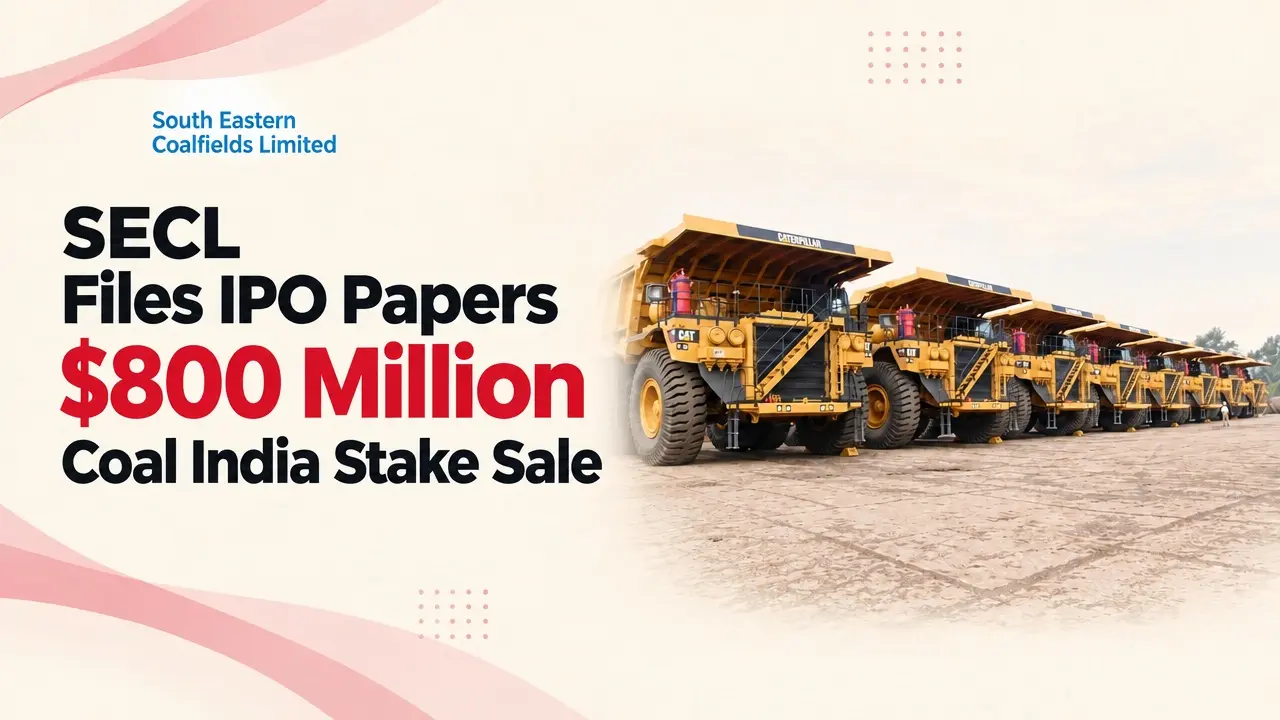

Coal India filed draft papers with the market regulator on Monday for the initial public offering of South Eastern Coalfields, the arm that produced 16.94 per cent of India’s coal last financial year. The offer of 668.1 million shares is entirely a sale by the parent, and people familiar with the filing told Business Standard it could raise about $800 million.
The draft red herring prospectus is dated November 1 and was lodged with SEBI, the BSE and the NSE. Coal India owns SECL’s full paid up capital of 668.06 crore shares, and the 66.81 crore shares on offer are 10 per cent of that equity, so the parent’s holding falls to 90 per cent. SBI Capital Markets, ICICI Securities, IDBI Capital Markets and Motilal Oswal Investment Advisors are the lead managers.
Read more on newzshort:
Carlsberg India Files Public IPO Papers For 86.42 Million Shares
The Numbers Behind The Offer
SECL reported revenue from operations of Rs 32,956.52 crore for the year to March 2026 and a profit after tax of Rs 4,754.59 crore, with operating EBITDA of Rs 7,423.77 crore. That is an operating margin of 22.5 per cent and a net margin of 14.4 per cent, respectable for a business that sells most of its output to power utilities.
The company mined 176.29 million tonnes in FY26, up 5.25 per cent from 167.49 million tonnes and the fastest growth among Coal India subsidiaries. Three opencast mines in the Korba coalfield, Gevra, Dipka and Kusmunda, produced about 126 million tonnes, or 71.48 per cent of the total, against a combined clearance of 172.5 million tonnes a year.
Read more on newzshort:
SEBI Clears IPO Papers Of Atomberg, 3 Others
What $800 Million Implies
At roughly Rs 88 to the dollar, $800 million is about Rs 7,040 crore, which values all of SECL near Rs 70,400 crore and puts the 66.81 crore shares at about Rs 105 each against a face value of Rs 2. Measured against FY26 profit, that is a trailing multiple of 14.8 times. The size is unofficial, so the price band will be the first hard number investors get.
A Programme, Not A One Off
SECL is the fourth Coal India arm to head for the market in a year. The board cleared sales of up to 25 per cent in SECL and Mahanadi Coalfields in March. Bharat Coking Coal listed in January after a 10 per cent offer subscribed 147 times and now trades about 25 per cent below its debut price, while CMPDI, listed on March 30 after a 15 per cent sale, is up 39 per cent. Mahanadi filed its own draft papers in September.
Chairman B Sairam said in August that both coal arms would list this financial year, subject to market conditions and government direction. Coal India has reason to want the cash. It is funding mine infrastructure, first mile evacuation and a push into critical minerals and coal gasification, and selling group equity pays for that without loading debt onto the subsidiary.
Where The Risk Sits
The demand backdrop is strong. Coal India supplied a record 70.3 million tonnes in October, 19 per cent more than a year earlier, and produced 67.2 million tonnes, while coal imports fell 5.83 per cent to 104.57 million tonnes in August. A listed SECL gives public investors direct exposure to that import substitution story.
Concentration is the first thing a buyer should price. More than 71 per cent of output comes from three pits in one coalfield, and audited reserves of 4.61 billion tonnes support about 26 years at current volumes, against roughly 45 years at Mahanadi. Coal India’s one billion tonne roadmap asks SECL for 245 million tonnes by FY30, about 39 per cent above FY26, which needs new mines, wider clearances and evacuation that keeps pace.
What To Watch
Watch three things: the price band and the multiple it implies, how long SEBI takes to clear the papers, and the price Mahanadi draws if it reaches the market first. Anchor demand will be read as a verdict on coal itself, because the Bharat Coking Coal drawdown shows how fast the street can re-rate a listed miner.
The editorial read is that this is a monetisation exercise presented as a growth story. SECL receives nothing from the offer, since every rupee accrues to the parent. Minority holders get a coal price and dividend proposition with no fresh capital to extend a 26 year reserve life, so terminal value is the whole case and the price band has to answer for it.