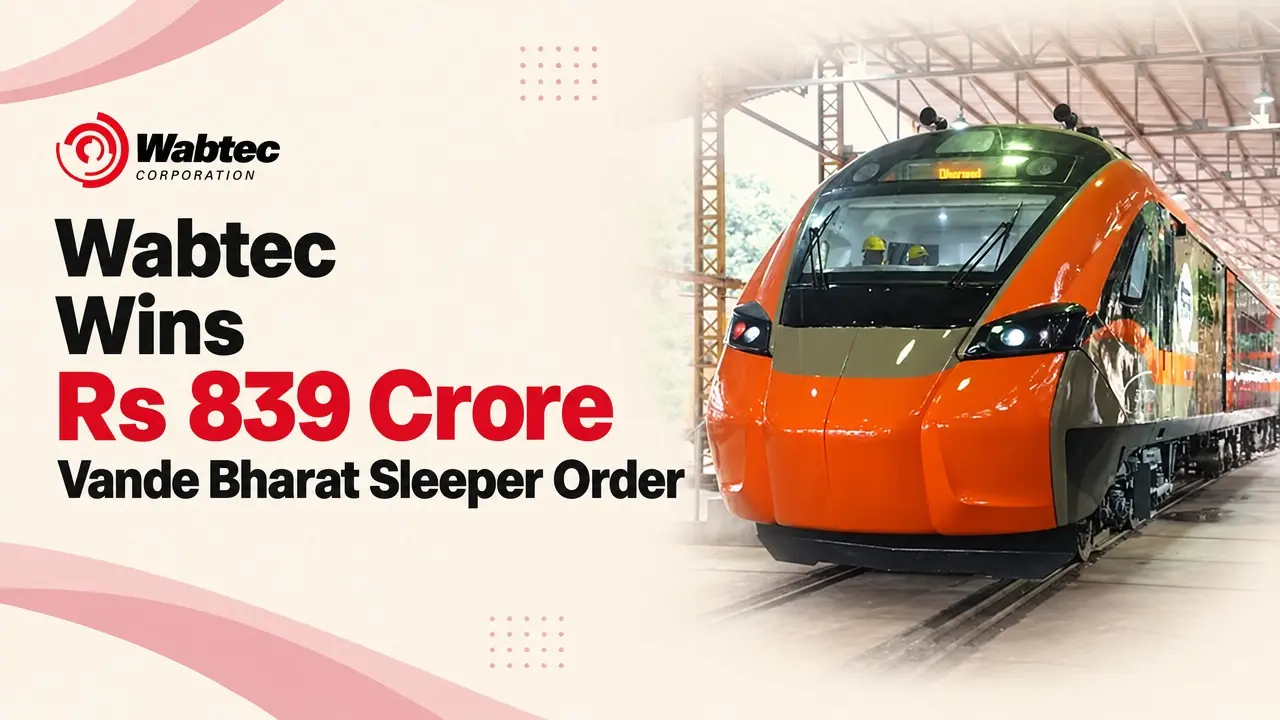

Wabtec Corporation has won orders worth about $94 million, or Rs 839 crore, from Indian Railways to supply onboard systems for the Vande Bharat Sleeper programme, the Pittsburgh-based rail equipment maker said on Tuesday, 27 October 2026. The packages cover brake systems, doors and gangway solutions for the long-distance sleeper fleet.
The scope runs past hardware. Wabtec will handle system delivery, integration with the coach design, testing, commissioning and long-term reliability support, according to the company’s announcement. Pascal Schweitzer, president of Wabtec Transit, said the orders reinforce the company’s commitment to Indian Railways modernisation and reflect its local manufacturing base.
Read more on newzshort:
L&T Tech Wins Five-Year Nokia R&D Deal In India
The coaches come from the Integral Coach Factory in Chennai, which is building 50 Vande Bharat Sleeper trainsets of 24 coaches each. The programme has already moved from prototype to service: the first sleeper service began on 17 January 2026, and a second one, between Mumbai and Bengaluru, starts on 1 November, The Economic Times reported.
Split the order and the unit economics become clearer. At Rs 839 crore across 50 trainsets, Wabtec’s systems work out to roughly Rs 16.8 crore per 24 coach set, or about Rs 70 lakh per coach across 1,200 coaches. That is the money for brakes, doors and gangways alone, before the coach shell, bogies, berths and pantry.
Read more on newzshort:
Kent RO Invests Rs 250 Crore In Lithium Battery Plant Near Noida
Why Brakes And Doors Carry A Long Tail
Rolling stock contracts get the headlines, but subsystem orders carry a different kind of value. Brake, door and gangway systems sit on the maintenance critical path for the life of a rake, which gives the supplier a stream of spares, overhaul and reliability work long after delivery. Wabtec listed long-term operational reliability support in its own scope of work.
The company estimates localisation of 80 to 90 per cent across its product portfolio in India. If that holds for these packages, most of the Rs 839 crore is spent inside the country rather than imported, which matters for a programme the government presents as a domestic manufacturing showcase.
India As An Export Base, Not Only A Market
Schweitzer said Wabtec is building India into a global centre of excellence for manufacturing and engineering, with components exported to Europe and the United States. He described a two-way strategy: supply Indian Railways, metro operators and private operators with localised technology for projects such as Vande Bharat Sleeper and Chennai Metro Phase 2, then use the same capacity for exports.
The company also plans to compete for upcoming high-speed rail corridors, leaning on its work with SNCF in France, Deutsche Bahn in Germany, Trenitalia in Italy, the UK network and China. That puts it against Siemens, Alstom and the Indian consortia that have won coach orders.
The Wabtec Backstory
Wabtec was formed in 1999 by the merger of Westinghouse Air Brake and MotivePower, and its brake and door capability in India traces to the 2016 purchase of 51 per cent of France’s Faiveley Transport for $1.7 billion. The 2019 combination with GE Transportation, valued at $11 billion, added locomotives to the portfolio.
In the sleeper programme, the first ten trainsets were developed with BEML, which assembled them at its Bengaluru facility, and nine rakes had been built by July 2026, according to publicly tracked programme data. The 24 coach design with a pantry car is the next step up.
Risks And Open Questions
Three things could dull the announcement. ICF’s production ramp is the first: 50 trainsets of 24 coaches is a large step from the nine rakes built so far, and a subsystem delay cascades into commissioning. The localisation figure is a company estimate rather than an audited disclosure. And the export hub pitch rests on order visibility outside India that Wabtec has not quantified.
Editorial View: The Order Book Matters More Than The Headline
On its own, Rs 839 crore is modest beside rolling stock contracts worth thousands of crores. The signal is what it says about direction: from ten BEML built sets to a 50 set ICF line, with foreign subsystem makers localising instead of importing. The tests that follow are concrete. Watch the Mumbai to Bengaluru launch on 1 November, ICF’s monthly rake output against the 50 set target, and whether Wabtec turns its high-speed ambition into a named bid.