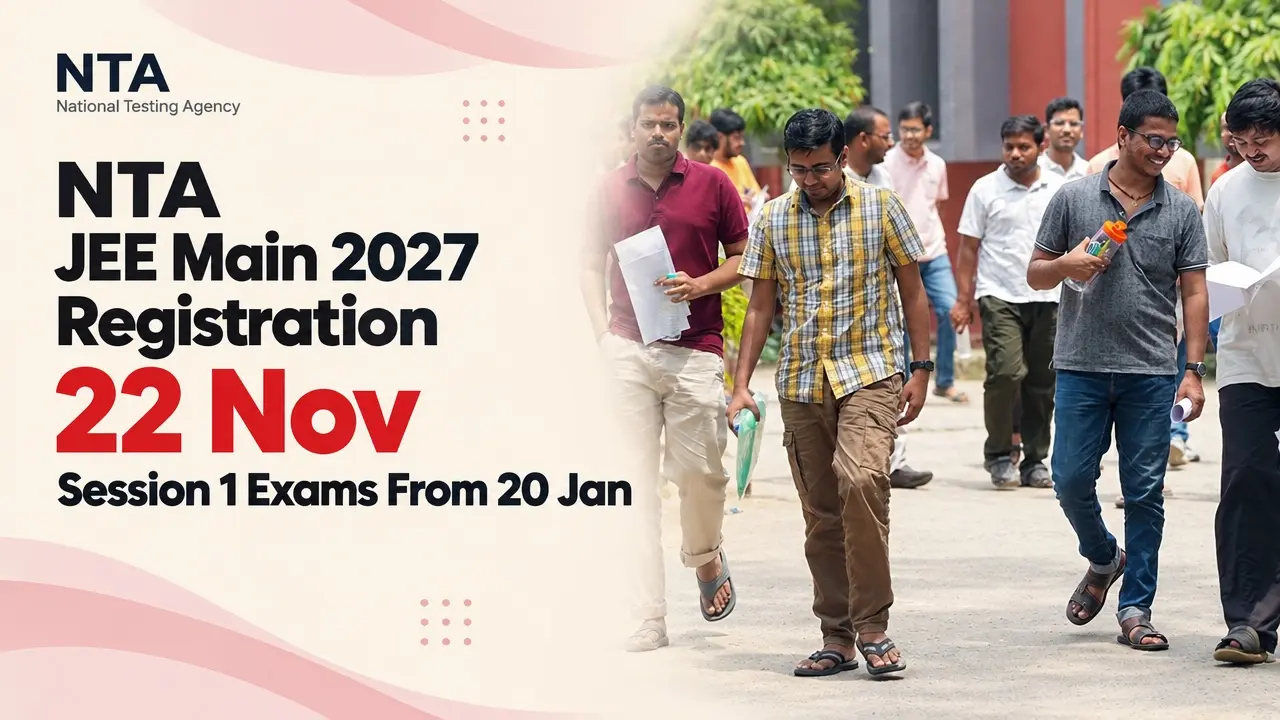

The National Testing Agency opened registration for JEE Main 2027 session 1 on 24 October, and the exam calendar has moved with it. The window closes on 22 November at 11:50 pm, and the bulletin published on the National Testing Agency portal puts the January sitting on 20, 21, 22, 23, 24 and 28 January 2027. The April session will be held on 2 to 7 April.
Two changes matter more than the dates. The form is now wired into MeriPehchaan, the MeitY single sign-on that carries DigiLocker, JanParichay and e-Pramaan, so a candidate can finish identity verification through eKYC using Aadhaar, PAN, a driving licence or APAAR instead of typing every detail by hand. Candidates must also capture a live photograph inside the form, through a webcam or by scanning a QR code with a phone, in addition to the scanned passport photo.
Read more on newzshort:
UP TGT Recruitment 2026: 17,735 Posts Open
A Tighter January Sitting, With A Gap In The Middle
Session 1 now runs across six days, 20 to 24 January and then 28 January, leaving 25 to 27 January free. NTA has not explained the gap in the bulletin, and a computer-based test of this size is usually packed into consecutive days. Read against a form that opened in October, the schedule gives a candidate about three months from registration to exam, with the April session standing by as the second chance.
What has not changed is how the two sessions combine. A candidate may sit either or both, the same application number carries forward, and NTA merges the normalised scores using the better of the two totals rather than subject-wise bests when it builds the rank list. That is the arithmetic that makes the April window, 5 January to 3 February, matter even for students registering this week.
Read more on newzshort:
RBI Releases 2027 Calendar for Class-I Officer Recruitment
What The Form Actually Costs
Fees are charged per session and have not moved by category. A general male candidate pays Rs 1,000 for Paper 1, Paper 2A or Paper 2B, a general female candidate pays Rs 800, OBC (NCL) and general EWS male candidates pay Rs 900 while women in those groups pay Rs 800, and SC, ST, PwD, PwBD and third gender candidates pay Rs 500. Two papers cost double, so Paper 1 with Paper 2A comes to Rs 2,000 for a general male applicant. Applying between 23 and 26 November adds a flat Rs 500 late fee.
The paper is unchanged at 75 questions and 300 marks. Physics, Chemistry and Mathematics each carry 20 multiple-choice questions and five numerical-value questions, a correct answer is worth four marks, and a wrong one costs a mark. Candidates name four preferred cities, may write in any of 13 languages including Hindi, Bengali, Tamil and Telugu, and get three hours, or four for those entitled to a scribe.
Eligibility Is Broad, The Verification Is Not
There is no age limit. Anyone who passed Class 12 in 2025 or 2026, or is appearing in 2027, can apply with Physics and Mathematics plus Chemistry, biotechnology, biology, a technical vocational subject or another qualifying paper. The paperwork has tightened: the Class 10 certificate, scanned photograph, signature and live photo are all mandatory, disability claims are checked against the UDID portal, and filing more than one application is treated as unfair means with cancellation of the result.
Where The Friction Will Show
The practical risk sits with candidates whose Aadhaar carries an old name, an incomplete date of birth or a mobile number they no longer use, because the correction window from 27 to 29 November is the only repair slot before the city slip on 30 December and the admit card on 13 January. A student without a webcam depends on a phone and a working QR scan, and poor lighting can fail the 80 percent face rule.
The direction is right. Identity checks have been the weakest link in large public examinations, and tying the form to a government identity rail is cheaper and harder to game than manual verification. The cost is a funnel that assumes a smartphone, a steady connection and clean Aadhaar records, none of which is universal. NTA helpdesks, not the correction window, will decide how many of those students actually reach the exam hall.
What To Watch Next
Session 2 registration opens on 5 January and closes on 3 February, with the exam on 2 to 7 April. Answer-key challenges, the final key and the rank list follow, and counselling through JoSAA decides who takes a seat. Until then, the only date that matters is 22 November.