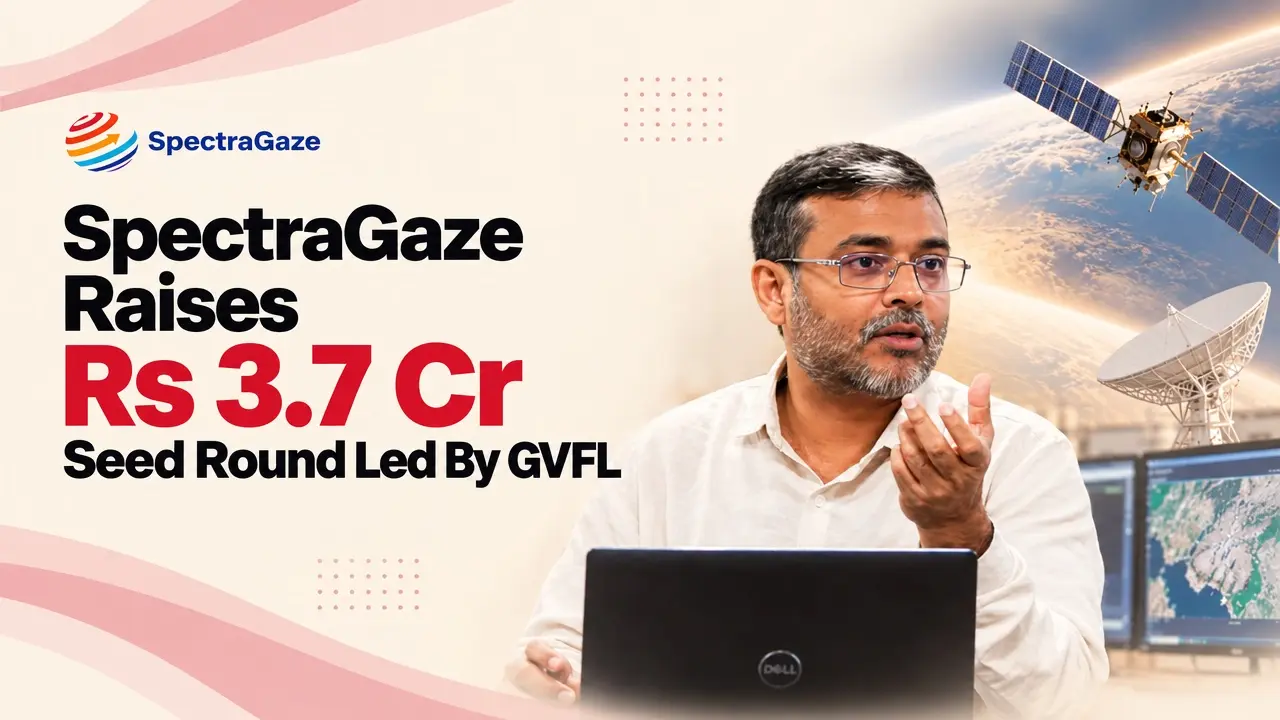

SpectraGaze Systems, an Ahmedabad deeptech startup that builds optical imaging sensors and electro-optical payloads for space, defence and science, has raised Rs 3.7 crore in a seed round led by venture capital firm GVFL. Angel investors also participated. It is the company’s first external fundraise, reported on 24 October 2026.
The company was founded in 2023 by Arup Banerjee, a former ISRO scientist with 23 years of experience, and was incorporated in Ahmedabad on 19 May 2023. For three years it ran on money from customer programmes rather than investor capital, a detail that matters more than the cheque size.
Read more on newzshort:
Bengaluru Space Robotics Startup Cosmochute Raises $1.5 Million in Pre-Seed Funding
What The Company Actually Builds
SpectraGaze makes the front end of an imaging chain: infrared detectors, detector dewar cooler assemblies, image sensors and hyperspectral cameras. The roadmap covers Earth observation, space-based surveillance, greenhouse gas mapping and drone-based hyperspectral imaging. On its site, SpectraGaze describes the work as indigenous, high-performance electro-optical systems for next-generation space missions.
Its customer list is unusually institutional for a young startup. SpectraGaze counts ISRO, the Physical Research Laboratory and listed electronics maker Kaynes Technology among its customers. It has delivered an infrared detector and a test system to ISRO, and secured an image sensor contract with AMETEK for ISRO’s HRSAT programme.
Read more on newzshort:
Nandan Nilekani-Backed Fundamentum Frontier Advisors Raises Rs 3,000 Crore for AI and Deeptech
Why An Imported Detector Is A Policy Problem
Infrared detectors are a choke point in Indian space and defence programmes. The devices are largely imported, which lengthens supply chains and exposes buyers to export control rules in supplier countries. That gap is why this round exists at all. The clearest proof point is the iDEX PRIME Challenge, which SpectraGaze won for an Infrared Detector Dewar Cooler Assembly that includes the detector. The brief, set by India Optel Limited under the iDEX PRIME X round, asked for a detector currently not made in India.
HRSAT is the second anchor. It is a high-resolution Earth observation constellation first planned as three satellites, later cut to two, HRSAT 1A and 1B, now scheduled to launch together on a PSLV in 2027. The satellites are designed to image at roughly one metre resolution in panchromatic mode, with uses running from mapping and agriculture to urban planning and disaster management. A payload supplier in such a programme gets revenue and a reference customer at once.
The Numbers Behind The Cheque
Indian spacetech startups have raised about $871 million across 241 rounds since inception, according to Tracxn data as of July 2026. The sector raised a record $200 million across 53 rounds in 2025 and about $113 million across 24 rounds in 2026 up to July. That works out to roughly $3.6 million per round since inception and $4.7 million this year, which places a Rs 3.7 crore cheque well below the sector’s centre of gravity.
Detector development is capital intensive: vacuum testing, calibration and qualification absorb cash long before revenue arrives. A cheque this size funds development and delivery on existing programmes, not a fabrication line. SpectraGaze said the money will fund product development, deliveries on current programmes, engineering hiring, testing infrastructure and business development.
Risks And Open Questions
The first risk is concentration. A handful of institutional customers means a handful of delivery timelines that the company does not control. The nearest test is commercial: SpectraGaze is building a hyperspectral camera for a 3U satellite, due for delivery to Kaynes in November 2026. Kaynes set up Kaynes Space Technology as a wholly owned subsidiary in June 2025 and said on its first quarter FY27 call that its first 3U satellite was in prototype, targeting a mid-2027 launch.
The second is whether custom work turns into products. Programme work pays the bills but does not scale; a catalogued detector or camera does. For Indian detector manufacturing to mean anything beyond import substitution on paper, one domestic supplier has to get there. Analysis: the customer-funded model is the strongest part of this story because it proves demand before equity, but it caps growth at the pace of government procurement. A company positioned this way usually needs a strategic or state-linked follow-on round an order of magnitude larger.
What To Watch
Three dates matter. The Kaynes hyperspectral camera delivery in November 2026 tests whether SpectraGaze can ship a payload on schedule. The HRSAT sensor work sits inside an ISRO programme due to fly in 2027, and a slip there hits revenue and credibility together. The third is the next round: its size and investor mix will show whether this seed was a step or a ceiling. GVFL, investing from Ahmedabad since 1990, is the first institutional name on the register; the second is the one that decides the scale.